Table of Contents
- Why This Question Matters Before You Travel
- Is My Netherlands Driving License Valid in Sri Lanka?
- Understanding the International Driving Permit
- Getting Your IDP Before You Leave the Netherlands
- Exact Documents Required for Each Vehicle
- Everything You Need to Know About the AAC Recognition Permit
- How to Get the AAC Permit — Step by Step
- What Vehicle Categories Does Your Dutch License Cover?
- Sri Lanka Road Rules Every Dutch Driver Must Follow
- Staying Safe on Sri Lankan Roads
- What to Expect When Renting a Vehicle
- Frequently Asked Questions
- Final Word
Why This Question Matters Before You Travel
There is a reason so many Dutch travelers search for this before booking their Sri Lanka trip.
Sri Lanka is the kind of place that rewards independent exploration. The best beaches are tucked down unmarked lanes. The most magical viewpoints are on roads buses never reach. The hill country is best experienced slowly, on your own schedule, with the windows down.
Renting a motorcycle, car, or tuk-tuk gives you that freedom completely.
But there is one thing that can derail all of it very quickly — driving without the correct documentation.
So before you book anything: Is my Netherlands Driving License valid in Sri Lanka?
The answer is no — not on its own. But this guide will show you exactly what you need, for every vehicle type, and the simplest way to get it sorted before you land.
Is My Netherlands Driving License Valid in Sri Lanka?
Your Netherlands driving license is a valid, recognized document in the Netherlands and across much of Europe.
In Sri Lanka, however, it carries no legal weight on its own.
Sri Lanka’s road traffic is governed by the Department of Motor Traffic Sri Lanka. Under Sri Lankan law, foreign nationals must carry additional documentation alongside their home country license in order to drive legally on public roads.
Presenting only your Dutch license at a police checkpoint will not pass. Officers are entitled to issue an on-the-spot fine or direct you to stop driving immediately.
The exact additional documents you need depend on one thing — the type of vehicle you are planning to drive. The requirements for a motorcycle, a car, and a tuk-tuk are different from each other. Getting clear on this before you travel is the single most important step you can take.
Understanding the International Driving Permit
The International Driving Permit — known as the IDP — is at the center of legal driving for most foreign tourists in Sri Lanka.
It is an officially recognized document that translates your driving license details into multiple languages accepted by over 150 countries worldwide. Sri Lanka is on that list and recognizes IDPs issued under both the 1949 Geneva Convention and the 1968 Vienna Convention.
A few important things to understand about the IDP before you apply.
The IDP is not a standalone document. It must always be carried together with your original Netherlands driving license. Without your Dutch license alongside it, the IDP has no legal validity at any checkpoint.
For motorcycles and cars — a digital IDP is acceptable in Sri Lanka. You do not necessarily need the physical booklet for these vehicle types.
For tuk-tuks — only the physical IDP booklet is accepted. A digital version will not be sufficient. This is because the physical booklet is required to obtain the AAC Recognition Permit — the additional document that tuk-tuk drivers must carry. Without the physical booklet in hand, the AAC cannot issue your permit.
If there is any chance you will want to drive a tuk-tuk during your trip, always request the physical IDP booklet when you apply — do not settle for a digital-only version.
For a broader overview of how the IDP works internationally, the AA UK IDP guide is a useful reference point.
APPLY FOR INTERNATIONAL DRIVING PERMIT !
Getting Your IDP Before You Leave the Netherlands
In the Netherlands, the International Driving Permit is issued by one organization only — the ANWB, the Royal Dutch Touring Club and the country’s official motoring authority.
The application process is quick and simple.
Documents and requirements:
- Your valid Netherlands driving license
- One passport-sized photograph
- Your Dutch passport or national identity card
- The application fee — around €17 to €20
How to apply:
Visit any ANWB branch in person and your IDP is typically issued on the same day. Online applications are also possible but factor in a few days for postal delivery.
The IDP is valid for 12 months from the date of issue.
If you plan to drive a tuk-tuk, always confirm with the ANWB that you are receiving the physical booklet format — not just a digital certificate. This is the version you need for the AAC Recognition Permit process in Sri Lanka.
Apply before you travel. Do not leave it until the last minute.
👉 Apply for your IDP through the ANWB website
Exact Documents Required for Each Vehicle
This is where many tourists get caught out — assuming the same rules apply to every vehicle. They do not.
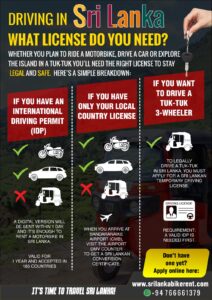
Here is the precise breakdown of what Dutch nationals need for each vehicle type in Sri Lanka.
🏍️ Motorcycles and Scooters
- Netherlands driving license — must include the motorcycle category (Category A)
- International Driving Permit — digital version is acceptable
🛺 Tuk-Tuks (Three-Wheelers)
- Netherlands driving license — must include the light vehicle category (Category B)
- International Driving Permit — physical booklet only (digital not accepted)
- AAC Recognition / Covering Permit — issued by the Automobile Association of Ceylon, based on your physical IDP
🚗 Cars
- Netherlands driving license
- International Driving Permit — digital or physical both acceptable
| Document | Motorcycle | Tuk-Tuk | Car |
| NL License — Category A (motorcycle) | ✅ Required | ❌ | ❌ |
| NL License — Category B (light vehicle) | ❌ | ✅ Required | ✅ Required |
| IDP — Digital Acceptable | ✅ Yes | ❌ No | ✅ Yes |
| IDP — Physical Booklet | Optional | ✅ Mandatory | Optional |
| AAC Recognition Permit | ❌ Not required | ✅ Required | ❌ Not required |
| Valid Passport | ✅ Yes | ✅ Yes | ✅ Yes |
| Rental Agreement | ✅ Yes | ✅ Yes | ✅ Yes |
| Insurance Documents | ✅ Yes | ✅ Yes | ✅ Yes |
The critical distinction — the AAC Recognition Permit is only required for tuk-tuks. Motorcycles and cars do not need it. But tuk-tuk drivers must have all three documents without exception.
Always carry original physical documents when driving. Photocopies and screenshots are not accepted at Sri Lankan police checkpoints.
Everything You Need to Know About the AAC Recognition Permit
The AAC Recognition Permit — also called the Covering Permit — is issued by the Automobile Association of Ceylon (AAC) and is the document that specifically authorizes foreign tourists to drive a tuk-tuk (three-wheeler) in Sri Lanka.
Motorcycles and cars do not require it. It is exclusively a tuk-tuk requirement.
Here is the key thing to understand about how the process works.
The AAC issues the Recognition Permit based on your physical IDP booklet. An AAC officer will examine your physical booklet and issue the permit from it. This is exactly why a digital IDP is not sufficient if you want to drive a tuk-tuk — the physical document is the basis for the entire permit process. Without it, the AAC cannot issue the Recognition Permit, and without the Recognition Permit, you are not legally authorized to drive a three-wheeler.
How long is it valid? The AAC Recognition Permit is valid for one full year from the date of issue. Even if you are only visiting Sri Lanka for two weeks, the permit lasts 12 months — which is useful if you return.
How much does it cost?
| Application Route | Cost |
| Direct at AAC Office, Colombo | LKR 8,500 |
| Through your rental office | LKR 12,000 |
How to Get the AAC Permit — Step by Step
There are two ways to obtain the AAC Recognition Permit. One is more convenient. One is cheaper. Here is how both work.
✅ Option 1 — Through Your Rental Office (Recommended)
This is the smartest and most convenient route for the vast majority of tourists — and the approach we strongly recommend.
Here is how it works:
When you book your tuk-tuk rental, simply let the rental company know that you need the AAC Recognition Permit arranged. Provide them with a copy of your physical IDP booklet and your Netherlands driving license in advance.
The rental office will liaise with the AAC on your behalf, handle the entire paperwork process, and have your AAC Recognition Permit ready and waiting when you arrive to collect your vehicle.
This means no extra trips across Colombo on your first day. No waiting in queues. No navigating an unfamiliar city while jet-lagged. Your permit is sorted before you even land.
Cost through rental office: LKR 12,000
The difference versus going direct (LKR 8,500) is LKR 3,500 — a very reasonable amount to pay for the time and convenience saved. For most travelers, it is absolutely worth it.
APPLY FOR AAC CONVERTIN PERMIT!
Option 2 — Direct at the AAC Office in Colombo
If you prefer to go direct, here is the process step by step.
Step 1 — Arrive in Sri Lanka with your physical IDP booklet and your original Netherlands driving license ready.
Step 2 — Make your way to the AAC main office in Colombo. 📍 Address: 40, Sir Macan Markar Mawatha, Galle Face, Colombo 03 🌐 Website: www.aaceylon.lk
Step 3 — Present your physical IDP booklet, your original Netherlands driving license, and your passport showing a valid Sri Lanka visa.
Step 4 — Pay the fee of LKR 8,500.
Step 5 — Your AAC Recognition Permit will be issued — usually on the same day within a few hours. Arrive early in the morning to minimize waiting time.
Step 6 — Keep the AAC Recognition Permit with your physical IDP and Netherlands license at all times when driving a tuk-tuk.
What Vehicle Categories Does Your Dutch License Cover?
Your Netherlands driving license will have specific categories printed on it. These categories determine what you can legally drive in Sri Lanka.
Category A covers motorcycles and scooters. You must have this specific endorsement on your Dutch license to ride any two-wheeled vehicle in Sri Lanka. A standard car license does not give you the right to ride a motorbike — this is a common and expensive mistake.
Category B covers standard cars and light vehicles. In Sri Lanka, Category B also covers tuk-tuks (three-wheelers). This is the most widely held category among Dutch drivers.
Category BE or CE covers vehicles with trailers or heavier commercial vehicles — relevant for a small number of specialist trips.
Check your Netherlands license before booking any rental. The category printed on your card must match the vehicle you intend to drive. Riding a motorcycle with only a Category B license is illegal and will completely void any insurance you have taken out.
Sri Lanka Road Rules Every Dutch Driver Must Follow
The single biggest adjustment for Dutch drivers in Sri Lanka — traffic drives on the left side of the road.
Coming from the Netherlands where traffic flows on the right, this takes real mental adjustment. Roundabouts, junctions, overtaking, and pulling out of side roads all feel unfamiliar at first. Give yourself a full morning on quieter roads to find your rhythm before tackling busy highways or city traffic.
Rules you must know and follow:
- Maximum speed on expressways: 100 km/h
- Maximum speed in towns and urban areas: 50 km/h
- Seatbelts are compulsory for all front seat passengers
- Using a mobile phone while driving is strictly illegal
- The blood alcohol limit is 0.08% — drink-driving enforcement is serious
- Helmets are compulsory for all motorcycle and scooter riders without exception
- Tuk-tuks face specific route restrictions in certain urban zones — check locally
Ignoring these rules — particularly around helmets and alcohol — can result in significant fines or worse. Always drive within the law.
The Department of Motor Traffic Sri Lanka publishes full national road traffic regulations for anyone who wants to review them before traveling.
Staying Safe on Sri Lankan Roads
Sri Lanka offers some of the most scenic driving in Asia. The coastal roads are beautiful. The mountain routes through the hill country are dramatic and winding. Getting around independently is a genuine highlight of any trip.
That said, road conditions and driving culture are very different from the Netherlands. A degree of preparation and patience goes a long way.
The most practical safety advice for Dutch drivers in Sri Lanka:
- Do not drive after dark in rural or mountainous areas — roads are poorly lit and hazards appear without warning
- Check weather before entering the hills — monsoon season turns mountain roads dangerously slippery
- Wildlife can appear on roads at any time near national parks — elephants, monkeys, and dogs are all common
- Buses and tuk-tuks overtake without much warning — stay calm, give way, and be patient
- Google Maps is reliable across most of Sri Lanka — download offline maps before heading into remote areas
- Never assume a petrol station is around the corner in rural areas — fill up whenever you see one
If you feel uncertain about driving on the left or navigating unfamiliar roads, hiring a local driver is an extremely affordable option in Sri Lanka. It removes all the stress from getting around and adds a knowledgeable local perspective to every journey.
What to Expect When Renting a Vehicle
Vehicle rental is available all across Sri Lanka — at Colombo’s airports, along the southern and eastern coasts, in the hill country, and in all major tourist towns.
Motorcycles and scooters remain the most popular rental choice among European visitors. They offer total freedom and are perfect for coastal roads and off-the-beaten-track exploration.
Tuk-tuks are a brilliant and uniquely Sri Lankan experience — fun, open-air, and ideal for shorter trips through coastal villages and town centers. Just make sure your AAC Recognition Permit and physical IDP are fully in order before you ride.
Before accepting any rental vehicle, always go through these checks:
- Confirm that valid insurance is included and documented in your rental agreement
- Sign and keep a copy of the rental agreement — both parties should have a signed copy
- Physically inspect the vehicle together and document any existing damage before leaving
- Get a 24-hour emergency contact number for breakdowns or accidents
- Confirm the fuel policy clearly before you accept the vehicle
Motorcycle rental rates in Sri Lanka typically run from $15 to $35 USD per day, varying by engine size, bike model, and rental duration. Longer rental periods usually come with better daily rates. Tuk-tuks are similarly priced.
Local operators like Boat Tours Sri Lanka are experienced in helping Dutch and European tourists navigate the full documentation process — including arranging the AAC Recognition Permit before your arrival — so that everything is in place the moment you collect your vehicle.
Frequently Asked Questions
Q1: Is my Netherlands Driving License valid in Sri Lanka without any other documents? No. Your Dutch license alone has no legal standing for driving in Sri Lanka. You need supporting documents, and the specific documents depend on which vehicle you plan to drive.
Q2: Can I drive a motorcycle in Sri Lanka with just my Netherlands license and a digital IDP? Yes. For motorcycles, your Netherlands license with Category A plus a digital IDP is sufficient. No AAC Recognition Permit is needed.
Q3: What exactly do I need to legally drive a tuk-tuk in Sri Lanka? You need three things — your Netherlands driving license with Category B, the physical IDP booklet (not digital), and the AAC Recognition/Covering Permit issued by the Automobile Association of Ceylon.
Q4: Why does a tuk-tuk require the physical IDP booklet when a motorcycle does not? Because the AAC Recognition Permit — which is required for tuk-tuks — is issued based on your physical IDP booklet. The AAC officer needs to see and process the physical booklet to issue the permit. Without the physical booklet, you cannot get the AAC permit at all.
Q5: What is the cheapest way to get the AAC Recognition Permit? Going directly to the AAC office in Colombo costs LKR 8,500. Arranging it through your rental office costs LKR 12,000 but saves you time, travel, and hassle on arrival.
Q6: Can my rental company arrange the AAC Recognition Permit before I arrive? Yes — and this is the recommended approach. Contact your rental company at the time of booking, provide your IDP and license details, and they will have the permit ready when you collect your vehicle.
Q7: How long does the AAC Recognition Permit last? It is valid for one full year from the date of issue.
Q8: Do I need the AAC Recognition Permit for a car rental? No. The AAC Recognition Permit is only required for tuk-tuks. Cars and motorcycles do not need it.
Q9: What happens if I drive a tuk-tuk without the AAC Recognition Permit? You are driving illegally. You face on-the-spot fines, potential vehicle impoundment, and legal proceedings. You are also almost certainly uninsured, which creates serious financial risk in any accident.
Q10: Can I use a photocopy of my Netherlands license at a checkpoint? No. You must carry the original physical Netherlands driving license at all times. Photocopies and digital images are not accepted by Sri Lankan police.
Q11: How long does it take to get the AAC Recognition Permit at the Colombo office? Usually a few hours on the same day. Arrive early in the morning to minimize waiting time.
Q12: What if I only have a Category A motorcycle license — can I still drive a tuk-tuk? No. Tuk-tuks require the light vehicle category — Category B — on your Netherlands license. A motorcycle-only license is not sufficient for three-wheelers.
Final Word
Let us answer the original question one final time.
Is my Netherlands Driving License valid in Sri Lanka?
Not on its own — but getting road-legal is completely straightforward once you know exactly what is needed.
For motorcycles, your Dutch license with Category A plus an IDP — digital is fine. For cars, your Dutch license plus an IDP. For tuk-tuks, you need all three — your Dutch license with Category B, the physical IDP booklet, and the AAC Recognition Permit from the Automobile Association of Ceylon.
The most important thing to remember about tuk-tuks — the AAC Recognition Permit is issued from your physical IDP booklet. You need the physical booklet first. Without it, the AAC cannot process your permit, and without the permit, you cannot legally or safely drive a three-wheeler.
The smartest move for tuk-tuk renters is to contact your rental company in advance and ask them to arrange the AAC Recognition Permit before you arrive. Pay the LKR 12,000, skip the Colombo office queue, and have everything ready from day one.
Get your physical IDP from ANWB before you fly. Confirm your permits and rental arrangements in advance. Carry all original documents every single time you drive. Take the first day slowly on left-hand roads.
Do that — and Sri Lanka’s incredible coastlines, mountain passes, and hidden corners are completely yours to explore at your own pace.
Enjoy every kilometer. 🌴