
Table of Contents
- The Question Every Luxembourg Traveler Asks
- Is My Luxembourg Driving License Valid in Sri Lanka?
- Your Complete Document Guide by Vehicle Type
- Understanding the International Driving Permit
- How to Get Your IDP in Luxembourg Before You Travel
- The AAC Recognition Permit — What It Is and Who Needs It
- How to Get Your AAC Permit — Step by Step
- AAC Permit Costs — Direct vs Through Your Rental Office
- What to Expect When Renting a Vehicle in Sri Lanka
- Road Rules Luxembourg Drivers Must Know
- Driving Safety Tips for First-Time Visitors
- FAQs
- Wrapping Up
The Question Every Luxembourg Traveler Asks
You have planned the trip. Flights are booked. Accommodation is sorted.
Now you are searching online at midnight wondering whether your Luxembourg driving license is actually going to work in Sri Lanka — or whether you are going to land at Bandaranaike Airport and immediately hit a bureaucratic wall.
It is a very fair question. And it is one that thousands of European tourists get wrong every single year.
Here is the thing. Sri Lanka has specific legal requirements for foreign drivers. Those requirements are different for each type of vehicle. And they are completely separate from anything that applies within the EU.
Your Luxembourg license is a perfectly valid document at home. But it needs supporting paperwork before it means anything on a Sri Lankan road.
Is my Luxembourg Driving License valid in Sri Lanka? This guide answers that question completely — and gives you the exact steps to get road-legal before your trip even begins.
Is My Luxembourg Driving License Valid in Sri Lanka?
Let us be completely straight with you from the start.
Your Luxembourg driving license alone is not valid in Sri Lanka.
Full stop. No workarounds. No grey areas.
Under Sri Lanka’s Motor Traffic Act, every foreign driver must carry specific supporting documents alongside their home country license. Which documents you need depends entirely on the type of vehicle you intend to drive.
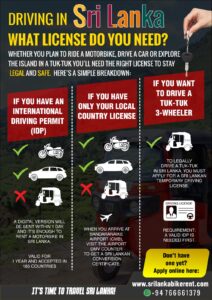
For cars — your Luxembourg license plus an International Driving Permit.
For motorcycles and scooters — your Luxembourg license with a motorcycle category plus an International Driving Permit.
For tuk-tuks (three-wheelers) — your Luxembourg license with a light vehicle category, a physical International Driving Permit booklet, and an AAC Recognition/Covering Permit from the Automobile Association of Ceylon.
That last one — the tuk-tuk — catches more tourists off guard than any other vehicle type. The AAC Recognition Permit is a Sri Lanka-specific document that most people have never heard of until they start researching their trip.
Here is the complete picture.
Your Complete Document Guide by Vehicle Type
Before you book any rental, understand exactly what paperwork applies to your chosen vehicle. There are no shortcuts here — Sri Lankan police checkpoints are active and document checks are real.
Motorcycles and Scooters
What you need:
- Valid Luxembourg driving license with motorcycle category listed
- International Driving Permit — digital version is acceptable
Important: A Luxembourg license that covers cars only does not legally extend to motorcycles or scooters in Sri Lanka. Your license must specifically include a motorcycle category.
No AAC Recognition Permit is required for two-wheeled vehicles.
Tuk-Tuks / Three-Wheelers
What you need:
- Valid Luxembourg driving license with light vehicle category
- International Driving Permit — physical booklet only, digital not accepted
- AAC Recognition/Covering Permit issued by the Automobile Association of Ceylon
The tuk-tuk requires the most documentation of any vehicle. The physical IDP booklet is not optional — it is the document the AAC uses to issue your Recognition Permit. You cannot get one without the other.
Cars
What you need:
- Valid Luxembourg driving license
- International Driving Permit — digital or physical both acceptable
Cars are the simplest option from a paperwork perspective. Your Luxembourg license paired with an IDP covers you completely.
The rule that matters most:
Tuk-tuks need the AAC Recognition Permit. Motorcycles and cars do not. And to get the AAC Recognition Permit, you must first have the physical IDP booklet. This is the sequence that every Luxembourg tuk-tuk driver must follow.
Understanding the International Driving Permit
The International Driving Permit — known universally as the IDP — is a travel document that presents your driving license information in 12 languages. It exists because many countries cannot read foreign-language licenses, and the IDP provides an internationally recognised translation.
The IDP’s legal foundation is the 1949 Geneva Convention on Road Traffic. Sri Lanka is a signatory to that convention — which is exactly why an IDP is recognised and required on Sri Lankan roads.
Key things to know about your IDP:
It works alongside your original license, never instead of it. Your Luxembourg license and your IDP must be carried together at all times. Presenting one without the other is not sufficient.
It is valid for 12 months from the date it is issued, as long as your original Luxembourg license remains valid throughout that period.
For cars and motorcycles, a digital IDP is perfectly fine in Sri Lanka. For tuk-tuks, only the physical booklet is accepted — and that physical booklet is what the AAC examines when issuing your Recognition Permit.
If you have any intention of driving a tuk-tuk during your trip, always get the physical booklet. A physical IDP covers every vehicle type. A digital IDP limits your options once you arrive.
For more background on how IDPs work internationally, see the AA International Driving Permit Guide and the UNECE Geneva Convention on Road Traffic.
APPLY FOR INTERNATIONAL DRIVING PERMIT !
How to Get Your IDP in Luxembourg Before You Travel
Getting your IDP sorted before you fly is the most important single step in this entire process. Do not leave this until you land in Sri Lanka — it cannot be issued there.
In Luxembourg, IDPs are issued by the Automobile Club du Grand-Duché de Luxembourg — the ACL.
Documents to bring:
- Original valid Luxembourg driving license
- Two recent passport-size photographs
- Copy of your valid passport
- Administration fee payment — typically under €20
How fast is the process?
Most applicants receive their IDP on the same day or within a few working days. It is genuinely quick and simple.
When should you apply?
At a minimum, two to three weeks before your departure date. Earlier is always better. If you are planning to drive a tuk-tuk, confirm with the ACL that you are receiving the physical booklet format — not just a digital version.
Check the ACL official website for current fees, office hours, and any document requirements that may have been updated since this article was published.
The AAC Recognition Permit — What It Is and Who Needs It
The AAC Recognition/Covering Permit is issued by the Automobile Association of Ceylon and is required exclusively for foreign nationals who want to drive a tuk-tuk (three-wheeler) in Sri Lanka.
It is not needed for motorcycles. It is not needed for cars. It is a tuk-tuk-specific permit and it is non-negotiable under Sri Lankan law.
Here is the process in plain terms:
You arrive in Sri Lanka with your physical IDP booklet already in hand. The AAC reviews your physical IDP, records the details, and uses that document as the basis for issuing your Recognition Permit. Without the physical IDP booklet, the AAC cannot process your application. The order is fixed — physical IDP first, AAC permit second.
How long is the AAC Recognition Permit valid?
One full year from the date it is issued. This is excellent value, particularly for long-stay visitors, digital nomads, or travellers who plan to return to Sri Lanka within the year.
Who issues it?
The Automobile Association of Ceylon (AAC), located in Colombo. However — and this is the most practical piece of advice in this entire article — you do not necessarily need to go there yourself.
How to Get Your AAC Permit — Step by Step
There are two routes to getting your AAC Recognition Permit. Choose the one that fits your travel plans.
Route 1 — Through Your Rental Office (Best Option for Most Tourists)
This is the approach we recommend for the majority of travellers visiting Sri Lanka.
How it works:
Step 1 — Contact your rental office before your trip and inform them you want to drive a tuk-tuk.
Step 2 — Send them a scanned copy of your Luxembourg driving license and your physical IDP booklet details.
Step 3 — The rental office submits your AAC application and handles the entire process on your behalf.
Step 4 — Your AAC Recognition Permit is fully prepared and waiting for you on the day you arrive and collect your vehicle.
You land in Sri Lanka, go straight to the rental office, pick up your permit and your tuk-tuk, and you are on the road the same day. Zero queues. Zero trips to Colombo. Zero waiting around.
This route costs LKR 12,000 — slightly more than going direct — but the time and convenience savings make it the smarter choice for almost every tourist.
APPLY FOR AAC CONVERTIN PERMIT!
Route 2 — Apply Directly at the AAC Office in Colombo
If your rental operator does not offer the advance permit service, or if you prefer to handle the process yourself, you can visit the AAC office directly after arriving in Sri Lanka.
Step 1 — Gather your documents:
- Original Luxembourg driving license with light vehicle category
- Physical IDP booklet
- Valid passport with entry visa or arrival stamp
- Passport-size photographs
- Completed application form (collected at the AAC counter)
Step 2 — Visit the AAC office:
Automobile Association of Ceylon (AAC) 40, Sir Macan Markar Mawatha Galle Face, Colombo 3, Sri Lanka
Step 3 — Submit your documents and pay the fee of LKR 8,500.
Step 4 — Your Recognition Permit is typically issued the same day. Arrive as early as possible and set aside a half day for the process.
AAC Permit Costs — Direct vs Through Your Rental Office
Here is a clear breakdown of the costs involved:
| Application Method | Cost | Processing | Best For |
| Direct at AAC office, Colombo | LKR 8,500 | Same day (arrive early) | Travellers already in Colombo |
| Through rental office | LKR 12,000 | Ready on arrival | Most tourists — saves time |
The LKR 3,500 difference between the two options buys you something genuinely valuable — your permit is handled before you arrive, removing the need for a dedicated trip to central Colombo. For most tourists, this is worth every rupee.
The AAC Recognition Permit is valid for one year from the date of issue, making either option excellent value for the coverage it provides.
What to Expect When Renting a Vehicle in Sri Lanka
Once your paperwork is in order, renting a vehicle in Sri Lanka is straightforward, affordable, and available everywhere from Colombo to Galle to Jaffna.
Documents you will need to present at the rental counter:
For a car:
- Original Luxembourg driving license
- IDP (digital or physical)
- Passport
- Security deposit
For a motorcycle or scooter:
- Original Luxembourg driving license with motorcycle category
- IDP (digital acceptable)
- Passport
- Security deposit
For a tuk-tuk:
- Original Luxembourg driving license with light vehicle category
- Physical IDP booklet
- AAC Recognition/Covering Permit
- Passport
- Security deposit
Any legitimate, reputable rental operator will check all of your documents before releasing a vehicle. If a rental shop waves you through without asking for your permits — that is a red flag. It suggests they are operating informally, which creates serious problems if anything goes wrong on the road.
Always request a written rental agreement that clearly states the daily rate, insurance coverage, fuel policy, mileage terms, and damage liability. Do not sign anything you have not read in full.
Road Rules Luxembourg Drivers Must Know
Sri Lankan roads are a world apart from Luxembourg. Here are the rules and realities every foreign driver needs to understand:
You will be driving on the LEFT. Sri Lanka follows left-hand traffic — the opposite of Luxembourg. This is the single most important adjustment you will make. Take it slowly on your first day, particularly at junctions, roundabouts, and when making right turns.
Speed limits to know:
- Towns and urban areas: 50 km/h
- Rural open roads: 70–80 km/h
- Expressways: 100–120 km/h
Motorcycle helmets are legally required for the rider and every passenger. Sri Lankan police enforce this without exception.
Seat belts are mandatory for all front-seat occupants.
Using a mobile phone while driving is illegal. Traffic police actively enforce this rule.
Alcohol limit is 0.08% — the same as many EU countries. Roadside checkpoints, particularly at night, do conduct breathalyser tests.
Buses and tuk-tuks rule the road. This is not an exaggeration. Buses in particular travel fast, stop suddenly, and pull into traffic without much warning. Give them space and never try to race them.
Rural roads bring their own hazards. Cattle, dogs, and wildlife crossing the road are common throughout the island. Slow down whenever you approach a village or a rural stretch.
Always carry all your documents in the vehicle. Police checkpoints operate island-wide. Your Luxembourg license, IDP, and AAC Recognition Permit (if driving a tuk-tuk) need to be on your person whenever you are driving.
Driving Safety Tips for First-Time Visitors
Smart preparation before you start the engine makes your Sri Lanka driving experience far safer and more enjoyable:
Give yourself time to adapt on day one. Choose a quiet road for your first drive rather than a main highway. Left-hand traffic takes genuine mental adjustment and your brain needs time to rewire.
Do not drive in unfamiliar areas after dark. Rural roads in Sri Lanka can be completely unlit, poorly marked, and shared with animals that appear from nowhere. Night driving outside of towns and cities carries real risk.
Save offline maps before leaving your accommodation. Download your route on Google Maps before you set off. Signal quality drops significantly in hill country and coastal villages.
Make document copies and store them separately. Keep photocopies of your driving license, IDP, AAC permit, and passport in a separate bag. Store originals in your hotel safe unless you specifically need them.
Watch your fuel gauge in rural areas. Petrol stations thin out considerably once you leave main towns. Fill up whenever you have the opportunity, even if your tank is only half empty.
Check your travel insurance before you travel. Many travel insurance policies contain exclusions for motorcycles and three-wheelers. Read your policy carefully. If your cover does not explicitly include your vehicle type, upgrade it before you fly.
Expect city traffic to test your patience. Colombo traffic during peak hours can bring roads to a near standstill. What looks like a ten-minute drive can take an hour. Build extra time into any city journey.
Embrace the horn. Horn use in Sri Lanka is constant, normal, and communicative. Drivers use it to signal their presence — not to express frustration. Do not be alarmed by it and do not read aggression into it.
FAQs
Q1: Is my Luxembourg Driving License valid in Sri Lanka for a car?
Not alone. Your Luxembourg license must be accompanied by a valid IDP — digital or physical — to legally drive a car in Sri Lanka.
Q2: Is my Luxembourg Driving License valid in Sri Lanka for a motorcycle?
Only if your Luxembourg license includes a motorcycle category. You also need a valid IDP — a digital version is acceptable for motorcycles. No AAC permit is required.
Q3: Is my Luxembourg Driving License valid in Sri Lanka for a tuk-tuk?
Not without additional documents. Driving a tuk-tuk legally requires three things: your Luxembourg license with light vehicle category, a physical IDP booklet, and an AAC Recognition/Covering Permit from the Automobile Association of Ceylon.
Q4: Why does the AAC need my physical IDP booklet specifically?
The AAC issues your Recognition Permit based on the details in your physical IDP booklet. They inspect and record it as part of their issuance process. A digital IDP cannot be used for this purpose — only the physical booklet qualifies.
Q5: What is the cheapest way to get the AAC Recognition Permit?
Going directly to the AAC office in Colombo costs LKR 8,500. Applying through your rental office costs LKR 12,000 but includes having the permit prepared and ready before you arrive, saving you a dedicated trip to central Colombo.
Q6: How long does the AAC Recognition Permit last?
One year from the date it is issued — making it valid for extended stays and return visits within that period.
Q7: Can I sort out the AAC permit after arriving in Sri Lanka if I forgot to arrange it in advance?
Yes. Visit the AAC office at 40 Sir Macan Markar Mawatha, Galle Face, Colombo 3 with your physical IDP, Luxembourg license, passport, and photographs. Permits are generally issued the same day. Arrive early and budget a half day.
Q8: Can I get an IDP inside Sri Lanka if I forgot to get one before travelling?
No. IDPs must be issued in your home country before you travel. In Luxembourg, this means visiting the ACL before your departure. Plan ahead.
Q9: What if I drive a tuk-tuk without the AAC Recognition Permit?
You are operating illegally. The consequences can include fines, vehicle impoundment, and invalidation of your travel insurance — especially in the event of an accident. This is not a risk worth taking.
Q10: Is driving in Sri Lanka difficult for someone from Luxembourg?
The main challenge is adjusting to left-hand traffic. Roads range from excellent expressways to very narrow rural lanes. City driving is hectic but manageable with patience. Most visitors adapt within a day or two and find self-driving one of the best decisions of their trip.
Q11: Does my rental company’s insurance cover me for a tuk-tuk?
Basic third-party insurance is typically included in tuk-tuk rental agreements, but coverage varies between operators. Always confirm what is and is not covered before signing your agreement. Separately, verify that your personal travel insurance also covers three-wheeled vehicles.
Q12: Is there a difference between the AAC Recognition Permit and the DMT Recognition Permit?
Yes. The AAC Recognition/Covering Permit specifically covers tuk-tuk (three-wheeler) operation by foreign nationals and is issued by the Automobile Association of Ceylon. Always ensure you are applying for the correct permit for your vehicle type.
Wrapping Up
You now have the complete picture.
Is my Luxembourg Driving License valid in Sri Lanka? Not on its own — but with the right documents in place, you are fully legal and ready to explore one of the most beautiful countries in Asia entirely on your own terms.
Here is the summary that matters:
Driving a car? Luxembourg license plus IDP. That is it.
Riding a motorcycle or scooter? Luxembourg license with motorcycle category plus IDP. Digital IDP is fine.
Driving a tuk-tuk? Luxembourg license with light vehicle category, physical IDP booklet from the ACL in Luxembourg, and AAC Recognition/Covering Permit from the Automobile Association of Ceylon. The physical IDP must come first — the AAC permit is issued based on it. Valid for one full year.
The single smartest move for tuk-tuk drivers: Contact your rental office before your trip. Let them handle the AAC permit application on your behalf. Pay the LKR 12,000, send them your documents, and arrive in Sri Lanka to find your permit already waiting. It is the most efficient, stress-free approach available to you.
Sri Lanka rewards independent travellers. The hill country roads at dawn, the coastal stretches between fishing villages, the jungle paths that no tour bus will ever navigate — all of it is accessible when you are driving yourself.
Sort your documents. Get the physical IDP. Apply for your AAC permit in advance if you want a tuk-tuk. Drive on the left.
The rest is one extraordinary adventure.

Useful official resources: