Table of Contents
- Introduction
- Is My Norway Driving License Valid in Sri Lanka?
- Documents You Need Based on Your Vehicle
- Understanding the International Driving Permit
- How to Get Your IDP in Norway
- The AAC Recognition Permit for Tuk-Tuks
- Step-by-Step Guide to Getting Your AAC Permit
- Driving Rules You Must Know in Sri Lanka
- What Happens If You Drive Without Proper Documents
- Renting a Motorcycle as a Norwegian Tourist
- Practical Tips Before You Hit the Road
- FAQs
- Conclusion
1. Introduction
Sri Lanka draws millions of visitors every year — and for good reason. Tropical beaches stretch along the entire coastline. Ancient ruins sit quietly in jungle clearings. Tea estates roll across cool mountain slopes. And the people are some of the warmest you will ever meet.
One of the best ways to truly experience this island is by driving yourself. Whether it is a leisurely ride along the coast on a scooter, a road trip up to the hill country in a car, or the unforgettable adventure of steering a tuk-tuk through busy village streets — driving in Sri Lanka is a memory that lasts a lifetime.
But there is one question that every Norwegian traveler absolutely must get right before picking up any set of keys — is my Norway Driving License valid in Sri Lanka?
The answer is yes — but with important conditions. And those conditions are different depending on which type of vehicle you plan to drive.
Read this guide fully before you travel and you will arrive in Sri Lanka completely prepared.
2. Is My Norway Driving License Valid in Sri Lanka?
Your Norwegian driving license is recognized in Sri Lanka — but you cannot simply show up and start driving with it alone.
Sri Lanka operates under the rules of the 1949 Geneva Convention on Road Traffic. Norway is a member of this same convention. This means Norwegian licenses are accepted — but only when they are accompanied by a valid International Driving Permit (IDP).
Driving with only your Norwegian license and no IDP is illegal in Sri Lanka. It does not matter how long you have been driving or how clean your record is back home. Without the IDP, you are not covered.
And for tuk-tuks specifically, there is one more layer — an AAC Recognition Permit issued by the Automobile Association of Ceylon. We cover this in full detail in Sections 6 and 7.
The official rules for foreign drivers in Sri Lanka are overseen by the Department of Motor Traffic Sri Lanka. It is always worth checking their latest guidance before your trip.
3. Documents You Need Based on Your Vehicle
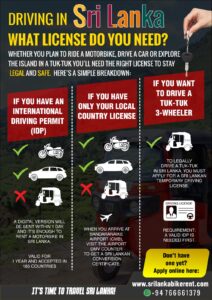
This is the most important section of this guide. The exact documents you need in Sri Lanka depend entirely on which vehicle you are planning to drive. Many tourists make the mistake of assuming one set of documents covers everything — it does not.
Driving a Car in Sri Lanka:
- Your valid Norwegian driving license
- A valid International Driving Permit (IDP)
Simple and straightforward. These two documents together are all you need to legally drive a car in Sri Lanka.
Riding a Motorcycle or Scooter in Sri Lanka:
- Your valid Norwegian driving license — must include a motorcycle category
- A valid International Driving Permit (IDP)
Good news for motorcycle riders — a digital IDP is perfectly acceptable for two-wheelers in Sri Lanka. You do not need to carry the physical booklet if you are only riding a motorcycle or scooter.
Driving a Tuk-Tuk (Three-Wheeler) in Sri Lanka:
- Your valid Norwegian driving license — must include a light vehicle category
- A valid International Driving Permit — physical booklet only
- An AAC Recognition Permit (also called a Covering Permit) from the Automobile Association of Ceylon
This is where tuk-tuks are very different from all other vehicles. You need a third document — the AAC Recognition Permit — which is not required for cars or motorcycles. And crucially, for tuk-tuks you must have the printed physical IDP booklet. A digital IDP on your phone will not be accepted.
The reason for this is simple — the Automobile Association of Ceylon needs to see and verify your physical IDP booklet in order to issue your AAC Recognition Permit. No physical booklet means no AAC permit, and no AAC permit means no legal tuk-tuk driving.
4. Understanding the International Driving Permit
The International Driving Permit is an internationally recognized document that works alongside your national driving license. Think of it as an official translation of your license into dozens of languages — including Sinhala and Tamil, the two official languages of Sri Lanka.
When a Sri Lankan police officer or rental company sees your Norwegian license, they may not be able to read it. Your IDP solves that problem instantly by presenting the same information in a format they can understand.
Here are the most important things to know:
The IDP is valid for 12 months from its date of issue. It is not a standalone document — it must always be carried with your original Norwegian driving license. It is accepted in more than 150 countries, including Sri Lanka. It can only be issued in Norway — there is absolutely no way to get one after you have left the country.
For motorcycle and car drivers, a digital version of the IDP is acceptable in Sri Lanka. For tuk-tuk drivers, you must have the physical printed booklet because the AAC requires it to issue the Recognition Permit.
Make sure you understand which version you need before you apply.
APPLY FOR INTERNATIONAL DRIVING PERMIT !
5. How to Get Your IDP in Norway
Getting your IDP in Norway before you travel is easy, quick, and affordable. Here is how to do it.
Through Statens Vegvesen — Norwegian Public Roads Administration:
Statens Vegvesen is the official Norwegian government body responsible for roads and vehicle licensing. You can apply for your IDP through their offices or digital services. Visit the Statens Vegvesen website for the latest application process and current fees.
Through NAF — Norges Automobil-Forbund:
NAF is the Norwegian Automobile Federation and one of the most popular and trusted places for Norwegians to obtain their IDP. The process is typically fast and hassle-free. Find your nearest NAF office and learn more at the NAF official website.
What you need to bring:
You will need your valid Norwegian driving license, a recent passport-size photograph, a completed application form, and a small fee — usually somewhere between 100 and 300 NOK depending on where you apply.
A very important reminder:
Apply for your IDP no later than 2 weeks before your departure. Once you have left Norway, there is no way to get one. If you are planning to drive a tuk-tuk in Sri Lanka, make sure you specifically request the physical printed booklet and not just a digital version. This step is critical.
6. The AAC Recognition Permit for Tuk-Tuks
If driving a tuk-tuk is on your Sri Lanka bucket list — and it absolutely should be — then the AAC Recognition Permit is the document you need to understand.
The AAC Recognition Permit (sometimes called a Covering Permit) is issued by the Automobile Association of Ceylon (AAC). It is specifically required for foreign nationals who want to legally drive a tuk-tuk or three-wheeler in Sri Lanka. Cars and motorcycles do not need this permit — it is only for tuk-tuks.
Here is how the process works. When you apply for the AAC Recognition Permit, the Automobile Association of Ceylon examines your physical IDP booklet and uses it as the basis for issuing the permit. This is why the physical booklet is non-negotiable for tuk-tuk drivers. A screenshot or digital copy of an IDP simply cannot be processed.
Once issued, your AAC Recognition Permit is valid for one full year from the date of issue. This means that if you visit Sri Lanka more than once within that year, you will not need to apply again — your permit will still be valid.
The AAC Recognition Permit is well established and the process is very familiar to both the AAC staff and reputable tuk-tuk rental operators across Sri Lanka. Thousands of international tourists go through this process every year without any problems.
7. Step-by-Step Guide to Getting Your AAC Permit
There are two ways to get your AAC Recognition Permit. One is significantly easier and more convenient for tourists. Here are both options explained clearly.
Option 1 — Apply Through Your Rental Operator (Strongly Recommended)
This is by far the most convenient method for visitors, especially those arriving in Negombo or areas outside Colombo.
Many tuk-tuk rental operators in Sri Lanka can apply for your AAC Recognition Permit on your behalf before you even arrive in the country. You simply share your documents with them in advance — typically your Norwegian license scan and IDP details — and they handle the application process with the AAC. By the time you land in Sri Lanka, your permit is already prepared and waiting for you.
This means no extra trips into Colombo, no waiting at government offices, and no wasted holiday time on your first day.
Cost when arranged through a rental operator: 12,000 LKR
If you are renting a tuk-tuk through a local tourism service such as tuktukrentaly.com, ask them about arranging your AAC Recognition Permit in advance as part of your rental booking. It is the smoothest and most stress-free way to handle this requirement.
APPLY FOR AAC CONVERTIN PERMIT!
Option 2 — Visit the AAC Office in Colombo Yourself
If you prefer to handle things directly, you can visit the Automobile Association of Ceylon office in Colombo after you arrive in Sri Lanka.
The AAC office staff are experienced with international visitors and the process is generally smooth when you arrive with everything you need.
What to bring to the AAC office:
Your original valid Norwegian driving license, your physical IDP booklet (absolutely essential — digital will not work here), your original passport, one passport-size photograph, and the applicable fee.
Cost at the AAC office directly: 8,500 LKR
Factor in travel time to Colombo, potential waiting time at the office, and travel time back. Go as early in your trip as possible — ideally on day one or day two — so you have your permit ready before you start driving.
Find the AAC office address, contact details, and opening hours at the Automobile Association of Ceylon website.
Side-by-Side Comparison
| Via Rental Operator | Direct at AAC Colombo | |
| Cost | 12,000 LKR | 8,500 LKR |
| Convenience | Excellent — ready on arrival | Requires a visit to Colombo |
| Timing | Sorted before you fly | After arrival only |
| Physical IDP needed | Yes | Yes |
| Best for | Most tourists | Those already in Colombo |
8. Driving Rules You Must Know in Sri Lanka
Sri Lanka has its own driving culture and rules that are quite different from Norway. Knowing these before you get behind the wheel will make your experience much safer and more enjoyable.
Left-hand traffic. Sri Lanka drives on the left side of the road, the same as the United Kingdom. In Norway you drive on the right. This is the single biggest adjustment to make and it requires full concentration, particularly at junctions, roundabouts, and when you are turning. Give yourself a day or two to get fully comfortable with this before attempting busy roads.
Speed limits. The general limits are 50 km/h in built-up areas, 70 km/h on main roads, and 100 km/h on expressways.
Seat belts are compulsory for the driver and all front-seat passengers.
Mobile phones must not be used while driving unless via a hands-free system.
Drunk driving carries severe penalties in Sri Lanka. Do not drink and drive under any circumstances.
Horn use is a normal part of driving in Sri Lanka. Drivers use their horns to signal that they are overtaking, to warn pedestrians, or simply to communicate on busy roads. This is not aggressive behavior — it is simply how road communication works locally.
Road quality varies greatly. Main highways are generally in good condition. Secondary roads can be patchy. Mountain and rural roads can be narrow, steep, and rough in places. Adjust your speed accordingly.
Unexpected hazards including animals, pedestrians, and slow-moving vehicles are common on roads outside cities. Always drive at a speed that gives you enough time to react.
For more detailed information on Sri Lankan traffic rules, the Automobile Association of Ceylon is a reliable resource.
9. What Happens If You Drive Without Proper Documents
It is worth being very clear about what can happen if you drive in Sri Lanka without the correct documents. The consequences are serious.
Fines at police checkpoints. Sri Lankan police run regular document checks, particularly in tourist areas and on main highways. Being caught without a valid IDP — or without the AAC Recognition Permit while driving a tuk-tuk — will result in an on-the-spot fine.
Vehicle impoundment. In more serious cases, the vehicle can be seized by police. Recovering an impounded vehicle is time-consuming, expensive, and deeply disruptive to your holiday.
Travel insurance becomes void. This is perhaps the most financially dangerous outcome. If you are involved in any kind of road accident while driving without the proper documentation, your travel insurer will almost certainly reject any claim. You could be left personally liable for vehicle repairs, your own medical treatment, and any costs arising from damage or injury to other people.
Detention or court proceedings. In serious incidents, foreign drivers without valid documentation can face detention or legal proceedings, which can have significant long-term consequences.
Obtaining your IDP before you leave Norway and arranging your AAC Recognition Permit before or upon arrival costs a fraction of what any of these outcomes could cost you. It is simply not worth the risk.
10. Renting a Motorcycle as a Norwegian Tourist
Renting a motorcycle or scooter is one of the most popular choices for independent travelers in Sri Lanka. Coastal roads, jungle trails, mountain passes, and quiet village roads are all spectacular on two wheels.
Here is what to check before you rent.
Confirm your Norwegian license includes a motorcycle category. Category A covers motorcycles over 125cc. Category A1 covers lighter motorcycles up to 125cc. A standard car-only license — Category B — does not permit motorcycle riding in Sri Lanka under any circumstances.
Confirm your IDP covers motorcycles. Your IDP reflects exactly the same categories as your Norwegian license. If motorcycles are not listed on your Norwegian license, they will not appear on your IDP either.
A digital IDP is fine for motorcycles. Unlike tuk-tuks, you do not need a physical booklet for two-wheelers. A digital version stored on your phone is legally acceptable.
Rent only from reputable operators. A trustworthy rental shop will provide a written rental agreement, a roadworthy and registered motorcycle, valid vehicle insurance, and a helmet. Walk away from any operator who cannot produce these.
Wear your helmet every single time. Helmet use is required by law in Sri Lanka. Beyond the legal requirement, the roads carry real risks and a helmet could save your life.
Do a full inspection before you ride. Check the brakes, front and rear. Check all lights. Check the tires for condition and pressure. Look at the mirrors. Check the fuel level. Point out any pre-existing damage to the rental operator and get it acknowledged in writing before you leave.
11. Practical Tips Before You Hit the Road
Here are straightforward, practical tips to help every Norwegian driver have a safe and enjoyable time on Sri Lankan roads.
Sort your IDP in Norway well before you travel. This is non-negotiable. Apply at least two weeks before your departure. If you plan to drive a tuk-tuk, request the physical printed booklet — not just a digital document.
Contact your rental operator before you fly if you want a tuk-tuk. The best option is to have your AAC Recognition Permit arranged and ready before you even land. A good local rental operator can do this for you.
Keep your documents protected. Sri Lanka has a tropical climate with sudden heavy rain. Keep your Norwegian license, physical IDP booklet, and AAC Recognition Permit together in a waterproof wallet or document pouch at all times.
Take your first drive slowly. Left-hand traffic feels unfamiliar for the first day or two. Start on quiet roads and gradually build up to busier routes and highways.
Do not drive in rural areas after dark. Street lighting is sparse or nonexistent in many rural parts of Sri Lanka. Animals on the road, unmarked hazards, and deep potholes make night driving genuinely dangerous outside of well-lit towns.
Download offline maps before you leave your accommodation. Google Maps and Maps.me both work very well across Sri Lanka. Having offline maps ready is invaluable if you lose mobile data in remote areas.
Make sure your travel insurance explicitly covers driving. Read your policy carefully. Check that it covers the specific vehicle type you plan to drive — including motorcycles and tuk-tuks if applicable.
Top up your fuel whenever you have the chance in remote areas. Fuel stations can be widely spaced in rural and mountain regions. Do not gamble on finding one when you need it.
Be patient with traffic. Sri Lankan roads are lively and busy. Horns, close overtaking, and unpredictable merging are all part of normal driving here. Stay calm, stay focused, and do not let it frustrate you.
12. FAQs
Q: Is my Norway Driving License valid in Sri Lanka? Yes, but only when carried alongside a valid International Driving Permit. Your Norwegian license alone is not sufficient. For tuk-tuks you also need an AAC Recognition Permit from the Automobile Association of Ceylon.
Q: What documents do I need to drive a car in Sri Lanka as a Norwegian? Your valid Norwegian driving license and a valid IDP. These two documents together are sufficient for car driving.
Q: What documents do I need to ride a motorcycle in Sri Lanka? Your valid Norwegian driving license with a motorcycle category and a valid IDP. A digital IDP is acceptable for motorcycle riders.
Q: What documents do I need to drive a tuk-tuk in Sri Lanka? Three documents — your valid Norwegian driving license with a light vehicle category, a physical IDP booklet, and an AAC Recognition Permit from the Automobile Association of Ceylon.
Q: Why do I need a physical IDP for a tuk-tuk but not for a motorcycle? Because the AAC needs to inspect your physical IDP booklet in order to issue your AAC Recognition Permit. Without the physical document they cannot process your application. For motorcycles, no AAC permit is required, so a digital IDP works fine.
Q: How much does the AAC Recognition Permit cost? It costs 8,500 LKR if you visit the AAC office in Colombo directly. It costs 12,000 LKR if you arrange it through a rental operator. The rental operator route is more convenient as the permit is ready before you arrive.
Q: How long is the AAC Recognition Permit valid for? The AAC Recognition Permit is valid for one full year from the date it is issued. If you return to Sri Lanka within that year, you will not need a new one.
Q: What is the easiest way to get the AAC Recognition Permit? Arrange it through your tuk-tuk rental operator before you travel. Send them your document details in advance and they will have your permit prepared and waiting when you land in Sri Lanka.
Q: Can I get an IDP after I arrive in Sri Lanka? No. IDPs can only be issued in your home country. You must get yours in Norway before you travel. There are no exceptions to this.
Q: How long is an IDP valid? An IDP is valid for 12 months from the date it is issued. Make sure yours will still be valid throughout your entire stay in Sri Lanka.
Q: What should I do if I am stopped by police while driving? Stay calm and cooperative. Present your Norwegian driving license, your IDP, and your AAC Recognition Permit if you are driving a tuk-tuk. Never attempt to offer money to a police officer.
Q: Is driving in Sri Lanka safe for tourists from Norway? Thousands of international tourists drive safely in Sri Lanka every year. The roads are manageable if you follow the rules, drive at a sensible speed, stay alert, and give yourself time to adjust to left-hand traffic. The biggest risks come from driving too fast or too confidently before you have had a chance to get used to local road conditions.
13. Conclusion
So — is my Norway Driving License valid in Sri Lanka?
Here is the clear summary.
For cars — bring your Norwegian driving license and a valid IDP. For motorcycles — bring your Norwegian license with a motorcycle category and an IDP. A digital IDP works fine. For tuk-tuks — bring your Norwegian license, a physical IDP booklet, and an AAC Recognition Permit from the Automobile Association of Ceylon.
The AAC Recognition Permit costs 8,500 LKR at the AAC office in Colombo or 12,000 LKR through a rental operator. Arranging it through your rental operator before you arrive is the easiest and most stress-free option for most tourists.
None of this is complicated. It simply requires a small amount of planning before you travel and a quick arrangement shortly after arrival if you are going the direct route.
Get your physical IDP booklet from NAF or Statens Vegvesen in Norway before you fly. Arrange your AAC Recognition Permit through your rental operator ahead of time if you want to drive a tuk-tuk. Carry all your documents safely. Drive on the left. Go slowly until you feel confident. And then enjoy every single kilometre of one of the world’s most remarkable islands.
Sri Lanka has incredible roads waiting to be explored. Go and enjoy them — the right way.