Table of Contents
- Can Indian Tourist Drive in Sri Lanka? The Straight Answer
- Is Your Indian Driving License Valid in Sri Lanka?
- The Complete Document Checklist — By Vehicle Type
- Everything You Need to Know About the IDP
- The AAC Recognition Permit — Who Needs It and Why
- How to Get Your AAC Permit Before You Arrive
- Essential Road Rules for Indian Drivers in Sri Lanka
- Best Routes and Driving Conditions Across Sri Lanka
- Frequently Asked Questions
1. Can Indian Tourists Drive in Sri Lanka? The Straight Answer
Can Indian tourist drive in Sri Lanka? Yes — and thousands of Indian visitors do it every single year with zero complications.
Sri Lanka is one of the most welcoming self-drive destinations in Asia for Indian tourists. The island drives on the left, road signs are in English, and the traffic culture feels remarkably familiar to anyone who has navigated Indian roads.
That said, there is one thing you must get right before anything else: your documents. What you need to carry depends entirely on whether you are planning to ride a motorcycle, drive a car, or get behind the wheel of a tuk-tuk. Each vehicle category comes with its own specific requirements — and mixing them up is where tourists run into trouble.
This guide breaks everything down clearly so you arrive fully prepared and spend zero time worrying about paperwork during your holiday.
2. Is Your Indian Driving License Valid in Sri Lanka?
Yes — your Indian driving license carries legal weight in Sri Lanka.
Sri Lanka is a signatory to the 1968 Vienna Convention on Road Traffic, an international agreement that establishes a framework for mutual recognition of driving licenses across member nations. India is also part of this framework, which means your Indian license is a recognized document on Sri Lankan roads.
However, and this is important — your Indian license is the starting point, not the complete answer. Sri Lanka requires foreign drivers to carry supporting documentation alongside their national license. Without this supporting paperwork, your Indian license alone does not give you the legal right to drive.
The exact documents you need to pair with your Indian license depend on the vehicle you choose. Read the next section carefully before booking any rental.
3. The Complete Document Checklist — By Vehicle Type
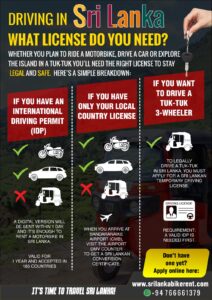
This is the most critical section of this entire guide. The answer to can Indian tourist drive in Sri Lanka is not just yes or no — it is yes, if you have the right documents for your specific vehicle.
🏍️ Motorcycles and Scooters
What you need:
- Valid Indian national driving licence with motorcycle category
- International Driving Permit — digital version is acceptable
Motorcycles carry the simplest requirement of all vehicle types. As long as your Indian license includes the motorcycle category and you have a valid IDP — even saved digitally on your phone — you are fully legal to ride anywhere in Sri Lanka. No additional permits, no AAC office visits, no complications.
🚗 Cars
What you need:
- Valid Indian national driving licence
- International Driving Permit — digital or physical both accepted
Cars are equally straightforward. Your Indian license paired with an IDP gives you complete legal clearance to rent and drive a car across Sri Lanka. No additional steps required beyond these two documents.
🛺 Tuk-Tuks (Three-Wheelers)
What you need:
- Valid Indian national driving licence with light vehicle category
- International Driving Permit — physical booklet only (digital NOT accepted)
- AAC Recognition Permit issued by the Automobile Association of Ceylon
Tuk-tuks are in a category of their own. They require three documents instead of two, and one of those documents — the AAC Recognition Permit — is unique to three-wheeler operation. It is not needed for motorcycles or cars. Additionally, for tuk-tuk drivers, the IDP must be the physical printed booklet. A digital copy is not sufficient because the AAC uses your physical IDP as the basis for issuing the Recognition Permit.
The single most important rule to remember: The AAC Recognition Permit is for tuk-tuks only. Motorcycles and cars do not need it. But if a tuk-tuk is on your itinerary, you need all three documents — and the IDP must be physical.
4. Everything You Need to Know About the IDP
The International Driving Permit (IDP) is an internationally accepted booklet that translates your driving license details into multiple languages. It works alongside your original Indian license — never as a replacement for it.
How to apply for an IDP in India:
The process runs through your local Regional Transport Office (RTO). Submit Form 4A along with your original Indian driving license, passport-size photographs, address proof, and the processing fee. Fees generally range between ₹500 and ₹1,000 depending on the state.
Turnaround time is typically 3 to 7 working days, though certain RTOs process applications on the same day. The IDP is valid for 12 months from the date of issue.
Physical vs digital — making the right choice:
For motorcycle and car rentals, a digital IDP displayed on your phone is generally accepted across Sri Lanka. However, if there is even a small chance you might want to drive a tuk-tuk during your trip, always get the physical booklet. The Automobile Association of Ceylon requires your physical IDP in hand before they can process an AAC Recognition Permit. A digital copy cannot be substituted under any circumstance for this purpose.
The safest approach: always request the physical booklet from your RTO. It works for all three vehicle types and gives you complete flexibility from the moment you land.
For official application instructions, visit the Parivahan Sewa portal — the Government of India’s official transport services platform.
APPLY FOR INTERNATIONAL DRIVING PERMIT !
5. The AAC Recognition Permit — Who Needs It and Why
The AAC Recognition Permit (sometimes referred to as the AAC Covering Permit) is issued by the Automobile Association of Ceylon and is the document that legally authorizes foreign tourists to drive a tuk-tuk in Sri Lanka.
It is exclusive to three-wheelers. If you are riding a motorcycle or driving a car, you will never need to think about this permit. But if a tuk-tuk is part of your plans — even for a single day’s rental — this permit is non-negotiable.
Why is it needed specifically for tuk-tuks?
Sri Lanka classifies three-wheelers under a specific motor vehicle category governed by its own regulatory requirements. The AAC Recognition Permit is the mechanism through which foreign tourists are authorized to operate within this category.
How does the AAC issue it?
The AAC bases the permit on your physical IDP booklet. They verify your credentials from the physical document and issue the Recognition Permit accordingly. This is why digital IDPs are firmly off the table for tuk-tuk drivers — the entire issuance process depends on the physical booklet being present.
How long does it last?
The AAC Recognition Permit is valid for one full year from the date of issue. For Indian tourists who visit Sri Lanka frequently or plan a long-term stay, this represents outstanding value.
What does it cost?
There are two ways to obtain it and the price differs between them:
Visiting the AAC office in Colombo directly costs LKR 8,500. This is the cheaper option but requires you to make a separate trip to Colombo after arrival, which eats into your holiday time.
Applying through your tuk-tuk rental company costs LKR 12,000. The higher fee covers the service of having your permit fully processed and ready for collection the moment you arrive to pick up your vehicle. No office visits, no queues, no delays.
For most Indian tourists on a limited holiday schedule, the rental office route is by far the smarter choice.
APPLY FOR AAC CONVERTIN PERMIT!
6. How to Get Your AAC Permit Before You Arrive
The most efficient and stress-free way to secure your AAC Recognition Permit is to arrange it through your rental company before your trip begins. Here is exactly how the process works from start to finish.
Step 1 — Apply for your physical IDP at your local RTO in India.
Do this as early as possible — ideally at least two to three weeks before your departure date. Submit Form 4A with your license, photographs, and identity proof. Confirm explicitly that you want the physical booklet, not just a digital certificate. Allow up to 10 working days for delivery.
Step 2 — Book your tuk-tuk rental in advance and inform the company.
Contact your Sri Lankan rental company ahead of your trip. Let them know you need an AAC Recognition Permit arranged. Share a scanned copy of your physical IDP, your passport details, and your planned arrival date.
Step 3 — The rental company handles the AAC process.
Your rental company will submit the application to the AAC on your behalf, coordinate the processing, and have the permit officially prepared prior to your arrival. This saves you the time and inconvenience of visiting the AAC office yourself.
Step 4 — Collect your tuk-tuk and permit on arrival day.
When you arrive in Sri Lanka and head to your rental office, your AAC Recognition Permit is ready and waiting. Collect it alongside your vehicle, your physical IDP, and your Indian driving license — and your documentation is completely in order.
The cost via this route is LKR 12,000, compared to LKR 8,500 at the AAC office directly. The difference buys you a smooth, queue-free arrival and guarantees your holiday starts from day one without bureaucratic detours.
Prefer to handle it yourself in Colombo?
Visit the AAC office directly after arrival. Bring your physical IDP booklet, Indian driving license, passport, and Sri Lankan visa or ETA entry stamp. The fee is LKR 8,500 payable on the day. Processing is typically completed same-day, but arrive early in the morning to avoid afternoon queues.
7. Essential Road Rules for Indian Drivers in Sri Lanka
Answering can Indian tourist drive in Sri Lanka positively is only the beginning. Knowing the rules of the road is what keeps your journey safe and legal throughout.
Left-hand traffic is standard in Sri Lanka — identical to India. This is one of the biggest natural advantages Indian tourists have over visitors from Europe, America, or East Asia. The steering wheel is on the right, overtaking is on the right, and road habits feel instinctively familiar.
Speed limits are enforced by traffic police and speed cameras at fixed locations:
Built-up and urban areas are capped at 50 km/h. National highways permit up to 70 km/h. Expressways allow a maximum of 100 km/h. Hospital and school zones operate at 25 km/h during specified hours.
Seat belts are compulsory for the driver and all front passengers. Fines are issued on the spot at police checkpoints.
Mobile phones may not be used while driving unless connected to a certified hands-free system. Officers at checkpoints actively watch for phone use.
Alcohol and driving do not mix in Sri Lanka. The legal blood alcohol limit is 80mg per 100ml — but the safest approach is simply to not drive after drinking anything at all. Penalties include arrest, license suspension, and heavy fines.
Tuk-tuk operators are subject to particularly thorough documentation checks. Traffic police in tourist areas and at major road checkpoints routinely inspect three-wheeler drivers. Missing your physical IDP or AAC Recognition Permit at any one of these stops will result in an immediate fine regardless of how short your journey is or how friendly the situation seems.
General road behaviour in Sri Lanka is comparable to India — horns are used frequently as a communication tool, pedestrians and animals share rural roads, and patience in city traffic is essential especially around Colombo, Kandy, and Galle during peak hours.
8. Best Routes and Driving Conditions Across Sri Lanka
Sri Lanka spans approximately 435 km from north to south and roughly 225 km at its widest point. This compact scale makes self-drive exploration exceptionally rewarding — almost every corner of the island is reachable within a few hours.
Expressways are the fastest and most comfortable roads on the island. The E01 Southern Expressway connecting Colombo to Matara is excellent for cars and motorcycles. The E03 linking Colombo to Kandy cuts travel time dramatically. Both are toll-operated with fees between LKR 100 and LKR 600 per segment. Tuk-tuks are not permitted on any expressway — plan alternative routes if you are in a three-wheeler.
National highways are reliable for connecting major cities and tourist destinations. The A9 running through the Cultural Triangle toward Sigiriya and Anuradhapura is well-maintained and straightforward. Traffic around Colombo on the A1 and A2 can be congested during morning and evening rush hours — early starts make a significant difference.
Mountain and highland roads toward Ella, Nuwara Eliya, Haputale, and the Knuckles Range rank among the most breathtaking driving experiences in all of Asia. They are also among the most demanding. Roads are narrow, steep, and frequently shrouded in morning mist. Take these routes slowly, use your horn generously on blind bends, and never attempt them after dark.
Coastal roads along the southern and western shorelines between Negombo, Colombo, Galle, and Mirissa offer gorgeous ocean views with generally comfortable road surfaces. These routes are particularly popular among motorcycle riders and tuk-tuk adventurers alike.
Tuk-tuk specific advice: Practice extensively on flat ground before attempting any mountain route. Three-wheelers handle very differently from cars and motorcycles on steep inclines, and overconfidence on highland roads is the most common cause of tuk-tuk accidents involving tourists.
Night driving is discouraged island-wide outside of well-lit city centres. Stray animals, unlit cyclists, unmarked road humps, and sudden road deterioration are common hazards after dark. Plan each day’s driving to finish before sunset.
Fuel availability is good across major routes. Prices are government-regulated and consistent nationwide. Check current rates at the Ceylon Petroleum Corporation before your trip.
For comprehensive road safety guidance specific to Sri Lanka, visit the National Council for Road Safety Sri Lanka.
Frequently Asked Questions
Q1: Can Indian tourist drive in Sri Lanka with only their Indian driving license? No. An Indian driving license must always be accompanied by an International Driving Permit (IDP). For tuk-tuks, an AAC Recognition Permit is additionally required. For motorcycles and cars, the IDP paired with your Indian license is sufficient.
Q2: Do Indian tourists need the AAC Recognition Permit for motorcycles? No. The AAC Recognition Permit is exclusively required for tuk-tuk (three-wheeler) operation. Motorcycle riders only need their Indian driving license with motorcycle category and a valid IDP — digital or physical.
Q3: Why must the IDP be physical for tuk-tuk drivers but not for motorcycles? Because the Automobile Association of Ceylon issues the AAC Recognition Permit based on your physical IDP booklet. They require the physical document for verification purposes. A digital IDP cannot be used to obtain the AAC permit under any circumstances.
Q4: How much does the AAC Recognition Permit cost for Indian tourists? Direct at the AAC office in Colombo: LKR 8,500. Through your tuk-tuk rental company with the permit ready on arrival: LKR 12,000. The rental office route costs more but saves you a separate trip to Colombo and ensures zero delays on your arrival day.
Q5: How long is the AAC Recognition Permit valid? The AAC Recognition Permit is valid for one year from the date of issue — excellent value for frequent visitors or those on extended stays in Sri Lanka.
Q6: What is the smartest way to arrange the AAC permit as an Indian tourist? Apply through your tuk-tuk rental company before your arrival. Share your physical IDP details with them in advance, and they will coordinate everything with the AAC so the permit is ready when you collect your vehicle. This is faster, more convenient, and eliminates all uncertainty.
Q7: Can Indian tourists drive on Sri Lanka’s expressways in a tuk-tuk? No. Tuk-tuks are not permitted on Sri Lankan expressways. Plan your routes using national highways and B-roads if you are traveling in a three-wheeler.
Q8: Is it safe for Indian tourists to self-drive in Sri Lanka? Yes, it is generally very safe. Left-hand traffic, English signage, and familiar road culture make Sri Lanka one of the most comfortable self-drive destinations for Indian visitors in the entire region. The main risks are narrow mountain roads and night driving — both of which are manageable with sensible planning.
Q9: Can Indian tourists drive in Sri Lanka on a tourist visa? Yes. A standard Sri Lankan tourist visa (ETA) combined with the correct driving documents for your chosen vehicle is entirely sufficient to drive legally in Sri Lanka.
Q10: What happens if a tuk-tuk driver is caught without the AAC Recognition Permit? You face on-the-spot fines, possible vehicle impoundment, and potential detainment at a police checkpoint. Traffic police in Sri Lanka actively check three-wheeler operators’ documentation. Never operate a tuk-tuk without your physical IDP and AAC Recognition Permit both in hand.
Final Thoughts
Can Indian tourists drive in Sri Lanka? Without question — and done properly, it is one of the most joyful travel experiences the island has to offer.
The document process is simple once you understand it. Motorcycles and cars need only your Indian license and an IDP. Tuk-tuks need a physical IDP booklet and an AAC Recognition Permit arranged either through your rental company or at the AAC office in Colombo. Get your physical IDP sorted at your local RTO before leaving India, connect with your rental company early to arrange the AAC permit if needed, and everything else falls into place naturally.
Sri Lanka’s roads lead to ancient ruins, spice-scented highlands, turquoise coastlines, and vibrant local markets — all best explored on your own schedule, at your own pace, behind your own wheel.
Plan well, drive safely, and make every kilometre count.
For authoritative information, refer to the Department of Motor Traffic Sri Lanka, the Automobile Association of Ceylon, the National Council for Road Safety Sri Lanka, and the Parivahan Sewa Portal India.