
Table of Contents
- What Every Irish Driver Needs to Know First
- Can I Drive in Sri Lanka with My Irish Driving License? The Straight Answer
- The Essential Document Breakdown by Vehicle Type
- Understanding the International Driving Permit for Irish Travellers
- The AAC Recognition Permit — The Document Most Irish Tourists Miss
- How to Apply for Your AAC Permit Before You Land
- AAC Recognition Permit Costs — What to Expect in 2025
- Sri Lanka Driving Laws Irish Visitors Must Respect
- Your Best Vehicle Options as an Irish Tourist
- The Most Scenic Drives in Sri Lanka for Irish Visitors
- Staying Safe on Sri Lankan Roads — Real Advice
- FAQs
- Final Word
What Every Irish Driver Needs to Know First
Sri Lanka is one of those rare travel destinations that genuinely rewards people who explore it independently.
The freedom of riding a scooter along a sun-drenched coastal road, navigating a tuk-tuk through a spice market, or driving a jeep deep into elephant country is the kind of experience that stays with you for life.
But before any of that happens, there is one question standing between you and the open road.
Can I drive in Sri Lanka with my Irish Driving License?
The answer is yes — but the exact documents you need depend entirely on the type of vehicle you plan to drive. Get this right before you travel and everything else falls into place. Get it wrong and you risk fines, impounded vehicles, and invalidated insurance at the worst possible moment.
This guide gives you every detail you need — from IDP applications in Ireland to the specific local permit required for tuk-tuk drivers — so you arrive in Sri Lanka fully prepared and ready to explore.
Can I Drive in Sri Lanka with My Irish Driving License? The Straight Answer
Can I drive in Sri Lanka with my Irish Driving License? Under Sri Lankan law, your Irish driving licence alone is not sufficient to legally operate any motor vehicle on public roads.
Sri Lanka is a party to the 1949 Geneva Convention on Road Traffic. This international agreement requires foreign drivers to carry a valid International Driving Permit (IDP) alongside their home country licence when driving in Sri Lanka. Ireland is also a signatory to this same convention, making the IDP process clear and accessible for Irish licence holders.
No matter how many years you have been driving in Ireland, no matter how clean your record, your national licence on its own does not meet Sri Lanka’s legal requirement.
For most vehicles — cars, motorcycles, and scooters — your Irish licence paired with a valid IDP is everything you need. For tuk-tuks, there is one additional step that catches countless tourists by surprise. Understanding that difference before you book your rental could save you a significant amount of time and stress on arrival.
APPLY FOR INTERNATIONAL DRIVING PERMIT !
The Essential Document Breakdown by Vehicle Type
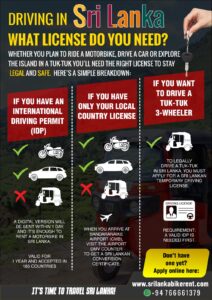
This is the section of this guide that matters most. Read it carefully before you make any rental bookings.
🏍️ Motorcycles and Scooters
To legally ride a motorcycle or scooter in Sri Lanka as an Irish visitor, you need:
Your valid Irish driving licence with motorcycle category included (Category A or AM), and a valid International Driving Permit. For motorcycles and scooters, a digital IDP is acceptable in Sri Lanka — you do not need the physical booklet.
No additional local permits are required. Two documents and you are road legal.
🚗 Cars and SUVs
To legally drive a car or SUV in Sri Lanka as an Irish visitor, you need:
Your valid Irish driving licence and a valid International Driving Permit.
Again, no additional local permits are required. Simple and straightforward.
🛺 Tuk-Tuks (Three-Wheelers)
This is where the requirements become more specific — and where many tourists make costly mistakes.
To legally drive a tuk-tuk in Sri Lanka as an Irish visitor, you need three documents:
Your valid Irish driving licence with light vehicle category, a valid International Driving Permit — critically, the physical booklet version is required (digital is not accepted for tuk-tuks), and an AAC Recognition Permit (also called a Covering Permit) issued by the Automobile Association of Ceylon.
The reason the physical IDP booklet is mandatory for tuk-tuk drivers is straightforward — the Automobile Association of Ceylon issues your AAC Recognition Permit based on your physical IDP document. Without the physical booklet, the AAC cannot process your permit, and without the permit, you cannot legally drive a tuk-tuk.
The critical distinction: Tuk-tuks require the AAC Recognition Permit. Motorcycles and cars do not. This single difference is the most important thing an Irish driver planning to rent a tuk-tuk in Sri Lanka needs to understand.
Understanding the International Driving Permit for Irish Travellers
An International Driving Permit is an internationally recognised companion document that translates your driving licence details into 12 languages, allowing road authorities in over 150 countries to verify your driving credentials.
It is not a replacement for your Irish licence. It works only when presented together with your original Irish driving licence — both documents must be on your person every time you drive.
Two versions of the IDP exist: the 1949 Convention IDP and the 1968 Convention IDP. Sri Lanka recognises the 1949 version exclusively, so when applying in Ireland, you must specifically request this version.
A critical note for tuk-tuk drivers: If you intend to rent a tuk-tuk at any point during your Sri Lanka trip, you must obtain the physical IDP booklet before you leave Ireland — not a digital version. The physical booklet is what the Automobile Association of Ceylon requires to issue your AAC Recognition Permit. A digital IDP will not be accepted for this purpose.
For motorcycles, scooters, and cars, a digital IDP is perfectly acceptable.
The IDP is issued by the AA Ireland and is valid for 12 months from the date of issue. It reflects the exact vehicle categories shown on your Irish licence, so it cannot grant you permission to drive a category your Irish licence does not already cover.
The cost is typically €15 to €20 — one of the best value travel documents you will ever purchase.
For additional guidance on driving abroad as an Irish licence holder, visit the Road Safety Authority Ireland (RSA).
The AAC Recognition Permit — The Document Most Irish Tourists Miss
If there is one piece of information in this entire guide that could save you from a serious problem in Sri Lanka, it is this section.
The AAC Recognition Permit — sometimes called the Covering Permit — is a document issued by the Automobile Association of Ceylon (AAC) that is legally required for any foreign tourist who wants to drive a tuk-tuk (three-wheeler) in Sri Lanka.
It is not required for motorcycles. It is not required for cars. It is required only for tuk-tuks.
Here is exactly how the process works.
The AAC issues your Recognition Permit using your physical IDP booklet as the basis document. This is why tuk-tuk drivers cannot use a digital IDP — the physical document is part of the permit issuance process itself. Your IDP details are recorded and the Recognition Permit is issued against them.
Once issued, the AAC Recognition Permit is valid for one year from the date of issue. It must be carried with you every time you drive a tuk-tuk in Sri Lanka, alongside your Irish licence and physical IDP.
Police checkpoints in popular tourist areas actively check for this permit on tuk-tuk drivers. Driving a three-wheeler without it exposes you to fines and potential impoundment — and if you are involved in any accident without the correct documentation, your travel insurance is almost certainly invalidated.
For official information about the AAC and their permit services, visit aaceylon.lk.
How to Apply for Your AAC Permit Before You Land
There are two ways to obtain your AAC Recognition Permit.
The first option is to visit the AAC office in Colombo yourself after you arrive in Sri Lanka, present your physical IDP booklet, and apply in person. This works perfectly well but requires you to visit the office and wait for processing — time that could otherwise be spent exploring.
The second option — and the one most experienced travellers strongly recommend — is to apply through your tuk-tuk rental operator before you travel.
When you book your tuk-tuk rental in advance and provide your IDP details to your operator, they handle the entire AAC permit application process on your behalf. Your AAC Recognition Permit is prepared and ready before you even board your flight to Sri Lanka. When you land, your permit is waiting for you along with your rental vehicle — no office visits, no queuing, no delays.
For anyone planning a tuk-tuk adventure in Sri Lanka, booking through a rental operator who offers advance AAC permit processing is by far the most efficient and stress-free approach. It means day one of your trip is exactly what it should be — the start of an adventure, not an administrative errand in Colombo.
APPLY FOR AAC CONVERTIN PERMIT!
AAC Recognition Permit Costs — What to Expect in 2025
The cost of your AAC Recognition Permit in 2025 depends on how you choose to obtain it.
If you visit the Automobile Association of Ceylon office in Colombo directly, the permit costs 8,500 LKR.
If you arrange the permit through your tuk-tuk rental operator, the cost is 12,000 LKR. The higher price reflects the convenience of having your permit fully arranged and ready before your arrival, eliminating the need to visit the AAC office yourself.
For most visitors, particularly those with limited time or those arriving with full itineraries, the additional cost of going through a rental operator represents genuinely good value. Your time in Sri Lanka is precious — spending a portion of your first day at an office in Colombo is rarely how anyone wants to begin their trip.
Sri Lanka Driving Laws Irish Visitors Must Respect
Sri Lanka and Ireland share one very welcome characteristic — both countries drive on the left-hand side of the road. For Irish visitors, this eliminates one of the biggest adjustment challenges that travellers from mainland Europe or North America face.
However, the similarities with Irish driving largely stop there.
Speed limits officially stand at 70 km/h on expressways and 50 km/h in urban areas. In practice, speeds vary enormously and you should always drive to road conditions rather than posted limits.
Seatbelts are legally required for all front-seat occupants. Rear-seat passengers are strongly advised to wear them as well.
Helmets are compulsory for all motorcycle and scooter riders without exception. Always insist that your rental operator provides a helmet before you accept any two-wheeled vehicle.
Drink driving carries severe criminal penalties under Sri Lankan law. The legal limit is 0.08% blood alcohol, but the only sensible policy is zero tolerance — do not drink and drive under any circumstances.
Buses and trucks dominate the roads outside major cities and overtake aggressively, including on blind corners and narrow mountain roads. Always give them maximum space and never compete with them for road position.
Animals crossing represent a constant and genuine hazard across Sri Lanka — stray dogs, cattle, water buffalo, and wild elephants near national parks can appear on any road at any time. This risk increases dramatically after dark.
For the official Sri Lanka road regulations and Highway Code, visit the Department of Motor Traffic Sri Lanka.
Your Best Vehicle Options as an Irish Tourist
With your documents correctly arranged, here is an honest overview of your rental options and what suits different types of travellers.
Cars and SUVs offer the most comfort and are the best option for families, groups, or anyone covering significant distances between major destinations. Your IDP and Irish licence are the only documents needed. A 4WD or SUV is essential for anyone venturing into the hill country around Kandy, Nuwara Eliya, or Ella, where mountain roads can be steep, narrow, and rough.
Scooters (100cc–125cc) are the perfect choice for solo travellers or couples exploring coastal areas. They are affordable, simple to ride, easy to park in busy towns, and give you genuine freedom on quieter roads. Irish licence with motorcycle category plus IDP — digital version acceptable — is all you need.
Motorcycles (150cc–250cc) are better suited to more experienced riders planning longer routes or mountain journeys. The same document requirements as scooters apply. Always confirm your Irish licence includes Category A before renting anything above 125cc.
Tuk-tuks are in a category of their own when it comes to the Sri Lanka experience. Noisy, bouncy, open to the breeze, and impossible not to love — driving one through village roads and along lagoon edges is unlike anything available back home. Just remember the three-document rule: Irish licence with light vehicle category, physical IDP booklet, and AAC Recognition Permit. Apply for the AAC permit through your rental operator well before you fly.
Before accepting any rental vehicle, photograph the entire vehicle thoroughly — every scratch, dent, crack, and area of wear — in daylight and ensure the rental operator signs off on these before you drive away.
The Most Scenic Drives in Sri Lanka for Irish Visitors
Sri Lanka consistently delivers road experiences that stay in the memory long after the tan fades.
Negombo to Kalpitiya is a magnificent 90km coastal journey along Sri Lanka’s northwest shore, passing lagoons, mangrove forests, fishing settlements, and quiet beaches. It is manageable and relatively flat, making it an ideal first drive for visitors still finding their feet on Sri Lankan roads.
Kandy to Ella via the B40 is widely considered one of the greatest driving routes in Asia. The road climbs through some of the world’s most famous tea country, passing waterfalls, misty mountain passes, and viewpoints that genuinely take your breath away. Budget a full day and never rush it.
Galle to Tangalle along the southern coast connects the stunning Dutch colonial fort city with a series of beautiful and less crowded beaches further east. The road is relaxed, scenic, and well-maintained — excellent for scooters or motorcycles.
Colombo to Sigiriya cuts through the Cultural Triangle and delivers you to the legendary Sigiriya rock fortress, one of Asia’s most extraordinary ancient sites, in approximately four hours from the capital.
Staying Safe on Sri Lankan Roads — Real Advice
Sri Lanka’s road fatality rate is considerably higher than Ireland’s. The World Health Organization’s Global Road Safety data consistently places South Asian nations including Sri Lanka among regions with elevated road accident risks.
Stating this plainly is not intended to put you off driving — it is intended to make sure you approach it with the right level of respect and preparation.
Drive during daylight only. Night driving outside major towns is genuinely dangerous. Unlit roads, unlit vehicles, stray animals, and potholes that are invisible in the dark make after-dark driving on rural routes a risk not worth taking.
Allow far more time than you expect. Google Maps journey estimates in Sri Lanka are consistently optimistic. Buses, livestock, road damage, and slow-moving vehicles will extend almost every journey you make. Build in buffer time for every trip.
Never challenge buses or trucks. Commercial vehicle drivers on Sri Lankan roads are experienced, assertive, and will not back down. Pull in and let them pass every single time.
Wear proper gear on two wheels. Even in 30-degree heat, a light motorcycle jacket and sturdy shoes provide protection that t-shirts and sandals cannot. Gravel rash in tropical heat is far more unpleasant and prone to infection than it would be at home.
Check your travel insurance carefully. Many Irish policies exclude motorcycle riding entirely or require specific advance notification for overseas driving. Confirm your coverage before you travel — and remember that driving without correct documentation can void any claim entirely.
FAQs
Q: Can I drive in Sri Lanka with my Irish Driving License alone? No. Sri Lankan law requires all foreign drivers to carry a valid International Driving Permit alongside their original national licence. Your Irish licence on its own is not legally sufficient for any vehicle type.
Q: Do I need a physical IDP or will a digital version work in Sri Lanka? For motorcycles, scooters, and cars, a digital IDP is accepted in Sri Lanka. For tuk-tuks, you must have the physical IDP booklet — the Automobile Association of Ceylon requires it to issue your AAC Recognition Permit.
Q: What exactly is the AAC Recognition Permit and who needs it? The AAC Recognition Permit is a document issued by the Automobile Association of Ceylon that is required specifically for foreign tourists driving tuk-tuks (three-wheelers) in Sri Lanka. It is not required for motorcycles or cars. It is issued based on your physical IDP booklet and is valid for one year.
Q: What documents do I need to ride a motorcycle in Sri Lanka? Two documents: your valid Irish driving licence with motorcycle category (A or AM) and a valid IDP. Digital IDP is acceptable. No additional local permits are required.
Q: What documents do I need to drive a tuk-tuk in Sri Lanka? Three documents: your valid Irish driving licence with light vehicle category, a physical IDP booklet (1949 Convention), and an AAC Recognition Permit from the Automobile Association of Ceylon. All three are mandatory.
Q: How much does the AAC Recognition Permit cost? 8,500 LKR if you visit the AAC office in Colombo directly. 12,000 LKR if you arrange it through your tuk-tuk rental operator — with the significant advantage that your permit is prepared and ready before you arrive in Sri Lanka.
Q: How long is the AAC Recognition Permit valid? It is valid for one year from the date of issue.
Q: What is the easiest way to get the AAC Recognition Permit? Apply through your tuk-tuk rental operator before you travel. They arrange the permit using your IDP details and have it ready on arrival. This saves you a visit to the AAC office in Colombo and means you can begin your trip without any administrative delays.
Q: Where do I get an IDP in Ireland and how much does it cost? The IDP is issued by the AA Ireland. Visit theaa.ie for details. The cost is typically €15 to €20 and it is valid for 12 months. Always specifically request the 1949 Geneva Convention IDP for travel to Sri Lanka.
Q: Does my Irish insurance cover me driving in Sri Lanka? Your Irish car insurance almost certainly does not cover you in Sri Lanka. You will need a separate travel insurance policy that includes driving cover. Check carefully whether your policy covers motorcycles and tuk-tuks specifically — many standard policies do not. Driving without the correct documentation also risks invalidating any claim.
Q: What do I do if stopped at a police checkpoint in Sri Lanka? Pull over calmly and safely. For motorcycles and cars, present your Irish licence and IDP politely. For tuk-tuks, present your Irish licence, physical IDP, and AAC Recognition Permit. Be cooperative and patient — checkpoints are routine for drivers with correct paperwork.
Q: Is it safe to drive in Sri Lanka as a first-time visitor? Yes, with the right preparation and a cautious approach. Drive during daylight, respect local road culture, avoid competing with buses and trucks, and give yourself plenty of time for every journey. Thousands of Irish tourists drive through Sri Lanka safely every year.
Final Word
Can I drive in Sri Lanka with my Irish Driving License? The answer is a clear and confident yes — provided you understand exactly which documents your chosen vehicle requires.
For motorcycles and scooters: your Irish licence with motorcycle category plus a valid IDP. Digital IDP is fine.
For cars and SUVs: your Irish licence plus a valid IDP. Nothing more needed.
For tuk-tuks: your Irish licence with light vehicle category, a physical IDP booklet, and an AAC Recognition Permit from the Automobile Association of Ceylon. Apply for the AAC permit through your rental operator before you fly — it costs 12,000 LKR through a rental operator versus 8,500 LKR direct at the AAC Colombo office, and it will be ready and waiting when you land.
None of this is complicated once you know what is required. The IDP takes less than 30 minutes and under €20 at AA Ireland. The AAC permit can be arranged entirely in advance through your rental operator. By the time you board your flight, every document can already be sorted.
Sri Lanka is waiting — winding coastal roads, misty mountain passes, lagoon villages, and spice routes that have been drawing adventurous travellers for centuries. Get your paperwork right and all of it is yours to explore, on your own terms, at your own pace.
Sort your documents. Pack your Irish licence. And get ready for one of the greatest drives of your life.
Helpful External Resources: