Table of Contents
- The Question Every Ukrainian Traveler Asks
- Is My Ukraine Driving License Valid in Sri Lanka?
- The Complete Document Guide by Vehicle Type
- What is an IDP and Why Do You Need One?
- How to Get Your IDP Before Leaving Ukraine
- What is the AAC Recognition Permit?
- How to Get Your AAC Permit — Costs and Steps
- Sri Lanka Road Rules Ukrainian Drivers Must Know
- Practical Driving Tips for First-Time Visitors
- Top Routes to Explore Sri Lanka by Motorcycle and Tuk-Tuk
- FAQs
- Final Summary
1. The Question Every Ukrainian Traveler Asks
Every year, thousands of Ukrainian travelers land in Sri Lanka with one thing on their mind — hitting the open road.
And who can blame them?
Sri Lanka is a country made for independent exploration. The kind of place where the best experiences are always just off the main road. A hidden beach down a palm-lined track. A remote waterfall that no tour bus ever visits. A local family running a roadside stall where the food is extraordinary and the conversation even better.
To find places like that, you need your own wheels.
That is exactly why so many Ukrainian visitors start researching before they fly. They want to know — is my Ukraine Driving License valid in Sri Lanka? Can I just pick up a motorcycle or jump in a tuk-tuk and go?
The answer is more nuanced than a simple yes or no. And getting it wrong can cost you — in fines, in insurance complications, and in wasted time at the side of the road explaining yourself to traffic police.
This guide gives you the complete, accurate answer. Everything you need to know, clearly explained, before you land.
2. Is My Ukraine Driving License Valid in Sri Lanka?
Let’s get straight to it.
A Ukrainian driving license is not valid as a standalone document in Sri Lanka.
Sri Lanka does not have a mutual recognition agreement with Ukraine. This means your Ukrainian license — regardless of how long you have held it or what categories it covers — is not accepted on its own by Sri Lankan traffic authorities, police, or reputable vehicle rental companies.
You will need additional documentation. What that documentation looks like depends entirely on which type of vehicle you intend to drive.
This is the part that catches most tourists off guard. Many assume that one solution covers all vehicles. It does not. Sri Lanka treats motorcycles, cars, and tuk-tuks as distinct categories with their own specific document requirements.
Get the right documents for your chosen vehicle and you are completely legal. Get the wrong combination — or miss one document — and you are driving illegally, potentially voiding your insurance and opening yourself up to legal problems that can seriously derail your trip.
The sections below break this down clearly and simply.
3. The Complete Document Guide by Vehicle Type
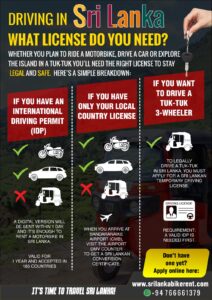
Study this section carefully. It is the most practical information in this entire guide.
Motorcycles and Scooters
If riding a motorcycle or scooter is your plan, here is what you need:
✅ Valid Ukrainian national driving license — must include motorcycle category coverage ✅ International Driving Permit (IDP) — a digital version is acceptable for motorcycles and scooters
That is it. Two documents. Get your IDP sorted before you fly and you are ready to ride from the moment you land.
Cars
Driving a car or light vehicle in Sri Lanka requires:
✅ Valid Ukrainian national driving license ✅ International Driving Permit (IDP) — digital version acceptable
Again, two documents. Straightforward and easy to arrange in advance.
Tuk-Tuks (Three-Wheelers)
This is where things get more involved — and where the vast majority of tourists run into problems.
Tuk-tuks are legally classified as a separate vehicle category under Sri Lankan road traffic law. They are not treated the same as cars or motorcycles. Driving one requires three documents, not two:
✅ Valid Ukrainian national driving license — must include light vehicle category (not motorcycle category) ✅ International Driving Permit — physical booklet only — a digital IDP is not accepted for tuk-tuks ✅ AAC Recognition/Covering Permit — issued by the Automobile Association of Ceylon (AAC)
All three together. Every time you drive a three-wheeler.
The single rule to remember:
Motorcycles and cars — Ukrainian license plus IDP. Tuk-tuks — Ukrainian license plus physical IDP booklet plus AAC Recognition Permit.
The AAC Recognition Permit is the document that changes everything for tuk-tuk drivers. It is required only for three-wheelers and is something most tourists have never heard of until they arrive and ask why they cannot simply rent one.
4. What is an IDP and Why Do You Need One?
The International Driving Permit — IDP — is an internationally recognized document that provides a certified translation of your driving license into 12 languages.
It does not function as a replacement for your original license. It is a companion document. Both your Ukrainian driving license and your IDP must be carried together every single time you drive. One without the other is not valid.
Sri Lanka recognizes the IDP under the framework of the 1949 Geneva Convention on Road Traffic, to which Sri Lanka is a signatory. This is what gives the IDP its legal standing on Sri Lankan roads.
There is one very important distinction to understand for Sri Lanka specifically.
For motorcycles and cars — a digital IDP is perfectly acceptable. You can carry it on your phone and show it to traffic police or rental companies without any issues.
For tuk-tuks — only the physical IDP booklet is accepted. This is not a minor technicality. The physical booklet is required because the Automobile Association of Ceylon (AAC) uses it as the basis for issuing your Recognition Permit. Without your physical booklet in hand, the AAC cannot process your tuk-tuk permit application. There is no workaround for this.
If a tuk-tuk is even a possibility during your Sri Lanka trip, request the physical booklet version of your IDP when you apply in Ukraine. You can always use a physical booklet for motorcycles and cars too — so there is no downside to getting the physical version regardless of your plans.
For more on the legal framework behind international driving permits, see the UNECE road transport conventions page.
APPLY FOR INTERNATIONAL DRIVING PERMIT !
5. How to Get Your IDP Before Leaving Ukraine
Applying for your IDP in Ukraine is a simple process. Here is exactly how to do it.
Who issues IDPs in Ukraine? The Ukrainian Automobile Association (UAA) — Українська Автомобільна Федерація — is the sole officially authorized body in Ukraine for issuing IDPs. Do not apply through any other source.
What documents do you need? Bring your valid Ukrainian driving license, your international passport, recent passport-size photographs, and the applicable processing fee.
How long does it take? Processing is generally fast — same-day or within a few working days at most, depending on the office.
Physical or digital — which should you choose? If you are planning to drive a tuk-tuk in Sri Lanka at any point, request the physical booklet specifically. Explain to the UAA that you need it for a tuk-tuk permit application in Sri Lanka. If you are only planning to ride a motorcycle or drive a car, a digital version is fine.
How long is it valid? IDPs issued in Ukraine are typically valid for one year from the date of issue. Make sure the validity period covers your entire Sri Lanka trip.
One rule that never changes: Your original Ukrainian driving license must be with you every time you drive. The IDP has zero legal standing without it. Keep both documents together in a safe and accessible place throughout your trip.
6. What is the AAC Recognition Permit?
The AAC Recognition Permit — also known as a Covering Permit — is issued by the Automobile Association of Ceylon, which is Sri Lanka’s official national automobile association.
This permit exists specifically to legally authorize foreign visitors to drive tuk-tuks (three-wheelers) on Sri Lankan roads.
Here is the key thing to understand about how it works.
The AAC issues your Recognition Permit based on your physical IDP booklet. When you visit the AAC office in Colombo, they examine your physical IDP, verify your Ukrainian driving credentials, and then issue the Recognition Permit accordingly. The physical booklet is not just preferred — it is required for this process. Without it, the AAC cannot and will not issue your permit.
This is precisely why a digital IDP is not sufficient for tuk-tuk drivers. The document chain is: physical IDP → AAC verification → AAC Recognition Permit issued. Remove the physical IDP from that chain and the whole process stops.
How long is the AAC Recognition Permit valid? The permit is valid for one year from the date of issue. This makes it excellent value for longer stays and for travelers who plan to return to Sri Lanka and drive a tuk-tuk again within that period.
Is this permit needed for motorcycles or cars? No. The AAC Recognition Permit is required only for tuk-tuks. If you are riding a motorcycle or driving a car, you do not need this permit at all.
7. How to Get Your AAC Permit — Costs and Steps
There are two routes to getting your AAC Recognition Permit. Each has its own advantages.
Route 1 — Through Your Rental Office (Recommended)
This is the most convenient option and the one most experienced travelers choose.
When you book a tuk-tuk rental with a reputable company, you can arrange your AAC Recognition Permit through them as part of the booking process. The rental office handles the entire application on your behalf.
The real advantage is timing. Your permit is prepared and ready before you arrive in Sri Lanka. On the day you land, there are no queues, no office visits, no administrative tasks to tick off. Your tuk-tuk is ready, your documents are complete, and your adventure begins immediately.
Cost through rental office: 12,000 LKR
Operators like Boat Tours Sri Lanka offer this complete service — handling your AAC permit as part of the rental package so everything is seamlessly ready on arrival day.
APPLY FOR AAC CONVERTIN PERMIT!
Route 2 — Direct at the AAC Office in Colombo
If you prefer to handle the permit yourself after arriving in Sri Lanka, you can visit the AAC office directly in Colombo.
Cost at AAC office: 8,500 LKR
What to bring:
- Your valid Ukrainian national driving license
- Your physical IDP booklet — this is non-negotiable. The AAC requires it to process your application.
- Your passport with valid Sri Lanka entry documentation
- Recent passport-size photographs
Visit the Automobile Association of Ceylon website for current office address, opening hours, and contact details. Build this visit into your first day or two in Colombo — before you attempt to rent or drive any tuk-tuk.
Cost Comparison at a Glance
| Route | Cost | Key Benefit |
| Direct — AAC Office Colombo | 8,500 LKR | Lower cost |
| Through Rental Office | 12,000 LKR | Permit ready before arrival |
Choose direct if saving money matters most. Choose the rental office route if having everything sorted before you land matters most. Both are fully legitimate options.
8. Sri Lanka Road Rules Ukrainian Drivers Must Know
Before you start driving, there are some essential rules and road characteristics that every Ukrainian visitor needs to understand.
Left-hand traffic. Ukraine drives on the right. Sri Lanka drives on the left — the same as the UK, India, and Australia. This is the single biggest adjustment you will make as a Ukrainian driver. It affects your natural road position, how you approach junctions, how you navigate roundabouts, and your instincts during overtaking. Give yourself a full day of quiet road driving before tackling busy highways or city traffic.
Speed limits. Generally 50 km/h in built-up urban areas and between 70 and 100 km/h on expressways and major highways. Observe these — traffic police are present on key routes.
Seat belts are compulsory for the driver and front-seat passengers. No exceptions.
No mobile phones while driving. Using a handheld device behind the wheel is illegal and carries fines.
Strict drink driving enforcement. The legal limit is 80mg of alcohol per 100ml of blood. Random police checks happen. The penalties are significant. Do not risk it.
Road sharing with animals. This is perhaps the most distinctive feature of driving outside Sri Lanka’s cities. Cows, dogs, monkeys, and even elephants in areas near national parks can appear on roads without warning. Always drive at a speed that gives you genuine stopping distance.
Horns are used constantly by Sri Lankan drivers as a general communication tool — to signal overtaking, to warn pedestrians, to say hello. It is entirely normal and not aggressive. Do not be startled or unsettled by it.
9. Practical Driving Tips for First-Time Visitors
A little preparation goes a long way when driving in Sri Lanka for the first time.
Take the first day gently. No matter how experienced a driver you are back home, driving on the left for the first time will feel strange. Start with quiet residential roads or coastal back roads before you attempt city driving or mountain passes.
Plan around daylight. Rural Sri Lankan roads outside cities have very limited lighting at night. Unmarked hazards, animals crossing, and unlit vehicles are genuine risks after dark. Arrive at your destination before sunset whenever possible and plan your daily distances with this in mind.
Document checklist before every ride. Make it a habit to check you have your Ukrainian license, physical IDP booklet, and AAC Recognition Permit before you start the engine each day. A quick two-second check before you ride saves significant headaches if you get stopped.
Pre-departure vehicle inspection. Before accepting any rental vehicle — motorcycle, scooter, or tuk-tuk — walk around it carefully. Test the brakes, check tire condition, confirm the lights and horn work, and photograph every scratch or dent. Share the photos with the rental company before you leave. This protects you from unfair damage claims when you return it.
Helmets are mandatory and non-negotiable. Sri Lankan law requires helmets for motorcycle and scooter riders. Beyond the legal requirement, wearing one is simply the sensible decision on roads that can be unpredictable.
Insurance matters. Confirm that your travel insurance covers motorcycle or vehicle use in Sri Lanka and that the rental agreement includes adequate coverage. Drive only with proper insurance in place.
10. Top Routes to Explore Sri Lanka by Motorcycle and Tuk-Tuk
With your documents sorted and your vehicle ready, Sri Lanka opens up as one of the most rewarding road destinations in all of Asia.
The Southern Coastal Highway — Colombo to Matara This is the perfect starting route for Ukrainian drivers adjusting to left-side driving. The road runs along Sri Lanka’s southwestern coast with the Indian Ocean on one side and coconut groves on the other. Fishing villages, beach cafes, surf breaks, and whale watching towns line the route. Manageable traffic outside of Colombo and beautiful scenery make this an ideal first-day ride.
The Hill Country Circuit — Kandy to Ella For motorcycle riders with more confidence on the road, the mountain routes between Kandy and Ella are among the most visually stunning roads in Asia. Tea estates carpet the hillsides, waterfalls appear around every bend, and the temperature drops beautifully as you climb. The roads require concentration but reward every effort with unforgettable views.
The Cultural Triangle — Anuradhapura, Polonnaruwa, Sigiriya This north-central region is home to Sri Lanka’s most significant ancient sites. The roads between these cities are wide, relatively flat, and well suited to longer riding days. Wildlife crossings are common — watch for elephants, peacocks, and monitor lizards sharing the road with you.
The Negombo to Colombo Coastal Strip — Ideal Tuk-Tuk Introduction For your first tuk-tuk experience, the coastal road south from Negombo toward Colombo is an excellent choice. The route hugs the seafront, passes through busy fishing communities, and gives you a genuine immersion in Sri Lankan coastal life — all at the relaxed pace that tuk-tuk travel demands.
For trusted motorcycle and tuk-tuk rentals with full documentation support — including AAC permit arrangement before you arrive — Boat Tours Sri Lanka is a reliable and locally experienced option for Ukrainian travelers visiting the island.
FAQs
Q1: Is my Ukraine Driving License valid in Sri Lanka without any additional documents? No. Your Ukrainian license alone is not recognized in Sri Lanka. You need supporting documents, and the specific documents depend on which type of vehicle you plan to drive.
Q2: What documents do I need to ride a motorcycle in Sri Lanka? Your valid Ukrainian national driving license with motorcycle category coverage, plus a valid IDP. A digital IDP is perfectly acceptable for motorcycles and scooters.
Q3: What documents do I need to drive a tuk-tuk in Sri Lanka? Three documents — your Ukrainian license with light vehicle category, a physical IDP booklet (not digital), and an AAC Recognition Permit from the Automobile Association of Ceylon.
Q4: Why do I need a physical IDP for a tuk-tuk but not for a motorcycle? The Automobile Association of Ceylon issues the AAC Recognition Permit based on your physical IDP booklet. They verify and process the permit directly from that document. Without the physical booklet, the AAC cannot issue your tuk-tuk permit. This is why a digital IDP is insufficient for three-wheeler drivers.
Q5: How much does the AAC Recognition Permit cost? 8,500 LKR if you apply directly at the AAC office in Colombo. 12,000 LKR if you arrange it through your rental office — with the benefit that it is prepared and ready before you arrive in Sri Lanka.
Q6: How long is the AAC Recognition Permit valid? One year from the date of issue.
Q7: Can I arrange the AAC permit before I arrive in Sri Lanka? Yes — and this is the recommended approach. Book your tuk-tuk rental with a reputable company and ask them to arrange the AAC permit as part of the process. It will be ready and waiting when you land.
Q8: Do motorcycles need the AAC Recognition Permit? No. The AAC Recognition Permit is required only for tuk-tuks (three-wheelers). Motorcycle and car drivers do not need this permit.
Q9: What if I only have a digital IDP and want to drive a tuk-tuk? You will need to obtain a physical IDP booklet before you can get the AAC Recognition Permit. If you are still in Ukraine, contact the UAA and request the physical version. If you have already arrived in Sri Lanka without a physical IDP, you cannot drive a tuk-tuk legally until this is resolved.
Q10: Is driving on the left in Sri Lanka difficult for Ukrainian drivers? It takes adjustment but most drivers manage well within a day or two. The key is to start slowly on quiet roads, be especially careful at roundabouts and junctions where instincts from right-hand driving can mislead you, and give yourself time before attempting busy city traffic.
Q11: What documents do I need to drive a car in Sri Lanka? Your valid Ukrainian driving license and a valid IDP — digital or physical both accepted.
Q12: Where is the AAC office in Colombo? Current address, opening hours, and contact information are available on the Automobile Association of Ceylon official website.
Final Summary
So — is your Ukraine Driving License valid in Sri Lanka?
No, not alone. But with the correct documents for your chosen vehicle, you are completely road-legal and free to discover one of Asia’s most breathtaking countries entirely on your own schedule.
Here is your quick reference before you travel:
Riding a motorcycle or scooter? Ukrainian license with motorcycle category plus IDP — digital accepted. Done.
Driving a car? Ukrainian license plus IDP — digital accepted. Done.
Driving a tuk-tuk? Ukrainian license with light vehicle category, plus physical IDP booklet, plus AAC Recognition Permit from the AAC. Get the physical IDP from the UAA in Ukraine first. Then arrange your AAC permit through your rental company so it is waiting for you when you land — or visit the AAC office in Colombo on your first day.
Plan ahead, carry your documents every time you ride, wear your helmet, stay left, and give yourself the freedom to explore Sri Lanka the way it deserves to be explored — at your own pace, on your own route, on roads that genuinely take your breath away.