
Table of Contents
- Can I Drive in Sri Lanka With My Japanese License?
- Understanding the IDP — What It Is and Why You Need It
- How to Get Your IDP in Japan
- The AAC Recognition Permit — What It Is and Who Needs It
- Exact Documents You Need Per Vehicle Type
- Riding a Motorcycle in Sri Lanka as a Japanese Tourist
- Driving a Tuk-Tuk in Sri Lanka as a Japanese Tourist
- How to Get Your AAC Permit — Step by Step
- Driving a Car in Sri Lanka as a Japanese Tourist
- Sri Lanka Road Rules Every Foreign Driver Must Know
- Practical Tips for Driving in Sri Lanka
- FAQ
- Final Thoughts
Can I Drive in Sri Lanka With My Japanese License?
This is one of the most searched questions among Japanese travelers heading to Sri Lanka — is my Japan Driving License valid in Sri Lanka?
Here is the clear and direct answer.
Your Japanese driving license alone will not allow you to drive legally in Sri Lanka. You cannot simply land at Bandaranaike International Airport, pick up a motorcycle or tuk-tuk, and ride away. Sri Lankan law requires foreign visitors to hold additional documentation before operating any vehicle on public roads.
The good news is that the solution is not complicated. With the right preparation — most of which you can sort out before you even board your flight — you will have everything you need to drive legally and confidently across Sri Lanka.
The exact documents you need depend on what you plan to drive. Motorcycles and cars have simpler requirements. Tuk-tuks need one extra permit that you must plan ahead for.
Keep reading and you will know exactly what to prepare.
Understanding the IDP — What It Is and Why You Need It
The International Driving Permit (IDP) is a globally recognized document that works as an official translation of your driving license. Sri Lanka recognizes the IDP and requires foreign drivers to carry one alongside their national license.
Think of it this way — your Japanese driving license is the real document. The IDP sits next to it and explains your license details in languages that Sri Lankan authorities can read and verify.
You must carry both your Japanese license and your IDP together at all times when driving in Sri Lanka. One without the other is not sufficient.
Now here is an important detail that many travelers miss:
The IDP comes in two forms — digital and physical. Sri Lanka accepts both formats, but not for every vehicle type.
- For motorcycles and cars — a digital IDP on your phone is perfectly acceptable
- For tuk-tuks — you must carry the physical printed IDP booklet
The reason the physical booklet is specifically required for tuk-tuks links directly to the AAC Recognition Permit process, which we will explain in the next section.
APPLY FOR INTERNATIONAL DRIVING PERMIT !
How to Get Your IDP in Japan
The IDP in Japan is issued by the Japan Automobile Federation, more commonly known as JAF.
The process is quick, affordable, and can be completed at any JAF branch across Japan.
What to bring to the JAF office:
- Your valid Japanese driving license
- Your passport
- One passport-size photograph
- Approximately ¥3,000 for the fee
The IDP is typically issued on the same day you apply. It is valid for one year from the date of issue.
Visit the official JAF website for branch locations and the latest information: Japan Automobile Federation (JAF)
One very important point for tuk-tuk riders:
When you visit the JAF office, specifically request the physical printed IDP booklet. This is the version the Automobile Association of Ceylon (AAC) in Colombo will need to see when issuing your AAC Recognition Permit. Without the physical booklet, your AAC permit application cannot be processed — meaning you will not be able to legally drive a tuk-tuk in Sri Lanka.
Always sort your IDP well before your departure date. Do not leave it to the day before your flight.
The AAC Recognition Permit — What It Is and Who Needs It
The AAC Recognition Permit, sometimes called the Covering Permit, is a document issued by the Automobile Association of Ceylon (AAC) in Colombo.
This permit is only required for tourists who wish to drive tuk-tuks (three-wheelers) in Sri Lanka. If you are renting a motorcycle or a car, you do not need this permit at all.
Here is how the process works and why the physical IDP matters so much:
When you apply for the AAC Recognition Permit, the AAC office examines your physical IDP booklet and issues the Covering Permit based on the information inside it. The physical booklet is their reference document. A digital IDP cannot serve this purpose — the AAC will not accept it as a basis for issuing the permit.
This is the chain you need to follow for tuk-tuk driving:
Physical IDP from JAF in Japan → AAC Recognition Permit in Sri Lanka → Legal tuk-tuk driving
Break that chain at any point and you will not be able to drive a tuk-tuk legally.
The AAC Recognition Permit is valid for one full year from the date of issue — not 3 months as sometimes incorrectly stated online.
APPLY FOR AAC CONVERTIN PERMIT!
Exact Documents You Need Per Vehicle Type
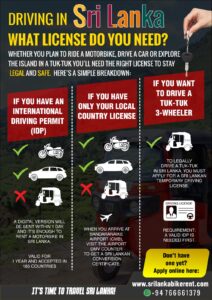
Here is the complete and accurate breakdown of what every Japanese tourist needs to drive legally in Sri Lanka:
For Motorcycles and Scooters:
- Valid Japanese driving license with the motorcycle category included
- International Driving Permit — digital version is acceptable
For Tuk-Tuks (Three-Wheelers):
- Valid Japanese driving license with the light vehicle category included
- International Driving Permit — physical booklet is required
- AAC Recognition Permit / Covering Permit issued by the AAC
For Cars:
- Valid Japanese driving license
- International Driving Permit — digital or physical, both accepted
A clear comparison at a glance:
| Vehicle | Licence Category Needed | IDP Needed | IDP Format | AAC Permit |
| Motorcycle / Scooter | Motorcycle category | Yes | Digital OK | Not required |
| Car | Standard car licence | Yes | Digital OK | Not required |
| Tuk-Tuk | Light vehicle category | Yes | Physical booklet only | Mandatory |
The single most important thing to understand from this table:
Tuk-tuks are the only vehicle that requires the AAC Recognition Permit. Motorcycles and cars do not. But if you want to drive a tuk-tuk, all three documents are non-negotiable.
Riding a Motorcycle in Sri Lanka as a Japanese Tourist
Sri Lanka is an extraordinary destination for motorcycle travel. The island offers an incredibly diverse range of riding experiences — from the flat coastal roads stretching along the western and southern shores to the winding mountain passes climbing through the central highlands.
Japanese tourists with a motorcycle license are well placed to enjoy all of it.
To ride legally, you need:
- A Japanese driving license that includes the motorcycle category
- A valid IDP — digital version is acceptable
No AAC permit. No extra trips to government offices. Just two straightforward documents and you are good to go.
One thing to be clear about — if your Japanese license covers only cars, it does not authorize you to ride a motorcycle in Sri Lanka. The motorcycle category must be specifically included on your license. Check this before you travel.
Quick checklist for motorcycle rental in Sri Lanka:
- Confirm your Japanese licence includes the motorcycle category
- Have your IDP ready — digital copy on your phone is fine
- Wear a helmet at all times — it is legally required
- Carry both your Japanese licence and IDP while riding
- Verify the rental bike comes with valid insurance and registration
Driving a Tuk-Tuk in Sri Lanka as a Japanese Tourist
Few travel experiences match the thrill of driving your own tuk-tuk through Sri Lanka. The winding coastal lanes, the busy market streets, and the quiet rural paths all take on a completely different character when you are behind the wheel of a three-wheeler.
But tuk-tuks have the most document requirements of any vehicle available to tourists. Every single document is mandatory — there are no shortcuts.
To drive a tuk-tuk legally in Sri Lanka, you need all three of the following:
- A Japanese driving license with the light vehicle category
- A physical IDP booklet from JAF
- An AAC Recognition Permit from the AAC in Colombo
The process flows in a specific order. First, you obtain the physical IDP from JAF in Japan before you travel. Then, in Sri Lanka, you take that physical IDP to the AAC office and they issue your Recognition Permit based on it. Once you hold all three documents, you are legally authorized to drive a tuk-tuk anywhere in Sri Lanka.
The AAC Recognition Permit is valid for one year from the date of issue.
How to Get Your AAC Permit — Step by Step
There are two ways to get your AAC Recognition Permit. One is the direct route through the AAC office. The other — and frankly the smarter option — is through your rental office before you even arrive in Sri Lanka.
Option 1 — Apply Directly at the AAC Office in Colombo
Step 1: Obtain your physical IDP booklet from JAF in Japan before departure.
Step 2: Arrive in Sri Lanka and head to the AAC office in Colombo, ideally on your first full day.
AAC Office Address: Automobile Association of Ceylon 40, Sir Macan Markar Mawatha, Galle Face, Colombo 03, Sri Lanka
Official website: Automobile Association of Ceylon
Step 3: Submit the following documents at the counter:
- Original Japanese driving license
- Physical IDP booklet
- Passport with valid entry stamp or visa
- Passport-size photographs (typically 2)
Step 4: Pay the fee of LKR 8,500.
Step 5: Collect your AAC Recognition Permit — usually issued the same day.
Option 2 — Apply Through Your Rental Office Before You Arrive
This is the option we strongly recommend for most travelers.
When you book your tuk-tuk rental, contact the rental company in advance and ask them to arrange your AAC Recognition Permit before your arrival. A good rental company will handle all the paperwork on your behalf and have your permit fully prepared and waiting for you when you land.
This means you can skip the AAC office visit entirely, collect your tuk-tuk, and start exploring Sri Lanka immediately.
Cost comparison:
| Application Method | Cost |
| Direct at AAC Office, Colombo | LKR 8,500 |
| Through your rental office | LKR 12,000 |
Yes, going directly is cheaper by LKR 3,500. But the rental office route saves you a full day of logistics in Colombo — traveling to the office, queuing, waiting for processing — which is time you could spend actually enjoying Sri Lanka.
For most visitors, the convenience is well worth the small extra cost.
At Boat Tours Sri Lanka, we arrange the AAC Recognition Permit in advance for all our tuk-tuk rental customers. Get in touch before your travel date and we will have everything ready for your arrival.
Driving a Car in Sri Lanka as a Japanese Tourist
Renting a car is a comfortable and practical option for families or anyone covering long distances across the island.
To drive a car legally in Sri Lanka, you need:
- A valid Japanese driving license
- A valid IDP — digital or physical, both are accepted
No AAC permit is required for cars. Keep your licence and IDP with you at all times and you are fully covered.
Sri Lanka’s road network connects all the major destinations across the island. The Southern Expressway makes the drive from Colombo to Galle fast and straightforward. The A1 highway through the hill country is one of the most scenic drives in all of Asia.
Sri Lanka Road Rules Every Foreign Driver Must Know
Before you get behind the wheel, take a few minutes to understand the key traffic laws in Sri Lanka. Ignorance of local rules is not an accepted excuse at a police checkpoint.
Drive on the LEFT. Sri Lanka and Japan share this traffic direction, which is a genuine advantage for Japanese drivers. You will feel naturally comfortable on Sri Lankan roads from the start.
Speed limits to follow:
- Built-up urban areas: 50 km/h
- Open rural roads: 70 km/h
- Expressways: 100 km/h
Laws you must follow:
- Seatbelts are compulsory for the driver and front passenger
- Motorcycle and tuk-tuk riders must wear a helmet at all times
- Mobile phone use while driving is illegal
- Drink driving carries severe penalties
- Pedestrians have right of way at marked crossings
What to expect on the road:
Sri Lankan roads — particularly in and around Colombo — can be intense. Buses frequently cut across lanes. Tuk-tuks weave through gaps that seem impossibly small. Motorbikes appear from unexpected directions. The key is to stay calm, be predictable in your own driving, and give other vehicles more space than you think you need.
Practical Tips for Driving in Sri Lanka
Here are the tips that will genuinely make your Sri Lanka driving experience better:
Handle all documents before you travel. If you are renting a tuk-tuk, arrange the AAC permit through your rental company in advance. Arrive in Sri Lanka with everything sorted.
Keep documents on your person at all times. Sri Lankan police do operate checkpoints, particularly on major routes. Always have your Japanese licence, IDP, and AAC permit (if applicable) accessible while driving.
Ease into local traffic gradually. Spend your first driving session on quieter back roads before attempting busy town centers or main highways. Give yourself time to adapt.
Watch out for unexpected road hazards. Animals crossing roads, deep potholes, unmarked speed bumps, and road flooding during heavy rain are all real hazards. Drive at a pace that gives you time to react.
Use offline maps. Remote areas of Sri Lanka have limited mobile coverage. Download Google Maps or Maps.me offline before leaving your accommodation.
Only rent from verified companies. Ask to see the vehicle’s insurance documents and registration certificate before accepting it. Reputable rental companies will have no problem showing these.
Plan around the monsoon seasons. The south-west monsoon affects the western and southern coasts from May to September. The north-east monsoon affects the northern and eastern regions from October to January. Road conditions can change dramatically during heavy rain. Check the Sri Lanka Meteorological Department for forecasts before long drives.
Fuel up when you can. In remote hill country areas, petrol stations can be few and far between. Top up whenever you see the opportunity rather than waiting until your tank is nearly empty.
FAQ
Q1: Is my Japan Driving License valid in Sri Lanka without any additional documents? No. Your Japanese driving license alone is not valid for driving in Sri Lanka. You need an IDP for motorcycles and cars. For tuk-tuks, you need a physical IDP plus an AAC Recognition Permit.
Q2: Can I use a digital IDP in Sri Lanka? For motorcycles and cars, yes — a digital IDP is acceptable. For tuk-tuks, you must have the physical printed IDP booklet. The AAC office needs to see the physical booklet to issue your Recognition Permit.
Q3: Where do I get an IDP in Japan? From the Japan Automobile Federation (JAF). Visit any JAF branch with your driving license, passport, one photograph, and approximately ¥3,000. The IDP is usually ready the same day.
Q4: Do I need the AAC permit for riding a motorcycle? No. Motorcycles only require a motorcycle-category Japanese license and a valid IDP. The AAC Recognition Permit is exclusively required for tuk-tuks.
Q5: Why does the AAC need my physical IDP to issue the Recognition Permit? The AAC office uses your physical IDP booklet as the reference document to verify your license category and issue the AAC Covering Permit. A digital copy does not serve this purpose and will not be accepted.
Q6: How much does the AAC Recognition Permit cost? LKR 8,500 if you visit the AAC office in Colombo directly. LKR 12,000 if arranged through a rental office — with the benefit that your permit is ready before you even arrive in Sri Lanka.
Q7: How long is the AAC Recognition Permit valid? One full year from the date of issue.
Q8: What is the simplest way to get the AAC permit as a tourist? Contact your tuk-tuk rental company before your travel date and ask them to arrange the AAC Recognition Permit on your behalf. They will have it ready for you on arrival, saving you a trip to the AAC office.
Q9: Do both Japan and Sri Lanka drive on the same side of the road? Yes — both Japan and Sri Lanka drive on the left side of the road. Japanese tourists will find this a significant advantage when adapting to driving in Sri Lanka.
Q10: What happens if I drive in Sri Lanka without the correct documents? Driving without the required documentation can result in fines, having your vehicle impounded, or other legal consequences. Always carry your full set of documents before driving anywhere in Sri Lanka.
Final Thoughts
So let’s return to the original question — is my Japan Driving License valid in Sri Lanka?
On its own, no. But with the right documents in place, it absolutely gives you the freedom to explore this beautiful island legally and independently.
Here is everything condensed into one simple summary:
Motorcycle or scooter — Japanese licence with motorcycle category plus a valid IDP. Digital IDP is fine. No AAC permit needed.
Car — Standard Japanese licence plus a valid IDP. Digital or physical both work. No AAC permit needed.
Tuk-tuk — Japanese licence with light vehicle category, a physical IDP booklet from JAF, and an AAC Recognition Permit from the AAC office in Colombo. All three are mandatory. The AAC issues the permit based on your physical IDP. The permit is valid for one year and costs LKR 8,500 direct or LKR 12,000 through your rental office — with the rental office route saving you considerable time and hassle by having everything ready before you land.
Prepare your IDP at JAF before leaving Japan. If tuk-tuk driving is part of your Sri Lanka plan, contact your rental company ahead of time and let them handle the AAC permit arrangement. Arrive ready, drive legally, and spend your energy discovering everything this incredible island has to offer.
Sri Lanka rewards travelers who explore it at their own pace. The open road here is unlike anywhere else in Asia — and now you know exactly how to make the most of it.