Table of Contents
- Why Getting This Right Matters More Than You Think
- Is My Austria Driving License Valid in Sri Lanka?
- The International Driving Permit — What It Is and Why You Need One
- Getting Your IDP in Austria — The Complete Process
- Your Document Checklist — Based on Your Vehicle Choice
- Riding a Motorcycle or Scooter in Sri Lanka
- Driving a Car in Sri Lanka
- Driving a Tuk-Tuk — What Nobody Else Tells You Correctly
- The AAC Recognition Permit — Fully Explained
- How to Get Your AAC Permit — Step by Step
- AAC Permit Cost Breakdown — Direct vs Rental Office
- Driving in Sri Lanka — Rules and Realities for Austrian Tourists
- How to Get Around Sri Lanka — All Your Options
- Frequently Asked Questions
- Summary — Your Quick Reference Before You Travel
1. Why Getting This Right Matters More Than You Think
Every year, thousands of European tourists land in Sri Lanka, walk up to a vehicle rental counter, and discover that they are missing a document they had absolutely no idea they needed.
Some get turned away by reputable rental companies. Others drive without the correct paperwork and face fines, confiscated vehicles, or worse — a road accident with no valid insurance to cover them.
The truth is that driving legally in Sri Lanka as a foreign tourist is completely achievable. But the exact requirements depend on which vehicle you plan to drive. And the rules for tuk-tuks in particular involve a step that almost every travel blog on the internet still describes incorrectly.
If you are an Austrian tourist planning to drive in Sri Lanka — whether on a scooter, in a car, or behind the wheel of a tuk-tuk — this guide gives you the fully accurate and reliable information you need before you travel.
Starting with the most important question of all.
Is my Austria Driving License valid in Sri Lanka?
2. Is My Austria Driving License Valid in Sri Lanka?
The direct answer is no — not by itself.
Sri Lanka does not recognize any foreign driving license, including EU licenses issued by Austria, as a standalone document for driving on its roads. This is established under the Sri Lanka Motor Traffic Act and applies to every foreign national regardless of their country of origin or how experienced they are as a driver.
To drive legally in Sri Lanka, every Austrian tourist must carry at minimum:
- ✅ Their original Austrian driving license
- ✅ A valid International Driving Permit (IDP)
Both documents must be carried together at all times. Presenting only one of them to traffic police or a rental company is not legally sufficient.
Beyond that, the full set of documents you need changes based on your vehicle choice. Tuk-tuks require an additional permit that motorcycles and cars do not. And the format of your IDP — physical or digital — also matters depending on what you are driving.
The sections below break all of this down clearly and accurately so you know exactly what to prepare before you leave Austria.
3. The International Driving Permit — What It Is and Why You Need One
An International Driving Permit is an internationally standardized document that presents your driving license information in 12 languages. It allows authorities and rental companies in foreign countries to verify that you hold a valid license without needing to understand the language or layout of your home country’s document.
The IDP works exclusively as a companion to your Austrian license. It cannot be used independently and carries no legal weight without your original national license presented alongside it.
Sri Lanka recognizes IDPs issued under two internationally accepted conventions:
- The 1949 Geneva Convention on Road Traffic
- The 1968 Vienna Convention on Road Traffic
Both are formally recognized under Sri Lankan law, which means an IDP issued in Austria by an authorized body is fully valid for use in Sri Lanka.
Physical vs Digital IDP — Why the Format Matters in Sri Lanka
This is a detail that most travel guides overlook entirely, and it is genuinely important.
The format of your IDP is not interchangeable across all vehicle types in Sri Lanka:
- Motorcycles and cars — a digital IDP is acceptable
- Tuk-tuks (three-wheelers) — a physical IDP booklet is mandatory
The reason the physical booklet is essential for tuk-tuks goes beyond a simple rule. The AAC Recognition Permit required to legally drive a tuk-tuk in Sri Lanka is issued directly based on your physical IDP booklet. The AAC officer reviews your physical document as part of the application process. Without it, the permit simply cannot be issued.
The smartest approach for any Austrian tourist is to always obtain a physical IDP booklet from the start. It covers every vehicle type and eliminates any risk of being caught short when you arrive.
Learn more about international driving permits via the FIA International Driving Permit information page.
APPLY FOR INTERNATIONAL DRIVING PERMIT !
4. Getting Your IDP in Austria — The Complete Process
Obtaining an IDP in Austria is refreshingly simple. Here is the complete step-by-step process.
Authorized Issuers in Austria
Only two organizations in Austria are officially authorized to issue IDPs to Austrian license holders:
ÖAMTC — Österreichischer Automobil-, Motorrad- und Touring Club Website: www.oeamtc.at
ARBÖ — Auto-, Motor- und Radfahrerbund Österreichs Website: www.arboe.at
Both have branch offices across Austria. Walk-in applications are welcome and the process is typically completed the same day.
Documents to Bring
- Your current valid Austrian driving license
- Two recent passport-sized photographs
- Your Austrian passport or national identity card
- The application fee — usually between €15 and €20
Timing Your Application
Apply at least three to four weeks before your departure. While same-day issuance is standard, building in extra time removes any risk if there are unexpected delays.
Always Request the Physical Booklet
Regardless of whether a digital option is available, always request and collect the physical IDP booklet. As explained above, this is essential for tuk-tuk driving and for the AAC permit application process.
IDP Validity Period
Your IDP is valid for 12 months from the date it is issued. If your trip to Sri Lanka falls close to the expiry date, apply for a fresh one before you travel. An expired IDP is treated as no IDP at all.
5. Your Document Checklist — Based on Your Vehicle Choice
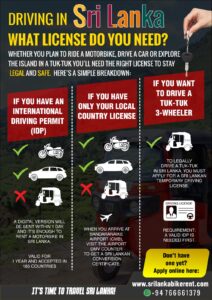
Here is your complete and accurate document checklist, organized by vehicle type:
For Motorcycles and Scooters:
- ✅ Valid Austrian driving license with motorcycle category
- ✅ International Driving Permit — digital version acceptable
For Cars:
- ✅ Valid Austrian driving license (standard)
- ✅ International Driving Permit — digital version acceptable
For Tuk-Tuks (Three-Wheelers):
- ✅ Valid Austrian driving license with light vehicle category
- ✅ International Driving Permit — physical booklet required
- ✅ AAC Recognition Permit from the Automobile Association of Ceylon
In table format for easy reference:
| Vehicle | License Category Needed | IDP Format | Extra Permit |
| Motorcycle / Scooter | Motorcycle category | Digital or Physical | ❌ Not required |
| Car | Standard | Digital or Physical | ❌ Not required |
| Tuk-Tuk | Light vehicle category | Physical only | ✅ AAC Recognition Permit |
The single biggest takeaway here — tuk-tuks are in a category of their own under Sri Lankan law and require one additional document that motorcycles and cars simply do not.
6. Riding a Motorcycle or Scooter in Sri Lanka
For Austrian tourists who hold a motorcycle license category, riding a scooter or motorbike through Sri Lanka is one of the most liberating travel experiences imaginable.
The requirements to ride legally are straightforward:
- ✅ Austrian driving license with motorcycle category (A or A1)
- ✅ Valid IDP — digital or physical both accepted
No further permits are needed. With these two documents in hand, you are free to ride throughout Sri Lanka.
What to Know Before Renting a Bike
Motorcycle and scooter rentals are plentiful in all major tourist zones — Negombo, Hikkaduwa, Mirissa, Ella, Kandy, Arugam Bay, and Trincomalee among them. Daily rental costs typically fall between LKR 3,000 and LKR 6,000 (roughly $10 to $15).
Before accepting a rental bike, always do the following without exception:
- Test the brakes, horn, lights, and tires yourself
- Photograph all existing scratches and damage before signing anything
- Confirm that third-party insurance is included in the rental agreement
- Request a written rental contract and keep your copy
Wearing a helmet is compulsory under Sri Lankan law. Always wear one, even for short distances. If the rental operator does not supply one, rent or purchase a helmet separately.
7. Driving a Car in Sri Lanka
Renting and driving a car in Sri Lanka as an Austrian tourist is equally uncomplicated from a documentation standpoint.
To drive a car legally in Sri Lanka you need:
- ✅ Your standard Austrian driving license
- ✅ A valid IDP — digital or physical both accepted for cars
No extra permits are required. Carry both documents together and you are fully covered.
Choosing Between Self-Drive and Chauffeur-Driven
Self-drive car rental suits confident drivers who are comfortable adapting quickly to left-hand traffic. It offers complete flexibility to explore at your own pace and on your own schedule.
Hiring a chauffeur-driven car is an extremely popular option among European tourists and is particularly well-suited to longer journeys — Colombo to Kandy, Kandy to Nuwara Eliya, or the hill country down to the south coast. Drivers typically know the roads intimately and many are remarkably knowledgeable about local history, culture, and the best places to eat and stop along any given route.
8. Driving a Tuk-Tuk — What Nobody Else Tells You Correctly
This section contains information that the vast majority of travel websites and blogs still get completely wrong. Read it carefully.
Self-driving a tuk-tuk through Sri Lanka is one of the most exciting and memorable travel experiences the island offers. Rolling through rural villages, coastal towns, and jungle tracks in your own three-wheeler is something tourists talk about for years afterward.
But here is the reality that most guides miss entirely.
Tuk-tuks are legally classified as a separate vehicle category under Sri Lankan motor traffic law. They are not simply treated as cars under a standard light vehicle license. As a result, the document requirements for legally driving a tuk-tuk are different — and more involved — than for cars or motorcycles.
To legally self-drive a tuk-tuk in Sri Lanka as an Austrian tourist, you must have all three of the following:
- ✅ Your Austrian driving license with light vehicle category — note this is light vehicle, not motorcycle category
- ✅ A physical IDP booklet — digital IDPs are not accepted for tuk-tuks under any circumstances
- ✅ An AAC Recognition Permit from the Automobile Association of Ceylon
All three are non-negotiable. If even one is missing, you are not legally covered to drive a tuk-tuk in Sri Lanka.
The AAC Recognition Permit is the document that most travel blogs either ignore entirely or describe incorrectly as a Temporary Driving License from the Department of Motor Traffic. It is neither of those things. It is a specific permit issued by the Automobile Association of Ceylon and it is the correct and accurate requirement for tuk-tuk drivers.
9. The AAC Recognition Permit — Fully Explained
The AAC Recognition Permit — sometimes referred to as the Covering Permit — is an official document issued by the Automobile Association of Ceylon (AAC) that formally recognizes your foreign driving qualifications for the purpose of operating a three-wheeler in Sri Lanka.
This permit is specific to tuk-tuks. Motorcycles and cars do not require it.
The Critical Link Between Your Physical IDP and the AAC Permit
Here is something that is essential to understand — and that almost no other guide explains properly.
The AAC Recognition Permit is issued directly based on your physical IDP booklet. When you apply at the AAC office or through your rental company, your physical IDP is reviewed and used as the foundational document for processing and issuing the Recognition Permit.
This is precisely why the physical IDP booklet is an absolute requirement for tuk-tuk drivers. The AAC cannot issue the Recognition Permit based on a digital IDP. Without the physical booklet in your possession, the entire application process cannot proceed.
The document chain for tuk-tuk drivers therefore works like this:
Austrian License → Physical IDP Booklet (from ÖAMTC or ARBÖ in Austria) → AAC Recognition Permit (from AAC in Sri Lanka)
Each document in this chain depends on the previous one. Missing any link breaks the entire chain.
AAC Recognition Permit Validity
The permit is valid for one year from the date of issue. This means a single permit covers all tuk-tuk driving in Sri Lanka within a 12-month window — useful for tourists who make multiple visits to Sri Lanka within the same year.
Official information about the Automobile Association of Ceylon is available at www.aac.lk.
10. How to Get Your AAC Permit — Step by Step
There are two routes to obtaining the AAC Recognition Permit. Here is an honest look at both.
Route 1 — Through Your Tuk-Tuk Rental Office (Highly Recommended)
This is the option that most experienced Sri Lanka travelers and repeat visitors strongly recommend. It is faster, more convenient, and means your permit is ready before you even arrive.
Step 1 — Book your tuk-tuk rental and notify the company about the AAC permit. When arranging your tuk-tuk rental, inform your rental provider that you need an AAC Recognition Permit. Send them a copy of your Austrian license and IDP details ahead of your arrival.
Step 2 — Your rental office handles the entire application with the AAC. The rental company submits your application and processes the permit through the AAC on your behalf. You do not need to visit any office or deal with any paperwork yourself.
Step 3 — Collect your tuk-tuk and your permit together on arrival. When you arrive to pick up your tuk-tuk, your AAC Recognition Permit is already prepared and included with your rental documentation. You walk out the door fully legal and ready to explore.
This route saves you a trip to central Colombo, eliminates waiting time at the AAC office, and means your holiday starts the moment you arrive — not after a morning of administrative paperwork.
APPLY FOR AAC CONVERTIN PERMIT!
Route 2 — Apply Directly at the AAC Office in Colombo
If you prefer to handle the process yourself, or if your rental provider does not offer the advance application service, visiting the AAC office directly is a straightforward option.
Automobile Association of Ceylon (AAC) Website: www.aac.lk
What to Bring
- Original Austrian driving license with light vehicle category
- Physical IDP booklet — this is mandatory and cannot be replaced with a digital version
- Valid passport with a current Sri Lankan visa
- Recent passport-sized photographs
- The permit fee in Sri Lankan Rupees (see Section 11)
Practical Tips for Visiting the AAC Office
Go as early in your trip as possible to avoid losing travel days. Contact the AAC directly through their official website before visiting to confirm current office hours, fees, and any updated requirements. Having all your documents organized and ready before you arrive will make the process as smooth and quick as possible.
11. AAC Permit Cost Breakdown — Direct vs Rental Office
The cost of the AAC Recognition Permit varies depending on how you choose to obtain it:
| Method | Cost |
| Direct at the AAC office in Colombo | LKR 8,500 |
| Through your tuk-tuk rental office | LKR 12,000 |
The difference of LKR 3,500 (approximately €10) covers the administrative service your rental company provides — managing the application, liaising with the AAC, and having your permit prepared in advance of your arrival.
For most tourists, this is a worthwhile investment. Ten euros to save a morning of paperwork and a trip across Colombo is a reasonable trade-off, especially on a short trip where every day counts.
If you are traveling on a tighter budget and have flexibility in your schedule early in your trip, visiting the AAC office directly at LKR 8,500 is a perfectly reasonable choice.
Factor this permit cost into your tuk-tuk rental budget from the beginning so there are no surprises when you arrive in Sri Lanka.
12. Driving in Sri Lanka — Rules and Realities for Austrian Tourists
With your documents organized, the next thing to prepare for is the road itself. Driving in Sri Lanka is a genuinely different experience from Austria, and a few key adjustments will make your time on the road significantly safer and more enjoyable.
Traffic Flows on the LEFT
This is the most fundamental adjustment for any Austrian driver. Sri Lanka drives on the left side of the road — a legacy of British colonial rule. The steering wheel is on the right side of the vehicle and all overtaking happens on the right.
Coming from Austria where traffic flows on the right, this reversal takes real concentration. Be especially careful at roundabouts, junctions, when making turns, and whenever you pull out after stopping. Give yourself a day or two of gentle, low-traffic driving before tackling busy urban roads or highways.
Speed Limits to Know
- Built-up areas and towns: 50 km/h
- Open rural roads: 70 km/h
- Expressways and highways: 100 to 120 km/h
Speed enforcement has increased significantly in recent years, particularly on the Southern Expressway and in school zones.
The Meaning of Honking
Austrian drivers are accustomed to horn use being reserved for genuine emergencies or expressions of frustration. In Sri Lanka it means none of those things. Horns are used constantly and casually to communicate — signaling overtaking intentions, warning pedestrians, greeting other drivers at blind corners. It is simply part of how Sri Lankan roads function. Use yours freely when the situation calls for it.
The Road Is Shared With Everyone
Motorcycles, tuk-tuks, buses, cyclists, vendors, pedestrians, stray animals, and occasionally wild elephants near national park boundaries all share the same tarmac. Drive at a pace that gives you time to react to whatever appears around the next corner.
Do Not Drive Rural Roads at Night
Outside of Colombo, Kandy, and Galle, road lighting is minimal to nonexistent. Unlit vehicles, pedestrians walking along the roadside, and unmarked hazards make night driving on rural roads unnecessarily risky. Plan your route to reach your destination before dark wherever possible.
Keep Your Documents Accessible
Police checkpoints are a regular feature on Sri Lankan roads, especially near tourist areas and on main expressways. Keep your Austrian license, IDP, and any additional permits within easy reach at all times. If you are driving a tuk-tuk, your AAC Recognition Permit must also be on your person.
Legal Requirements for All Drivers
Seat belts are compulsory for all vehicle occupants. The legal blood alcohol limit is 0.08% BAC. Given how different and demanding Sri Lankan roads can be for first-time visitors, driving with zero alcohol is the safest and most sensible approach throughout your entire trip.
Current and official traffic regulations are available through the Sri Lanka Police website.
13. How to Get Around Sri Lanka — All Your Options
Sri Lanka offers Austrian tourists a genuinely excellent range of transport options. Here is a clear and practical overview of everything available to you.
Scooter or Motorcycle
With your Austrian motorcycle license and a valid IDP, renting a scooter or motorbike gives you unmatched freedom. You can explore at your own pace, stop wherever you choose, and reach corners of Sri Lanka that organized tours and larger vehicles simply cannot access.
Rental costs run between LKR 2,500 and LKR 5,000 per day. Inspect every bike carefully before accepting it, confirm insurance coverage, and always ride with a helmet.
Rental Car — Self-Drive
A self-drive car is ideal for those comfortable with left-hand driving who want comfort and flexibility for longer journeys. Well-suited to couples, families, or small groups covering significant distances between destinations.
Rental Car — With Driver
Hiring a car with a local driver is a favourite among European tourists for very good reason. All the navigation and traffic management is handled for you, while you focus entirely on enjoying the journey. Drivers are typically experienced, personable, and full of local knowledge about where to eat, what to see, and which roads are worth taking.
Self-Drive Tuk-Tuk
For the adventurous traveler who wants a truly unique Sri Lanka experience, self-driving a tuk-tuk is something you will never forget. Get your Austrian license, physical IDP, and AAC Recognition Permit sorted in advance — ideally through your rental office — and the whole island opens up to you at three-wheel speed.
Tuk-Tuk with Driver
For getting around town centers, beaches, and local markets without any document requirements on your side, hiring a tuk-tuk with a driver is cheap, fun, and completely stress-free. Agree on the fare before you get in and enjoy one of the most iconic Sri Lankan experiences there is.
Lagoon and Canal Boat Tours
If your itinerary includes the Negombo area on Sri Lanka’s western coast, exploring the Negombo Lagoon and its mangrove-lined canal network by boat is an experience that stands entirely apart from anything you will find on the road. Eco-friendly boat tours through the lagoon offer extraordinary wildlife sightings, peaceful natural scenery, and a genuine connection with local fishing communities — and are among the most memorable experiences Sri Lanka has to offer any visitor.
Frequently Asked Questions
Q1: Is my Austria Driving License valid in Sri Lanka without any other document?
No. Your Austrian license is not valid as a standalone document in Sri Lanka. You must always carry it together with a valid International Driving Permit. Additional documents are also required if you plan to drive a tuk-tuk.
Q2: Can I use a digital IDP in Sri Lanka?
For motorcycles and cars, yes — a digital IDP is acceptable. For tuk-tuks, no — a physical IDP booklet is mandatory. The physical booklet is also required as the basis for obtaining the AAC Recognition Permit for tuk-tuks.
Q3: Why do tuk-tuks need a physical IDP when other vehicles don’t?
Because the AAC Recognition Permit — which is required specifically for tuk-tuks — is issued based on your physical IDP booklet. The AAC officer reviews your physical document during the application process. Without the physical booklet, the Recognition Permit cannot be issued.
Q4: What category must be on my Austrian license to drive a tuk-tuk?
You need a light vehicle category on your Austrian license to drive a tuk-tuk in Sri Lanka. A motorcycle category is not sufficient for three-wheelers.
Q5: How much does the AAC Recognition Permit cost?
The cost is LKR 8,500 if you apply directly at the AAC office in Colombo, or LKR 12,000 if you apply through your tuk-tuk rental office. The higher cost through the rental office covers the service of having your permit prepared and ready before your arrival.
Q6: How long is the AAC Recognition Permit valid for?
It is valid for one year from the date of issue. A single permit covers all tuk-tuk driving in Sri Lanka within that 12-month period.
Q7: What is the easiest way to get the AAC permit as a tourist?
Apply through your tuk-tuk rental office before you travel. They manage the entire process with the AAC on your behalf and have your permit ready when you arrive to collect your vehicle. This is far more convenient than visiting the AAC office yourself during your trip.
Q8: Can I get an IDP after arriving in Sri Lanka?
No. IDPs can only be issued by an authorized automobile association in your home country. In Austria, that means ÖAMTC or ARBÖ. You cannot obtain an IDP once you are already in Sri Lanka.
Q9: Does my Austrian insurance cover me when driving in Sri Lanka?
No. Austrian motor insurance does not extend to Sri Lanka. Always ensure your rental vehicle includes valid local third-party insurance. Check your travel insurance policy as well to understand what vehicle coverage applies during your trip.
Q10: What documents should I always carry when driving in Sri Lanka?
For motorcycles and cars — your original Austrian license and your valid IDP. For tuk-tuks — your Austrian license, physical IDP booklet, and AAC Recognition Permit. Always carry originals, not photocopies.
15. Summary — Your Quick Reference Before You Travel
Before you book your flights, here is your complete at-a-glance checklist:
If you are riding a motorcycle or scooter:
- Get your IDP from ÖAMTC or ARBÖ in Austria — digital or physical both fine
- Carry your Austrian motorcycle license and IDP together at all times
- No additional permits needed
If you are driving a car:
- Get your IDP from ÖAMTC or ARBÖ in Austria — digital or physical both fine
- Carry your standard Austrian license and IDP together at all times
- No additional permits needed
If you are self-driving a tuk-tuk:
- Get a physical IDP booklet from ÖAMTC or ARBÖ — digital is not acceptable
- Confirm your Austrian license includes the light vehicle category
- Contact your tuk-tuk rental office in advance to arrange your AAC Recognition Permit
- Permit costs LKR 8,500 direct at AAC or LKR 12,000 through your rental office
- Permit is valid for one year from date of issue
Sort everything before you fly, give yourself time to adjust to left-hand driving when you land, and then go and explore one of the most spectacular islands on earth.
Sri Lanka is extraordinary. Drive safely and enjoy every single kilometre of it.