Table of Contents
- The Straight Answer: Is My Australian Driving Licence Valid in Sri Lanka?
- Breaking Down the International Driving Permit
- Getting Your IDP in Australia: State-by-State Guide
- The Tuk-Tuk Revolution: What Australian Drivers Need to Know
- AAC Recognition Permit: Your Ticket to Three-Wheeler Freedom
- Two Ways to Get Your AAC Recognition Permit
- Document Checklist: What You Need for Each Vehicle
- Motorcycle, Car, or Tuk-Tuk: Choosing Your Sri Lankan Ride
- Sri Lankan Traffic Culture: What Shocks Australian Drivers
- Safety Reality Check for Australian Drivers
- Smart Rental Strategies for Australians
- FAQs
1. The Straight Answer: Is My Australian Driving Licence Valid in Sri Lanka?
Is my Australian Driving Licence valid in Sri Lanka? Let’s answer this clearly right from the start.
No, your Australian licence alone won’t get you on the road in Sri Lanka.
But here’s where it gets interesting.
The permits you need depend entirely on what you want to drive. And many Australians are shocked to discover they can legally drive tuk-tuks with just their regular car licence.
Quick breakdown:
Driving a car? You need your Australian licence plus an International Driving Permit.
Riding a motorcycle? You need your Australian motorcycle licence plus an International Driving Permit.
Driving a tuk-tuk? You need your Australian car licence, a physical International Driving Permit booklet, AND an AAC Recognition Permit from Sri Lanka.
This applies whether you’re from Sydney, Melbourne, Brisbane, Adelaide, Perth, Hobart, or anywhere else in Australia.
The good news? Getting properly licensed is straightforward when you know the system.
2. Breaking Down the International Driving Permit
Let’s talk about the International Driving Permit (IDP) — what it is and why Sri Lanka requires it.
Think of the IDP as a translation service for your Australian licence.
It converts your licence details into multiple languages, including Sinhala and Tamil (Sri Lanka’s official languages). Without this translation, Sri Lankan authorities cannot verify your driving credentials.
Important IDP facts:
- Based on the 1949 Geneva Convention on Road Traffic
- Valid for exactly 12 months from issue
- Works only when carried with your original Australian licence
- Costs around $39 AUD
- Cannot be obtained outside Australia
Here’s the crucial distinction many Australians miss:
IDPs come in two formats — digital and physical booklet.
For cars and motorcycles, the digital version works perfectly fine.
But for tuk-tuks, you must have the physical booklet. Why? Because the AAC (Automobile Association of Ceylon) needs to see and process the physical document to issue your Recognition Permit.
Learn more about IDPs at the Australian Automobile Association website.
3. Getting Your IDP in Australia: State-by-State Guide
Here’s exactly where to get your International Driving Permit before you fly.
Your state determines which organisation handles IDP applications:
New South Wales → NRMA Victoria → RACV
Queensland → RACQ Western Australia → RAC WA South Australia → RAA Tasmania → RACT ACT / Northern Territory → NRMA or local authority
What to bring:
- Your current Australian driving licence (must be valid)
- One passport-style photograph
- Application form (get it online or at the office)
- Payment ($39 approximately)
Processing speed: Walk in, walk out same day at most locations.
Critical choice: Planning to drive tuk-tuks? Request the physical booklet, not just digital access. Make this clear when applying.
Timing tip: Apply 3-4 weeks before your departure. This gives you buffer time if there are any delays or if you need to make changes.
APPLY FOR INTERNATIONAL DRIVING PERMIT !
4. The Tuk-Tuk Revolution: What Australian Drivers Need to Know
This section changes everything you thought you knew about driving in Sri Lanka.
Can you legally drive a tuk-tuk with your Australian car licence?
Absolutely yes!
This surprises most Australians because it sounds too good to be true. But it’s completely legal and legitimate.
You don’t need special training, special courses, or special endorsements from Australia. Your standard car licence (Class C or equivalent light vehicle category) qualifies you.
The catch?
You need one additional document that motorcycles and cars don’t require: the AAC Recognition Permit.
This is where many travelers get confused or give up. But the process is actually simple.
Here’s the reality:
Cars and motorcycles → Just need your licence and IDP to drive legally
Tuk-tuks → Need your licence, physical IDP, AND the AAC Recognition Permit
That extra permit is your golden ticket to exploring Sri Lanka in the most authentic, fun, and flexible way possible — behind the wheel of your own three-wheeler.
Why this matters:
Tuk-tuks let you access places rental cars can’t reach. Narrow village lanes, steep mountain roads, tight parking spaces, crowded markets — tuk-tuks navigate them all effortlessly.
Plus, you’ll spend a fraction of what car rental costs, and fuel consumption is minimal.
5. AAC Recognition Permit: Your Ticket to Three-Wheeler Freedom
Let’s demystify the AAC Recognition Permit, also known as the Covering Permit.
What is it?
It’s an official document issued by the Automobile Association of Ceylon that specifically authorizes foreign drivers to operate three-wheelers in Sri Lanka.
Why only for tuk-tuks?
Sri Lankan traffic law treats three-wheelers as a distinct vehicle category. While your IDP covers standard vehicles, it doesn’t extend to three-wheelers without this additional authorization.
Key details:
- Issued exclusively by the AAC
- Based on your physical IDP booklet
- Valid for one full year (365 days from issue)
- Not tied to your visa duration
- Covers you for multiple trips within that year
Pricing:
Direct from AAC office: 8,500 LKR (approximately $28 AUD) Through rental company: 12,000 LKR (approximately $40 AUD)
Why pay extra through a rental company?
Convenience. They handle all paperwork in advance, and your permit is ready when you arrive. No navigating Colombo traffic, no waiting at government offices, no language barriers.
For an extra $12, most travelers find this worthwhile.
The AAC location:
Automobile Association of Ceylon
40 Sir Macan Markar Mawatha
Galle Face, Colombo 03
📞 +94 11 242 1528
🌐 www.aaceylon.lk
6. Two Ways to Get Your AAC Recognition Permit
You have two routes to getting your tuk-tuk permit. Choose based on your travel style and priorities.
Route 1: Pre-Arranged Through Rental Company (Easiest)
Before Departure:
Get your physical IDP booklet from your state motoring authority in Australia. Confirm it’s the physical version, not digital.
During Booking:
Contact your tuk-tuk rental company (research reputable operators before your trip). Tell them you need the AAC Recognition Permit prepared.
Document Submission:
Email or upload digital copies:
- Australian driving licence (front and back)
- Physical IDP booklet (all pages)
- Passport (photo page)
- Sri Lanka visa/ETA confirmation
Payment:
Transfer 12,000 LKR (around $40 AUD) to the rental company.
Upon Arrival:
Collect your tuk-tuk and your AAC Recognition Permit together. You’re immediately legal to drive.
Advantages: Zero hassle, saved time, no Colombo navigation required, ready to go instantly.
APPLY FOR AAC CONVERTIN PERMIT!
Route 2: DIY at AAC Office (Budget Option)
Before Departure:
Get your physical IDP booklet in Australia.
In Sri Lanka:
Head to the Automobile Association of Ceylon office in Colombo within your first few days.
Bring These Documents:
- Original Australian driving licence
- Physical IDP booklet (original)
- Passport
- Valid Sri Lankan visa/ETA
- Two passport photographs
- Completed AAC application form (available at office)
Payment:
Pay 8,500 LKR in cash at the office.
Processing:
Typically issued within 2-4 hours. Some travelers get it same day, others return the next morning.
Advantages: Save approximately $12, direct interaction with AAC staff.
Disadvantages: Time spent finding and traveling to the office, possible waiting time, navigating busy Colombo.
Bottom line: Most Australian travelers choose Route 1 for convenience, especially on shorter trips.
7. Document Checklist: What You Need for Each Vehicle
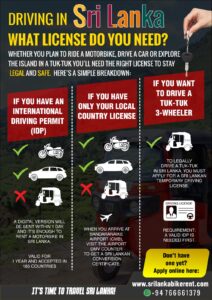
Let’s eliminate confusion with clear checklists for each vehicle type.
Driving Cars in Sri Lanka
Required documents:
✅ Valid Australian driving licence (original)
✅ International Driving Permit (digital or physical)
Optional documents:
📄 Photocopies of both as backup
That’s it! No AAC permit needed.
Riding Motorcycles or Scooters in Sri Lanka
Required documents:
✅ Valid Australian driving licence with motorcycle category/endorsement (original)
✅ International Driving Permit (digital or physical)
Critical note: If your Australian licence doesn’t include motorcycle category, you cannot legally ride any two-wheeled vehicle in Sri Lanka, including small scooters.
That’s it! No AAC permit needed.
Driving Tuk-Tuks (Three-Wheelers) in Sri Lanka
Required documents:
✅ Valid Australian driving licence with light vehicle/car category (original)
✅ International Driving Permit (physical booklet required, digital won’t work)
✅ AAC Recognition Permit (Covering Permit)
Also carry:
📄 Passport
📄 Valid Sri Lanka visa/ETA
Remember: Always carry ALL documents while driving. Police checkpoints happen frequently on major routes.
8. Motorcycle, Car, or Tuk-Tuk: Choosing Your Sri Lankan Ride
Now that you understand the permit requirements, let’s explore what each option offers.
Cars: Comfort and Protection
What your Australian car licence permits:
Standard sedans, SUVs, 4WDs, light vans — basically any passenger vehicle under light vehicle category.
Advantages:
- Air conditioning for tropical heat
- Protection from rain and sun
- Luggage space for longer trips
- Familiar driving experience
- Better visibility in chaotic traffic
Disadvantages:
- Higher rental costs ($30-60 USD daily)
- Difficult parking in cities and villages
- Can’t access narrow lanes or hidden spots
- Higher fuel consumption
Best for: Families, comfort seekers, long-distance travel, wet season visits.
Motorcycles: Freedom and Flexibility
What your Australian motorcycle licence permits:
Any motorcycle or scooter, from 50cc scooters to large touring bikes.
Advantages:
- Navigate traffic easily
- Low rental costs ($10-20 USD daily)
- Park anywhere
- Excellent fuel economy
- Thrilling coastal and mountain rides
Disadvantages:
- Exposure to weather and elements
- Requires motorcycle riding experience
- Limited luggage capacity
- More vulnerable in traffic
- Challenging on Sri Lanka’s chaotic roads
Best for: Experienced riders, solo travelers, coastal exploration, adventure seekers.
Tuk-Tuks: The Sweet Spot
What your Australian car licence permits (with AAC Recognition Permit):
Any three-wheeler/tuk-tuk available for rent.
Advantages:
- Authentic Sri Lankan experience
- Low cost ($15-25 USD daily)
- Navigate narrow village lanes
- Easy parking everywhere
- Fun and memorable
- Some weather protection (roof)
- More stable than motorcycles
Disadvantages:
- Limited speed (comfortable up to 60 km/h)
- Basic comfort level
- No air conditioning
- Open sides (some rain/dust exposure)
- Requires defensive driving
Best for: Adventure couples, cultural explorers, photography enthusiasts, beach hoppers, budget travelers.
9. Sri Lankan Traffic Culture: What Shocks Australian Drivers
Is my Australian Driving Licence valid in Sri Lanka becomes more complex when you experience actual road conditions.
Driving in Sri Lanka feels nothing like Australia. Here’s what to expect.
The Honking Symphony
Horns blast constantly — not from anger, but as communication. Drivers honk to announce their presence, request space, greet friends, warn pedestrians, and just because.
Get comfortable using your horn. It’s not rude; it’s expected.
Creative Lane Usage
Lane markings exist more as suggestions than rules. Vehicles weave, merge, and create lanes that don’t officially exist. Three lanes become five during rush hour.
The Unwritten Rules
Right of way goes to: The bigger vehicle, the more aggressive driver, or whoever committed first. Unlike Australia’s strict give-way rules, Sri Lankan roads operate on negotiation and assertion.
Speed bumps appear: Without warning or signage. Slow down in villages and near schools.
Animals share the road: Cows, dogs, chickens, and water buffalo wander freely. They have unofficial right-of-way everywhere.
Traffic Light Etiquette
Red lights are generally respected in cities, but enforcement varies. In rural areas, lights might be treated more casually, especially late at night.
The Overtaking Culture
Drivers overtake on blind curves, uphill climbs, and narrow roads. Oncoming traffic flashes headlights to warn of their approach during overtakes.
Parking Anywhere Philosophy
If there’s space, it’s parking. Sidewalks, corners, middle of streets during quiet times — all fair game.
Learn more about road safety from the Sri Lankan Department of Motor Traffic.
10. Safety Reality Check for Australian Drivers
Let’s talk honestly about safety concerns when driving in Sri Lanka.
The truth: Sri Lankan roads are more dangerous than Australian roads by statistical measures.
But thousands of international drivers (including Australians) drive successfully every day by understanding and respecting local conditions.
Real Challenges
Urban chaos: Colombo and major cities feature aggressive driving, minimal personal space between vehicles, and constant sensory overload.
Rural surprises: Country roads have unexpected obstacles — pedestrians walking in traffic lanes, parked vehicles without warning, livestock, potholes, unmarked construction zones.
Night driving: Limited street lighting makes night driving particularly hazardous. Avoid it when possible.
Weather factors: Monsoon rains create flash flooding, reduced visibility, and slippery surfaces. Roads wash out in heavy rain.
Infrastructure gaps: Guard rails are rare on mountain roads. Shoulders often don’t exist. Cliffs drop directly from road edges.
Safety Strategies
Start slow: Begin with quiet roads to build confidence before tackling busy areas.
Morning advantage: Early morning traffic is lighter and more manageable.
Expressways first: The Southern Expressway offers modern, safer driving to build confidence.
Defensive mindset: Assume nothing. Expect the unexpected. Leave space.
Helmet compliance: Always wear helmets on motorcycles and tuk-tuks. It’s legally required and potentially life-saving.
Avoid alcohol: Zero tolerance policy. Penalties are severe.
Insurance verification: Confirm your travel insurance covers your specific vehicle type with proper permits.
Alternative Approach
Many experienced travelers use a hybrid strategy:
- Hire drivers for Colombo and long highway stretches
- Self-drive tuk-tuks or motorcycles in quieter coastal towns
- Use drivers for stressful routes, go solo for scenic exploration
This balances safety, authenticity, and adventure.
11. Smart Rental Strategies for Australians
Let’s explore your practical options for getting around Sri Lanka.
Self-Drive Tuk-Tuk
Total cost breakdown:
- Tuk-tuk rental: $15-25 USD per day
- AAC Recognition Permit (one-time): 12,000 LKR (~$40 AUD) through rental company
- Fuel: Extremely economical, around $5-10 USD daily depending on distance
Who it suits: Adventurous couples or solo travelers wanting authentic experiences, flexibility to explore hidden spots, and budget-friendly transport.
Rental tips: Book with established companies that offer insurance, roadside assistance, and helmet provision. Read reviews carefully.
Self-Drive Car
Cost: $30-60 USD daily plus fuel
Who it suits: Families, groups, those prioritizing comfort, wet season travelers, people uncomfortable on two or three wheels.
Insurance note: Rental companies often offer additional insurance. Consider it given Sri Lanka’s road conditions.
Self-Drive Motorcycle
Cost: $10-20 USD daily plus fuel
Who it suits: Experienced motorcycle riders, solo adventurers, those with proper motorcycle licence endorsement.
Critical: Verify the rental shop checks your motorcycle licence endorsement. Reputable operators won’t rent without it.
Hire Car with Driver
Cost: $40-60 USD daily (includes vehicle, driver, and typically fuel)
Who it suits: First-time Sri Lanka visitors, those uncomfortable with chaotic traffic, families wanting stress-free travel, business travelers.
Benefits: Driver acts as guide, handles navigation, knows best restaurants and viewpoints, manages parking and tolls.
Hire Tuk-Tuk with Driver
Cost: $25-40 USD daily
Who it suits: Travelers wanting authentic tuk-tuk experience without driving stress, photographers needing flexible stopping, cultural enthusiasts.
Added value: Drivers often speak English, know hidden gems, and can arrange local experiences.
Mixed Approach
Smart strategy: Combine methods based on location and needs.
Example itinerary:
- Days 1-2 Colombo: Use hired driver
- Days 3-5 South Coast: Self-drive tuk-tuk
- Days 6-8 Hill Country: Hired driver for mountain roads
- Days 9-10 Coastal return: Self-drive tuk-tuk
This maximizes safety, experience, and value.
FAQs
Is my Australian Driving Licence valid in Sri Lanka without additional permits?
No. At minimum, you need an International Driving Permit alongside your Australian licence. For tuk-tuks, you also need the AAC Recognition Permit.
Can I legally drive a tuk-tuk in Sri Lanka with just my Australian car licence?
Yes, but only if you also have a physical IDP booklet and AAC Recognition Permit. Your car licence qualifies you for three-wheelers, but the additional permits are legally required.
Do I need special training or endorsement from Australia to drive tuk-tuks?
No. Your standard Australian light vehicle/car licence is sufficient. You don’t need special three-wheeler training or certification from Australia.
What’s the difference between digital and physical IDP?
Both are valid, but tuk-tuks require the physical booklet because the AAC needs to process it to issue your Recognition Permit. Digital IDP works fine for cars and motorcycles.
How much does the AAC Recognition Permit cost?
8,500 LKR (about $28 AUD) directly from the AAC office, or 12,000 LKR (about $40 AUD) if arranged through your rental company.
How long is the AAC Recognition Permit valid?
One full year from the date of issue, regardless of your visa duration. You can use it for multiple trips within that year.
Should I arrange my AAC Recognition Permit before arriving or get it in Colombo?
Most travelers prefer arranging it through their rental company before arrival. It costs slightly more but saves significant time and hassle.
Can I ride a scooter with my Australian car licence?
No. Scooters are two-wheeled vehicles requiring motorcycle endorsement on your Australian licence. A car licence doesn’t permit scooters.
What documents must I carry while driving in Sri Lanka?
Always carry: original Australian licence, IDP, and (for tuk-tuks) AAC Recognition Permit. Also wise to carry your passport and visa documentation.
Are police checkpoints common in Sri Lanka?
Yes, especially on major routes and near cities. Always stop politely and present all required documents when asked.
Can I get an IDP after arriving in Sri Lanka?
No. IDPs must be obtained in Australia before departure through your state motoring authority. They cannot be issued overseas.
Is wearing a helmet required in Sri Lanka?
Yes, it’s legally mandatory for all motorcycle and tuk-tuk riders and passengers. Fines apply for non-compliance.
Will my Australian travel insurance cover me driving in Sri Lanka?
Check your specific policy. Most require you to hold all legally required permits. For tuk-tuks, this means having the AAC Recognition Permit.
What happens if I’m caught driving without proper permits?
You face fines, possible vehicle impoundment, voided insurance coverage, and personal liability for any damages or injuries.
Do I need to take any driving tests in Sri Lanka?
No. Australians with valid licences and IDPs don’t need to sit any local driving tests.
Is it safe for Australians to drive in Sri Lanka?
Roads are more challenging than Australia, but thousands of international drivers do so successfully. Start cautiously, drive defensively, and consider hiring drivers for the most difficult routes.
Wrapping Up
So, is my Australian Driving Licence valid in Sri Lanka? You now have the complete picture.
Your Australian licence opens doors, but you need the right additional permits based on what you want to drive:
Cars: Australian licence + IDP = ready to go
Motorcycles: Australian motorcycle licence + IDP = ready to go
Tuk-tuks: Australian car licence + Physical IDP + AAC Recognition Permit = ready to go
The revelation many Australians miss: your regular car licence qualifies you to drive tuk-tuks — you just need the AAC Recognition Permit.
This unlocks one of the most authentic, affordable, and memorable ways to explore Sri Lanka. Picture yourself cruising palm-lined coastal roads, discovering hidden temples, stopping at roadside fruit stands, and experiencing the island at your own pace.
Action steps:
- Get your physical IDP booklet in Australia (2-3 weeks before departure)
- Contact a reputable tuk-tuk rental company in Sri Lanka
- Arrange your AAC Recognition Permit through them (worth the extra $12)
- Arrive, collect your documents and tuk-tuk, and start exploring
Drive safely, embrace the adventure, respect local road culture, and create unforgettable Sri Lankan memories!