Table of Contents
- Can South Africans Drive in Sri Lanka? The Definitive Answer
- The 5 Biggest Mistakes South Africans Make
- Understanding Your License Requirements by Vehicle Type
- The Tuk-Tuk Document Trap Most Tourists Fall Into
- Everything About the AAC Recognition Permit
- Physical vs Digital IDP: Why It Matters
- How to Get Your IDP in South Africa Before You Fly
- Smart Ways to Save Money on Your AAC Permit
- Road Conditions and Driving Culture in Sri Lanka
- FAQs
Can South Africans Drive in Sri Lanka? The Definitive Answer
Can South Africans drive in Sri Lanka? Yes — and you are about to discover exactly how to do it legally, safely, and without the costly mistakes that derail thousands of tourists every year.
South African passport holders have full legal permission to drive motorcycles, tuk-tuks, and cars throughout Sri Lanka. The island nation welcomes self-drive tourism and has clear frameworks for foreign drivers.
However, there is a massive gap between what travelers assume they need and what Sri Lankan law actually requires. This gap costs people money, wastes precious holiday time, and sometimes leaves them unable to drive at all.
The requirements change dramatically depending on which vehicle you choose — and most rental websites do not explain this clearly enough.
The 5 Biggest Mistakes South Africans Make
Before we dive into the technical details, let me save you from the five most expensive and frustrating mistakes South African travelers make when planning to drive in Sri Lanka.
Mistake 1: Assuming Your SA License Alone Is Enough
Your South African driver’s license is recognized in Sri Lanka under international convention — but it is never sufficient on its own. You must carry an International Driving Permit alongside it. No exceptions.
Mistake 2: Getting a Digital IDP for a Tuk-Tuk Trip
Digital IDPs work perfectly for motorcycles and cars. But if you plan to drive a tuk-tuk, you absolutely must have the physical IDP booklet. The AAC office will not issue your Recognition Permit without seeing the physical document.
Mistake 3: Not Knowing About the AAC Recognition Permit
Most South Africans have never heard of the AAC Recognition Permit before arriving in Sri Lanka. This permit is mandatory for tuk-tuk drivers and cannot be obtained outside Sri Lanka. Without it, no rental company will hand over a tuk-tuk — no matter how valid your other documents are.
Mistake 4: Trying to Get the AAC Permit on Arrival Day
The AAC office is located in Colombo and processes permits during business hours only. If you land on a Sunday, arrive late in the evening, or head straight to the beach, getting the permit becomes complicated. Smart travelers arrange it through their rental company before arrival.
Mistake 5: Confusing Motorcycle and Tuk-Tuk Requirements
Many people assume these vehicles have identical documentation rules because they are both two/three-wheeled. They do not. Motorcycles need your license and IDP only. Tuk-tuks need your license, physical IDP, and the AAC Recognition Permit.
Avoiding these five mistakes puts you ahead of 80% of foreign drivers arriving in Sri Lanka.
Understanding Your License Requirements by Vehicle Type
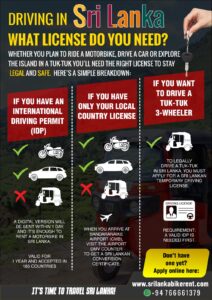
The single most important thing to understand is this: Can South Africans drive in Sri Lanka? Yes — but the documents required depend entirely on which vehicle you choose.
What Documents You Need
The documents required depend on your vehicle choice:
For Motorcycles and Scooters:
- Valid South African driving license with motorcycle category (Code A)
- International Driving Permit (digital version acceptable)
For Tuk-Tuks (Three-Wheelers):
- Valid South African driving license with light vehicle category (Code B or EB)
- International Driving Permit (physical booklet required)
- Sri Lankan AAC Recognition Permit from the Automobile Association of Ceylon
For Cars:
- Valid South African driving license
- International Driving Permit
The key difference you must understand? Tuk-tuks require the AAC Recognition Permit, while motorcycles do not.
This is not a minor administrative detail. This is the difference between driving legally and being turned away at the rental counter with nowhere to go.
The Tuk-Tuk Document Trap Most Tourists Fall Into
Tuk-tuks have become one of the most popular ways for international visitors to explore Sri Lanka. They are fun, affordable, uniquely Sri Lankan, and give you access to narrow village roads that larger vehicles cannot reach.
But tuk-tuks have a documentation requirement that catches almost every first-time visitor off guard.
Under Sri Lankan traffic law, three-wheeled motor vehicles require specific authorization from local authorities before foreign license holders can operate them. This authorization comes in the form of the AAC Recognition Permit (also called the Covering Permit).
You cannot get this permit outside Sri Lanka. You cannot skip this permit. And you cannot get this permit without the physical IDP booklet.
Here is where the trap closes on unsuspecting tourists:
Many South Africans now apply for digital IDPs because they are convenient and environmentally friendly. Digital IDPs work perfectly fine for motorcycles and cars in Sri Lanka.
But when you arrive at your tuk-tuk rental office with only a digital IDP, the rental agent will explain that you cannot legally drive a tuk-tuk without the AAC Recognition Permit — and the AAC office will not issue that permit based on a digital document.
At this point you have three bad options: travel to Colombo to try (and fail) to get the AAC permit, switch to a motorcycle if you have the right license category, or abandon your self-drive plans entirely.
All of this is avoidable if you know the requirement before applying for your IDP in South Africa.
Everything About the AAC Recognition Permit
The AAC Recognition Permit is only required for tuk-tuk drivers. If you are renting a motorcycle or car, you can skip this entire section.
What Exactly Is the AAC Recognition Permit?
The AAC Recognition Permit is an official authorization document issued by the Automobile Association of Ceylon (AAC) that permits foreign license holders to operate three-wheeled vehicles on Sri Lankan roads.
This permit is issued based on verification of your physical International Driving Permit. The AAC inspects your physical IDP booklet to confirm its authenticity and validity, then issues the Recognition Permit on that basis.
How Long Is the AAC Permit Valid?
The AAC Recognition Permit is valid for one year from the date of issue. This means if you return to Sri Lanka within that year, you do not need to reapply — the same permit remains valid.
How Much Does the AAC Recognition Permit Cost?
There are two ways to obtain the AAC Recognition Permit, with different costs:
- Direct application at AAC office in Colombo: 8,500 LKR (approximately USD 28)
- Application through your tuk-tuk rental office: 12,000 LKR (approximately USD 40)
The 3,500 LKR difference covers the administrative service, paperwork handling, and coordination between the rental company and the AAC office.
Which Method Should You Choose?
The overwhelming recommendation from experienced travelers is to arrange the AAC Recognition Permit through your rental office.
When you book your tuk-tuk rental and provide your IDP details in advance, the rental company prepares and processes your AAC Recognition Permit before you even land in Sri Lanka. When you arrive to collect your tuk-tuk, the permit is ready and waiting for you.
This approach saves you several hours of travel to the AAC office in Colombo, eliminates language barriers and bureaucratic confusion, and lets you start driving immediately upon arrival.
The 3,500 LKR premium (approximately USD 12) is worth every cent for the convenience and peace of mind it provides.
APPLY FOR AAC CONVERTIN PERMIT!
How to Get the AAC Permit Yourself in Colombo
If you prefer to handle the application personally, here is the step-by-step process:
Step 1: Obtain your physical IDP booklet from AA South Africa before your trip.
Step 2: Upon arrival in Sri Lanka, travel to the Automobile Association of Ceylon office in Colombo.
Step 3: Present your valid South African driver’s license and physical IDP booklet at the counter.
Step 4: Complete the AAC Recognition Permit application form provided by the office.
Step 5: Pay the application fee of 8,500 LKR (cash or card accepted).
Step 6: Wait approximately 1–2 hours while the permit is processed and printed.
Step 7: Collect your AAC Recognition Permit and verify all details are correct before leaving.
The AAC office is located at No. 40, Sir Mohammed Macan Markar Mawatha, Colombo 03. Operating hours are typically 9:00 AM to 4:30 PM, Monday to Friday. The office is closed on weekends and public holidays.
More information is available at the Automobile Association of Ceylon website.
Physical vs Digital IDP: Why It Matters
South Africa’s AA now offers both physical and digital International Driving Permits. Both are legitimate and internationally recognized — but they are not interchangeable for all purposes in Sri Lanka.
Digital IDP: When It Works
A digital IDP is perfectly acceptable for:
- Renting and driving motorcycles
- Renting and driving cars
- Presenting at police checkpoints
- Vehicle insurance verification
APPLY FOR INTERNATIONAL DRIVING PERMIT !
Physical IDP: When It Is Mandatory
A physical IDP booklet is absolutely required for:
- Obtaining the AAC Recognition Permit for tuk-tuk driving
- Any situation where the tuk-tuk rental process is involved
Why Does the AAC Require Physical IDPs?
The AAC office in Colombo needs to physically inspect and verify the security features, stamps, and signatures on your IDP before issuing the Recognition Permit. Digital documents cannot be verified in the same way, and the AAC has not updated its systems to accept them.
This policy may change in future years as digital verification systems improve — but as of 2025, the physical IDP booklet remains mandatory for tuk-tuk drivers.
What Should You Get?
The safest approach is to get the physical IDP booklet from AA South Africa.
The physical booklet covers all vehicle types, works in all situations, and eliminates any possibility of being turned away due to documentation issues. If you end up renting a motorcycle or car instead of a tuk-tuk, the physical IDP still works perfectly.
The digital IDP only makes sense if you are 100% certain you will not drive a tuk-tuk under any circumstances during your trip.
How to Get Your IDP in South Africa Before You Fly
Every South African who plans to drive in Sri Lanka must obtain an International Driving Permit before departure. This is non-negotiable regardless of which vehicle type you choose.
Who Issues IDPs in South Africa?
The Automobile Association (AA) of South Africa is the sole authorized issuing body for International Driving Permits in South Africa. Only IDPs issued by AA South Africa are legally recognized internationally.
Never use third-party websites or online services claiming to issue IDPs. These documents are not legitimate and will not be accepted in Sri Lanka.
What You Need to Bring to the AA
- Your valid South African driver’s license (credit card format)
- Two recent passport-sized photographs
- Completed IDP application form (available at AA branches)
- Payment for the application fee
Check the current fee structure on the AA South Africa website as prices change periodically.
How Long Does It Take?
Most AA branches process IDP applications on the same day. You typically receive your IDP within 2–4 hours of submitting your application.
Some AA branches offer while-you-wait service during quiet periods. Call ahead to confirm processing times at your nearest branch.
How Long Is the IDP Valid?
Your International Driving Permit is valid for 12 months from the date of issue.
Plan your application timing so that the 12-month validity window covers your entire trip to Sri Lanka. If you apply too early, the IDP may expire before or during your travels.
Finding Your Nearest AA Branch
AA South Africa has branches in all major cities and many smaller towns. Use the branch locator on the AA website to find your nearest location and confirm operating hours.
Smart Ways to Save Money on Your AAC Permit
If you are renting a tuk-tuk in Sri Lanka, the AAC Recognition Permit is unavoidable — but you do have options that affect the total cost.
Option 1: DIY Application (8,500 LKR)
Apply directly at the AAC office in Colombo and pay 8,500 LKR (approximately USD 28).
Advantages: Lowest possible cost, personal control over the process.
Disadvantages: Requires travel to Colombo, takes 1–2 hours of your holiday time, potential language barriers, only possible during office hours on weekdays.
Option 2: Through Your Rental Company (12,000 LKR)
Arrange the AAC Recognition Permit through your tuk-tuk rental office and pay 12,000 LKR (approximately USD 40).
Advantages: Permit ready upon arrival, no travel to Colombo required, no time wasted, stress-free process, expert handling.
Disadvantages: Higher cost than DIY option.
APPLY FOR AAC CONVERTIN PERMIT!
Which Option Saves You More Overall?
Consider the total cost beyond just the permit fee:
DIY Costs:
- AAC permit: 8,500 LKR
- Transport to/from AAC office in Colombo: 2,000–4,000 LKR
- Time value: 3–4 hours of your holiday
- Total: ~11,000–13,000 LKR plus lost holiday time
Rental Company Costs:
- AAC permit through rental office: 12,000 LKR
- Transport: 0 LKR (permit delivered to you)
- Time value: 0 hours (immediate start)
- Total: 12,000 LKR with zero hassle
The rental company option often works out equal or cheaper when you factor in transport and time — while delivering significantly better convenience.
Road Conditions and Driving Culture in Sri Lanka
Once your documentation is sorted, understanding Sri Lankan road culture helps you drive safely and confidently.
Driving on the Left
Sri Lanka drives on the left side of the road — identical to South Africa. This eliminates the biggest adjustment international drivers face and makes the transition much easier for South Africans.
Road Quality
Road conditions vary dramatically across the island:
- Expressways: Modern, well-maintained, smooth surfaces
- A-grade roads: Generally good condition with some potholes
- B-grade roads: Variable quality, narrow in places
- Rural roads: Rough surfaces, sharp corners, minimal lighting
Speed Limits in Sri Lanka
Official speed limits are:
- Urban areas: 50 km/h
- National roads: 70–100 km/h
- Expressways: 120 km/h
Police enforce these limits with speed cameras and mobile checkpoints. Fines are issued on the spot.
The Honking Culture
Honking is constant in Sri Lanka and serves as active communication rather than aggression. Drivers honk to signal overtaking, warn of blind corners, and announce their presence. This feels strange initially but becomes natural within a day or two.
Safety Equipment Requirements
- Helmets: Mandatory for all motorcycle riders and passengers
- Seat belts: Required for front-seat car passengers
- Lights: Headlights must be on when riding motorcycles even during daytime
Emergency Contact Numbers
Save these numbers before you start driving:
- Police: 119
- Ambulance: 110
- Fire Service: 110
For detailed traffic regulations, visit the Department of Motor Traffic Sri Lanka official website.
FAQs
Can South Africans drive in Sri Lanka legally? Yes. South Africans can legally drive motorcycles, cars, and tuk-tuks in Sri Lanka when carrying the appropriate documentation for their chosen vehicle type.
Do I need an IDP to drive in Sri Lanka as a South African? Yes. An International Driving Permit is mandatory for all foreign drivers in Sri Lanka, regardless of which vehicle you drive. Your South African license alone is not sufficient.
Can I use a digital IDP in Sri Lanka? Digital IDPs work for motorcycles and cars. However, if you plan to drive a tuk-tuk, you must have the physical IDP booklet because the AAC office requires it to issue the Recognition Permit.
What is the AAC Recognition Permit? The AAC Recognition Permit is a mandatory authorization document issued by the Automobile Association of Ceylon that allows foreign drivers to operate three-wheeled vehicles (tuk-tuks) in Sri Lanka. It is only required for tuk-tuks, not for motorcycles or cars.
How do I get the AAC Recognition Permit? You can apply directly at the AAC office in Colombo for 8,500 LKR, or arrange it through your tuk-tuk rental company for 12,000 LKR. The rental company option is recommended as they prepare everything before your arrival.
Can I get the AAC permit with a digital IDP? No. The AAC office in Colombo requires the physical IDP booklet to issue the Recognition Permit. Digital IDPs are not accepted for this purpose.
How long does the AAC Recognition Permit last? The AAC Recognition Permit is valid for one year from the date of issue. If you return to Sri Lanka within that year, the same permit remains valid.
Do I need the AAC permit to drive a motorcycle in Sri Lanka? No. The AAC Recognition Permit is only required for tuk-tuks (three-wheelers). Motorcycles require only your South African license with motorcycle category and your IDP.
Can I drive in Sri Lanka with only my South African license? No. You must carry both your South African license and a valid International Driving Permit at all times while driving in Sri Lanka.
Is it safe for South Africans to drive in Sri Lanka? Yes, with proper preparation. Sri Lanka drives on the left like South Africa. Main challenges include busy city traffic, aggressive bus drivers, and variable rural road conditions.
Final Thoughts
Can South Africans drive in Sri Lanka? Absolutely — and armed with the information in this guide, you are now prepared to do it correctly from day one.
The critical takeaways are simple: get your physical IDP booklet from AA South Africa before you fly, understand that tuk-tuks require the AAC Recognition Permit while motorcycles do not, and consider arranging your AAC permit through your rental company for maximum convenience.
Thousands of South African travelers drive through Sri Lanka every year and return home with incredible stories and unforgettable experiences. With the right preparation, you will join them.
Planning your Sri Lankan self-drive adventure? Research reputable rental companies that offer AAC permit assistance and ensure all your documentation is ready before departure.