
Table of Contents
- Can You Drive in Sri Lanka With a Swedish License?
- How Sri Lanka Treats Foreign Driving Licenses
- Breaking Down the Documents by Vehicle Type
- Physical IDP vs Digital IDP — What Sri Lanka Accepts
- How Swedish Drivers Can Get an IDP Before Traveling
- Everything You Need to Know About the AAC Recognition Permit
- The Smartest Way to Get Your AAC Permit Before You Arrive
- AAC Recognition Permit Cost Breakdown
- What It Is Really Like to Drive in Sri Lanka
- Choosing the Right Vehicle for Your Sri Lanka Trip
- The Real Consequences of Driving Without Correct Documents
- FAQs
Can You Drive in Sri Lanka With a Swedish License?
Is my Sweden Driving License valid in Sri Lanka? If you are planning to rent a vehicle and explore this extraordinary island at your own pace, this is the very first question you need to answer — before you book anything.
The honest answer is yes, your Swedish driving license is valid in Sri Lanka — but it cannot be used on its own. Every foreign driver in Sri Lanka must carry supporting documentation alongside their home country license. The exact documents you need depend on one critical factor: what type of vehicle you plan to drive.
Here is the simple version:
For motorcycles and scooters, you need your Swedish license with motorcycle category plus a valid International Driving Permit (IDP). A digital IDP is perfectly fine.
For cars, you need your Swedish license plus a valid IDP. Again, digital is accepted.
For tuk-tuks (three-wheelers), the requirements are stricter. You need your Swedish license, a valid physical IDP booklet — not digital — and an AAC Recognition Permit issued by the Automobile Association of Ceylon.
Get these documents sorted and Sri Lanka’s roads are entirely yours to enjoy. Skip them and you face fines, voided insurance, and serious legal exposure. The choice is straightforward.
How Sri Lanka Treats Foreign Driving Licenses
Sri Lanka’s road laws are governed by the Motor Traffic Act, which sets out clear rules for foreign drivers visiting the country. Under this legislation, international driving licenses are recognized — but only when accompanied by a valid International Driving Permit (IDP).
Sweden is a signatory to the 1968 Vienna Convention on Road Traffic, which means your Swedish license is internationally recognized in principle. However, recognition alone is not enough for Sri Lankan law. The IDP serves as the official companion document — a multilingual, standardized translation of your Swedish license that Sri Lankan traffic police can instantly read and verify.
Without your IDP, your Swedish driving license has no legal validity on Sri Lankan roads. This is true regardless of how long you have held your license, how clean your record is, or how far you have traveled to get there.
Your Swedish license combined with a valid IDP is generally recognized for driving in Sri Lanka for up to 3 months from your arrival date. For stays longer than 3 months, additional steps are required to remain legally compliant.
For full official guidance, visit the Sri Lanka Department of Motor Traffic website.
Breaking Down the Documents by Vehicle Type
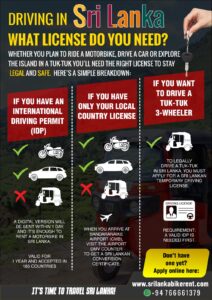
This is the section that matters most for Swedish visitors planning to rent a vehicle in Sri Lanka. The required documents differ by vehicle, and getting this wrong is one of the most common and costly mistakes tourists make.
Motorcycles and Scooters:
You need a valid Swedish driving license covering motorcycle category (Category A or A1) and a valid International Driving Permit. A digital IDP is acceptable for motorcycles. No additional permit of any kind is needed. This makes motorcycles the simplest option in terms of documentation.
Cars and SUVs:
You need a valid Swedish driving license (Category B) and a valid International Driving Permit. A digital IDP is acceptable for cars. No additional permit required.
Tuk-Tuks (Three-Wheelers):
This is the category that requires the most preparation. You need a valid Swedish driving license with light vehicle category, a valid International Driving Permit in physical booklet format only — digital copies are not accepted — and an AAC Recognition Permit from the Automobile Association of Ceylon. This permit is exclusive to tuk-tuk drivers. Cars and motorcycles do not require it.
| Vehicle | Swedish License Category | IDP Format | AAC Recognition Permit |
| Motorcycle / Scooter | A or A1 | Digital or Physical | Not Required |
| Car / SUV | B | Digital or Physical | Not Required |
| Tuk-Tuk (Three-Wheeler) | Light Vehicle | Physical booklet only | Required |
The tuk-tuk row is the one to study carefully. The AAC Recognition Permit requirement, combined with the physical-only IDP rule, is what separates tuk-tuk documentation from every other vehicle category in Sri Lanka.
Physical IDP vs Digital IDP — What Sri Lanka Accepts
This distinction matters enormously for Swedish visitors, and it is frequently overlooked until it is too late to fix.
For cars and motorcycles, Sri Lanka accepts both physical and digital versions of your IDP. If you have your IDP saved on your phone or stored digitally, rental companies and traffic police will accept it for these vehicle categories. Convenient, flexible, and straightforward.
For tuk-tuks, only the physical IDP booklet is accepted — full stop. There is a specific and important reason for this rule.
The AAC Recognition Permit — the additional document required for tuk-tuk drivers — is issued by the Automobile Association of Ceylon based on your physical IDP. The AAC needs to examine and verify your original IDP booklet in person before they can issue the Recognition Permit. A screenshot, PDF, or digital copy cannot be used for this verification process.
This means that if you arrive in Sri Lanka with only a digital IDP and decide you want to drive a tuk-tuk, you have a problem that cannot be solved on the ground. You would need to return to Sweden to obtain the physical booklet.
The simple rule: If there is any chance you might want to drive a tuk-tuk — and there usually is once you see them — always obtain the physical IDP booklet in Sweden before you travel. It covers you for all vehicle categories and removes all uncertainty.
APPLY FOR INTERNATIONAL DRIVING PERMIT !
How Swedish Drivers Can Get an IDP Before Traveling
Getting your IDP in Sweden is quick, affordable, and best handled well ahead of your departure date. Here is the complete process.
Where to apply:
In Sweden, IDPs are issued by authorized national organizations. The two main ones are NTF (Nationalföreningen för Trafiksäkerhetens Främjande) and MHF (Motorförarnas Helnykterhetsförbund). Both are fully accredited and internationally recognized as IDP-issuing authorities.
Full application details are available on the NTF Sweden official website.
What to prepare:
You need your valid original Swedish driving license, two recent passport-size photographs, a completed application form available from the issuing organization, and a processing fee of around 250–300 SEK.
How long does it take:
In-person applications are typically processed on the same day. If applying by post, allow several working days. Always apply early — ideally several weeks before your Sri Lanka trip — to avoid any last-minute stress.
How long is the IDP valid:
Your IDP is valid for 12 months from the date of issue. Check that yours will not expire before or during your time in Sri Lanka, particularly if you are planning an extended stay.
One final reminder: If you plan to drive a tuk-tuk, specifically request the physical IDP booklet. This is the version the AAC requires to issue your Recognition Permit. Without it, the tuk-tuk door is closed to you regardless of everything else.
Everything You Need to Know About the AAC Recognition Permit
The AAC Recognition Permit — sometimes referred to as the Covering Permit — is the document issued by the Automobile Association of Ceylon that legally authorizes foreign visitors to operate a tuk-tuk (three-wheeler) in Sri Lanka.
It is important to understand exactly what this permit is, why it exists, and what it covers.
Who needs it: Only tuk-tuk drivers. If you are renting a motorcycle or car, you do not need this permit at all. It is exclusive to three-wheeler operation by foreign visitors.
Who issues it: The Automobile Association of Ceylon (AAC). No other organization issues this permit. It cannot be obtained online independently, and it cannot be issued without your physical IDP booklet being presented and verified.
How it is issued: The AAC bases the Recognition Permit on your physical IDP. This is why the physical booklet — rather than a digital version — is a firm requirement for tuk-tuk drivers. The AAC examines your IDP, confirms the details, and issues the Recognition Permit in your name.
How long it is valid: The AAC Recognition Permit is valid for one year from the date of issue. This means a single permit covers multiple trips to Sri Lanka within a 12-month period, making it excellent value for frequent visitors.
Where the AAC is located: The Automobile Association of Ceylon is based in Colombo. You can visit their office directly or, more conveniently, arrange your permit through your rental company in advance of arrival.
The Smartest Way to Get Your AAC Permit Before You Arrive
Here is the travel tip that saves Swedish tuk-tuk enthusiasts the most time and hassle: apply for your AAC Recognition Permit through your rental office before you fly.
When you book your tuk-tuk rental, simply contact your rental company and inform them that you need the AAC Recognition Permit arranged in advance. Provide them with your IDP details and any other required information. They will handle the entire application process with the AAC on your behalf.
By the time your flight lands in Sri Lanka, your AAC Recognition Permit is already prepared and waiting for you at the rental office. You collect it on arrival, pick up your tuk-tuk, and head straight out on the road. No administration on your holiday, no Colombo office visits, no queues, no wasted days.
This advance arrangement is by far the most efficient route for international visitors — and it is exactly the service that Sri Lanka Bike Rent provides for our tuk-tuk rental customers in Negombo.
When you book your tuk-tuk rental with us, simply let us know at the time of booking. We manage the AAC permit process from our end, and everything is ready and confirmed before you arrive. You focus on the excitement of Sri Lanka — we handle the paperwork.
Alternatively, if you are traveling independently and prefer to manage the process yourself, you can visit the Automobile Association of Ceylon office directly in Colombo. Bring your original physical IDP booklet, Swedish driving license, passport, passport-size photographs, and the applicable fee. The AAC team is experienced in handling international tourist applications and the process is generally completed within the same day or one to two working days.
APPLY FOR AAC CONVERTIN PERMIT!
AAC Recognition Permit Cost Breakdown
The cost of your AAC Recognition Permit varies depending on how you choose to obtain it.
| Application Route | Cost (LKR) | Notes |
| Direct at AAC office, Colombo | 8,500 LKR | You visit in person, collect same day or within 1–2 days |
| Through your rental office (permit ready on arrival) | 12,000 LKR | Permit prepared before you land, collected at rental office |
The price difference between the two options is 3,500 LKR — a modest sum in the context of an international trip to Sri Lanka.
What does that 3,500 LKR difference actually buy you when applying through a rental office? It buys you a permit that is already processed, approved, and physically in hand the moment your trip begins. No half-day spent finding the AAC office in Colombo, no administrative uncertainty, no delay before your tuk-tuk adventure starts.
For travelers arriving directly into the Negombo area rather than Colombo, the rental office route is even more practical — making the detour to the AAC in Colombo entirely unnecessary.
If your itinerary takes you through Colombo in the first day or two and you are comfortable handling it yourself, the direct AAC route at 8,500 LKR is a perfectly reasonable option. But for most Swedish visitors arriving with limited time and big plans, letting your rental office handle it is simply the smarter travel decision.
Remember that the AAC Recognition Permit is valid for one full year — making either cost extremely good value if you plan to spend significant time in Sri Lanka or return within the year.
What It Is Really Like to Drive in Sri Lanka
Sri Lanka offers some of the most visually stunning and genuinely memorable driving in the whole of Asia. It also asks things of you that Swedish roads simply do not. Here is an honest picture of what to expect.
Left-hand traffic is the defining adjustment. Sweden drives on the right. Sri Lanka drives on the left. For the first few hours, your instincts will work against you — particularly at junctions, roundabouts, and when turning onto new roads. Give yourself time to adapt in a quieter area before committing to busy city driving. Most Swedish visitors find the switch becomes natural within half a day.
City traffic is an entirely different experience. Colombo, Kandy, and other Sri Lankan cities operate at a pace and density that feels genuinely chaotic to drivers from orderly Swedish roads. Tuk-tuks dart between lanes, buses pull out without warning, motorcycles filter through every gap, and pedestrians cross wherever they choose. The key is patience — it is not dangerous so much as it is unpredictable, and calm, observant driving keeps you safe.
Rural roads vary dramatically. The Southern Expressway linking Colombo to Matara is modern and fast. Coastal roads around Negombo are pleasant and manageable. Mountain roads in the central highlands — particularly around Ella, Nuwara Eliya, and Kandy — can be narrow, steep, and challenging after heavy rain. They are also some of the most breathtaking roads you will ever drive.
Speed limits apply and are enforced. Urban areas are typically limited to 50 km/h and expressways to 70–100 km/h. Traffic police are present across the island and roadside checkpoints are common. Fines are issued immediately and on the spot.
Night driving in rural areas carries real risk. Roads outside towns are poorly lit, livestock wander freely onto carriageways after dark, and in areas bordering national parks, elephant crossings are a genuine hazard. If you can avoid rural night driving, do so.
Fuel planning matters in remote areas. Petrol stations are plentiful in towns and along main routes but become genuinely scarce in highland and jungle regions. Always fill your tank before heading into less-populated areas.
Horns are part of the conversation. Sri Lankan drivers use horns constantly — to signal before overtaking, to warn pedestrians, to announce their presence at blind corners. It is communicative rather than aggressive. Do not let it unsettle you.
Choosing the Right Vehicle for Your Sri Lanka Trip
Your vehicle choice shapes your entire Sri Lanka experience. Each option offers a completely different style of travel.
Motorcycles are the freedom vehicle. Affordable to rent, simple to document, and capable of reaching places that larger vehicles cannot access, motorcycles are the top choice for solo adventurers and confident couples. A 125–150cc bike handles the full range of Sri Lankan roads from coastal flats to highland switchbacks. Documentation is the simplest of any vehicle — Swedish license with motorcycle category plus a valid IDP, digital accepted.
Cars deliver comfort and practicality. Ideal for families, longer journeys, or travelers who value air conditioning and luggage space above all else. Documentation is equally simple — Swedish license plus IDP, digital accepted. Costs are higher than motorcycles and tuk-tuks, and city parking demands patience.
Tuk-tuks deliver something neither cars nor motorcycles can — pure, unfiltered immersion in Sri Lankan life. Slower and more exposed than other options, they connect you to the landscape, the people, and the energy of Sri Lanka in a way that makes them unforgettable. The extra documentation step — physical IDP plus AAC Recognition Permit — is absolutely worth it for the experience they deliver.
Boat Tours Sri Lanka offers quality motorcycle and tuk-tuk rentals based in Negombo, ideally positioned for exploring the lagoon coastline, nearby temples, fishing villages, and the broader cultural triangle of the northwest. For tuk-tuk rentals, we arrange your AAC Recognition Permit in advance so it is ready on your arrival day. Reach out when you book and we handle everything.
Whichever vehicle you choose, inspect it carefully before signing any rental agreement, photograph all pre-existing damage, obtain a signed rental document, and confirm that your travel insurance policy explicitly covers the vehicle type you will be driving.
The Real Consequences of Driving Without Correct Documents
Understanding what is at stake if you drive without the correct documentation in Sri Lanka is essential. These are not theoretical risks — they are outcomes that happen to real tourists every year.
Immediate fines at checkpoints. Sri Lankan traffic police operate roadside checkpoints across the island. If you are stopped without a valid IDP alongside your Swedish license, a fine is issued on the spot. Refusal to cooperate can escalate the situation significantly.
Vehicle impoundment. In more serious cases of non-compliance, the vehicle can be seized and held until the legal matter is resolved. This can derail days of your trip and involve significant additional costs.
Voided travel insurance. This is the most financially dangerous consequence and the one most Swedish tourists underestimate. Every reputable travel insurance policy requires you to be in legal compliance with local driving laws as a condition of coverage. If you are involved in an accident while driving without a valid IDP — or without the required AAC Recognition Permit for a tuk-tuk — your insurer can and will reject your claim entirely. Medical bills, vehicle damage, and third-party liability costs can run into millions of Sri Lankan Rupees.
Deportation in serious cases. For persistent or severe non-compliance, Sri Lankan immigration and traffic law does allow for deportation proceedings. This is an extreme outcome but not an impossible one for drivers who repeatedly ignore legal requirements.
None of these outcomes are worth risking. The IDP costs around 250–300 SEK and takes minutes to arrange in Sweden. The AAC Recognition Permit costs 8,500–12,000 LKR and can be fully arranged before you land. Against the potential financial and legal exposure of driving without them, the cost and effort of compliance are negligible.
FAQs
Q: Is my Sweden Driving License valid in Sri Lanka? A: Yes, when accompanied by a valid International Driving Permit (IDP). The type of IDP accepted and whether you need additional documents depends on the vehicle you drive. Motorcycles and cars require your Swedish license plus IDP (digital accepted). Tuk-tuks require your Swedish license plus a physical IDP booklet plus an AAC Recognition Permit.
Q: Do I need a physical IDP or is digital acceptable in Sri Lanka? A: For cars and motorcycles, a digital IDP is accepted. For tuk-tuks, only a physical IDP booklet is accepted. The Automobile Association of Ceylon requires the physical booklet to verify and issue the AAC Recognition Permit for tuk-tuk drivers.
Q: What is the AAC Recognition Permit? A: The AAC Recognition Permit — also called the Covering Permit — is a document issued by the Automobile Association of Ceylon that authorizes foreign visitors to legally drive a tuk-tuk (three-wheeler) in Sri Lanka. It is valid for one year from the date of issue and is required only for tuk-tuks, not for motorcycles or cars.
Q: How much does the AAC Recognition Permit cost? A: Applying directly at the AAC office in Colombo costs 8,500 LKR. Arranging it through your rental company — with the permit prepared and ready before your arrival — costs 12,000 LKR. The permit is valid for one full year from the date of issue.
Q: What is the easiest way to get the AAC Recognition Permit? A: The easiest route is to arrange it through your tuk-tuk rental company before you travel. They process the application on your behalf and have the permit ready when you arrive in Sri Lanka. This eliminates the need to visit the AAC office in Colombo and means your tuk-tuk adventure starts immediately on arrival.
Q: Can I get an IDP after arriving in Sri Lanka? A: No. The IDP must be obtained from an authorized organization in your home country before you travel. In Sweden, you can apply through NTF or MHF. It cannot be arranged after landing in Sri Lanka.
Q: Do I need the AAC Recognition Permit if I am renting a motorcycle? A: No. The AAC Recognition Permit is required exclusively for tuk-tuk (three-wheeler) drivers. Motorcycles and scooters require only your Swedish license with motorcycle category and a valid IDP — digital or physical.
Q: How long is my IDP valid for driving in Sri Lanka? A: The IDP itself is valid for 12 months from the date of issue in Sweden. In Sri Lanka, foreign visitors can drive legally on their home country license and IDP for up to 3 months from their arrival date.
Q: How long does it take to get an IDP in Sweden? A: In-person applications at NTF or MHF are typically processed the same day. Postal applications take several working days. Apply well ahead of your departure to avoid any timing issues.
Q: Is Sri Lanka safe for Swedish drivers? A: Yes, with the right preparation and mindset. The main adjustment is switching to left-hand traffic, which most Swedish drivers adapt to within half a day. City traffic can be intense, rural roads vary in quality, and night driving in remote areas carries real risk. Alert, patient, and well-prepared drivers find Sri Lanka enormously rewarding to explore by road.
Q: What documents should I carry every time I drive in Sri Lanka? A: Always carry your original Swedish driving license, valid IDP, your AAC Recognition Permit if driving a tuk-tuk, your passport, and your vehicle rental agreement. Keep all documents together and never leave them at your accommodation.
Q: What is the minimum driving age in Sri Lanka? A: You must be at least 18 years old to legally drive any vehicle in Sri Lanka — car, motorcycle, or tuk-tuk.
Wrapping Up — Drive Sri Lanka the Right Way
Is my Sweden Driving License valid in Sri Lanka? Yes — and now you know exactly what that means in practice for every vehicle you might want to drive.
For motorcycles and cars, grab your Swedish license, sort your IDP (digital works fine), and you are road-legal from the moment you land. For tuk-tuks, get your physical IDP booklet in Sweden, arrange the AAC Recognition Permit through your rental company before you fly, and have everything waiting for you on arrival.
Sri Lanka is one of the most rewarding countries in Asia to explore independently. Ancient temples, working tea plantations, jungle-fringed national parks, and some of the most dramatic coastal scenery in the Indian Ocean are all connected by roads that invite exploration. With your paperwork properly sorted, there is nothing standing between you and an unforgettable journey.
Useful External Links:
- Automobile Association of Ceylon — Official Website
- Sri Lanka Department of Motor Traffic
- NTF Sweden — International Driving Permit
- Sri Lanka Tourism Development Authority
- Vienna Convention on Road Traffic — UNECE
- AA Guide to International Driving Permits