
Table of Contents
- Introduction
- So — Is My Switzerland Driving License Valid in Sri Lanka?
- The Complete Document Guide by Vehicle Type
- Getting Your IDP in Switzerland — Everything You Need to Know
- Physical IDP vs Digital IDP — The Difference That Changes Everything
- What Is the AAC Recognition Permit and Who Needs It?
- Two Ways to Get Your AAC Permit — Costs, Steps and Which Is Better
- Road Rules in Sri Lanka Every Swiss Driver Must Understand
- How Vehicle Rentals Work in Sri Lanka for Foreign Tourists
- The Real Risks of Driving Without Correct Documentation
- Essential Driving Tips for Swiss Tourists in Sri Lanka
- Frequently Asked Questions
- Final Words
Introduction
Sri Lanka has a way of making you want to explore every corner of it.
The south coast highway stretching past white sand beaches. The dramatic switchback roads climbing through Nuwara Eliya’s tea estates. The ancient forest routes connecting centuries-old temples that most tour buses never reach. Every one of these routes is better experienced on your own wheels — at your own pace, on your own schedule.
For Swiss travelers, the instinct to rent a motorcycle, hire a car, or take on the legendary tuk-tuk road trip is completely natural. Switzerland has a world-class driving culture and Swiss drivers are experienced, confident, and safety-conscious.
But before you make any booking or accept any set of keys, one question needs a clear, accurate answer — is my Switzerland driving license valid in Sri Lanka?
The honest answer is: it depends on what you want to drive, and the details matter far more than most travel websites acknowledge. This guide gives you the complete picture — including the specific tuk-tuk rules and AAC permit process that the vast majority of travel blogs either get wrong or skip entirely.
Read this before you rent anything. It could save you from a very expensive and very avoidable situation.
So — Is My Switzerland Driving License Valid in Sri Lanka?
Let us start with the direct answer before anything else.
No — your Switzerland driving license is not valid for driving in Sri Lanka on its own.
Sri Lanka’s road network is governed by the Department of Motor Traffic (DMT), and under Sri Lankan law, no foreign driving license — including those issued in Switzerland — grants automatic driving rights on public roads.
This surprises many Swiss travelers. Switzerland is globally recognized for the quality of its roads and the rigor of its driver training. But Sri Lanka operates its own independent legal framework, and that framework applies to every foreign visitor equally.
The solution is not complicated. It requires some preparation before you leave Switzerland and — if you want to drive a tuk-tuk — one additional step in Colombo after you arrive. Every part of this process is manageable, affordable, and well within reach.
The key is knowing exactly what you need based on the vehicle you plan to drive. And that is exactly what the next section covers.
The Complete Document Guide by Vehicle Type
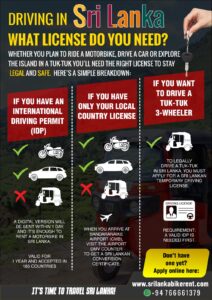
The biggest mistake Swiss tourists make is assuming the same rules apply to all vehicles. They do not. The requirements for a motorcycle are different from a car, and the requirements for a tuk-tuk are different again — with one extra document that most travelers have never heard of.
Here is the complete breakdown:
| Vehicle Type | Documents Required |
| Motorcycle / Scooter | Swiss License (Category A or A1) + IDP |
| Car | Swiss License + IDP |
| Tuk-Tuk (Three-Wheeler) | Swiss License (Category B) + Physical IDP Booklet + AAC Recognition Permit |
Motorcycles and Scooters
To ride a motorcycle or scooter legally in Sri Lanka as a Swiss tourist, you need:
- Your valid Swiss national driving license — must include the motorcycle category (Category A or A1)
- A valid International Driving Permit (IDP) — a digital version is acceptable for motorcycles
Your Swiss license must specifically show motorcycle authorization. If your license only covers cars (Category B), you cannot legally ride a motorcycle in Sri Lanka under any circumstances — regardless of what other documents you carry.
Cars
To drive a car legally in Sri Lanka as a Swiss tourist, you need:
- Your valid Swiss national driving license
- A valid International Driving Permit (IDP) — a digital version is acceptable for cars
Tuk-Tuks (Three-Wheelers)
Tuk-tuks are the vehicle where most tourists run into trouble. The requirements are more specific here and all three documents are mandatory — not optional extras.
To drive a tuk-tuk legally in Sri Lanka as a Swiss tourist, you need:
- Your valid Swiss national driving license — must include the light vehicle category (Category B)
- A valid International Driving Permit (IDP) — the physical booklet version is required, digital is not accepted
- An AAC Recognition/Covering Permit issued by the Automobile Association of Ceylon in Colombo
The critical point to remember: Tuk-tuks require the AAC Recognition Permit. Motorcycles and cars do not need it.
The physical IDP booklet is specifically required for tuk-tuks because the AAC office in Colombo uses it to verify and process your AAC Recognition Permit application. Without the physical booklet, the AAC cannot issue the permit. Without the permit, you cannot legally drive a tuk-tuk.
Getting Your IDP in Switzerland — Everything You Need to Know
The International Driving Permit is your foundational document for driving in Sri Lanka. Getting it before you leave Switzerland is the first step for every Swiss traveler planning to drive any vehicle on the island.
What is an IDP?
An International Driving Permit is an official document recognized in over 150 countries. It certifies that your Swiss driving license is valid in your home country and translates your license details into multiple languages so foreign authorities can verify them.
Sri Lanka accepts IDPs issued under both the 1949 Geneva Convention and the 1968 Vienna Convention on Road Traffic. Switzerland is a signatory to both, which means Swiss nationals are fully eligible to obtain an IDP that Sri Lanka will recognize.
APPLY FOR INTERNATIONAL DRIVING PERMIT !
Where to get your IDP in Switzerland:
IDPs in Switzerland are issued by two official automobile associations:
Visit whichever office is closest to you. Both are fully recognized and issue IDPs accepted internationally.
What to bring:
- Your valid Swiss driving license — original document only, not a photocopy
- Your Swiss passport or national identity card
- One recent passport-sized photograph
- Payment of approximately CHF 20 to CHF 30
Processing time:
Most TCS and ACS offices issue the IDP on the same day. Some locations may take a few days depending on their current volume. Call ahead to confirm before visiting.
Validity:
Your IDP is valid for 1 year from the date of issue. Check the expiry date carefully and make sure it covers your entire trip to Sri Lanka including any potential extension.
When to apply:
At least 3 weeks before your departure date. This gives you a comfortable buffer and removes any last-minute stress before a long trip.
Your IDP and your Swiss driving license must always be carried together whenever you are driving. One without the other is legally insufficient. Never leave either document at your hotel when you head out on the road.
Physical IDP vs Digital IDP — The Difference That Changes Everything
This is one of the most overlooked details in driving guides for Sri Lanka — and it is a detail that directly determines whether you can legally drive a tuk-tuk or not.
Here is the exact breakdown:
| Vehicle | IDP Format Accepted |
| Motorcycle / Scooter | Digital IDP acceptable |
| Car | Digital IDP acceptable |
| Tuk-Tuk (Three-Wheeler) | Physical IDP booklet required — digital not accepted |
For motorcycles and cars, a digital IDP stored on your smartphone is perfectly acceptable in Sri Lanka. This is convenient and completely valid for those two vehicle categories.
For tuk-tuks, the situation is fundamentally different. The physical IDP booklet is required — and the reason is specific and important. When you apply for your AAC Recognition Permit at the Automobile Association of Ceylon in Colombo, the AAC office requires your physical IDP booklet to process the application. A digital copy on your phone cannot satisfy this requirement. The AAC uses the physical document as the basis for verifying your credentials and issuing the permit.
This means that if you plan to drive a tuk-tuk during your Sri Lanka trip, you must request the physical IDP booklet from TCS or ACS in Switzerland — not a digital version.
The safest approach for any traveler who might want to drive both a motorcycle and a tuk-tuk during their trip is simple — always get the physical IDP booklet. It works for every vehicle category and removes any possibility of being caught in the wrong format at the wrong moment.
What Is the AAC Recognition Permit and Who Needs It?
The AAC Recognition Permit — also called the Covering Permit — is issued by the Automobile Association of Ceylon (AAC). It is the document that legally authorizes foreign tourists to drive tuk-tuks (three-wheelers) in Sri Lanka.
Why does this permit exist?
Under Sri Lankan motor traffic law, tuk-tuks are classified as a distinct vehicle category. They do not fall under the same legal framework as cars or motorcycles. Because of this separate classification, foreign tourists require a Sri Lanka-specific authorization document — the AAC Recognition/Covering Permit — in addition to their international driving credentials.
Who needs it?
Only tourists who plan to drive a tuk-tuk. If you are renting a motorcycle or a car, you do not need the AAC Recognition Permit at all.
How is it issued?
The AAC processes your Recognition Permit application based on your physical IDP booklet. This is the direct reason why the physical booklet is non-negotiable for tuk-tuk drivers. The AAC office physically verifies your IDP before issuing the permit.
How long is it valid?
The AAC Recognition Permit is valid for 1 year from the date of issue. This means if you visit Sri Lanka multiple times within a year, the same permit covers all your trips within that period.
Two Ways to Get Your AAC Permit — Costs, Steps and Which Is Better
There are two routes available for getting your AAC Recognition Permit. The right choice depends on your priorities — saving money or saving time.
Option 1 — Through Your Rental Office (Recommended for Most Tourists)
This is the most convenient option and the one we recommend for the majority of travelers.
How it works:
Step 1: When booking your tuk-tuk rental, tell your rental office that you need an AAC Recognition Permit arranged on your behalf.
Step 2: Your rental office will ask you to send copies of your Swiss driving license, physical IDP booklet, and passport details in advance of your arrival.
Step 3: The rental office handles the entire application and processing with the AAC on your behalf before you even land in Sri Lanka.
Step 4: When you arrive to collect your tuk-tuk on your rental day, your AAC Recognition Permit is already fully prepared and waiting for you. You complete the final paperwork and drive away legally covered from minute one.
Cost: LKR 12,000
Why choose this option?
Your first days in Sri Lanka are precious travel time. Spending a morning queuing at a government office in Colombo on day one is the last thing most travelers want. By arranging through your rental office, your permit is ready when you arrive. No queues, no navigation to an unfamiliar address in Colombo traffic, no risk of unexpected delays holding up your departure.
For most tourists the extra cost over the direct route is absolutely worth it in time saved and stress avoided.
APPLY FOR AAC CONVERTIN PERMIT!
Option 2 — Apply Directly at the AAC Office in Colombo
If you prefer to handle the process yourself or your rental company does not offer the permit service, you can visit the AAC office directly.
Address:
Automobile Association of Ceylon (AAC) 40 Sir Macan Markar Mawatha Galle Face, Colombo 03, Sri Lanka
What to bring:
- Your original Swiss driving license
- Your physical IDP booklet — mandatory, the AAC cannot process your application without it
- Your original passport plus a photocopy of the photo page and your current visa
- Recent passport-sized photographs
- Completed application form — available at the AAC counter on arrival
- LKR 8,500 in cash for the permit fee
What to expect on the day:
Arrive as early as the office opens to minimize waiting time. The full process typically takes a few hours. In most cases the permit is issued the same day. Plan your AAC visit into your first or second day in Colombo to ensure your tuk-tuk rental is legally covered as early as possible in your trip.
Cost: LKR 8,500
Check the AAC official website before your visit for current office hours, fees, and document requirements as these can occasionally be updated.
Quick Comparison:
| Direct at AAC Office | Through Rental Office | |
| Cost | LKR 8,500 | LKR 12,000 |
| Time Required | Half day in Colombo | No extra time needed |
| Permit Ready | Same day at AAC | Ready on arrival at rental |
| Convenience | Moderate | Very high |
Road Rules in Sri Lanka Every Swiss Driver Must Understand
Switzerland drives on the right side of the road. Sri Lanka drives on the left — the same as the UK, India, and Australia.
This single difference is the most significant adjustment for Swiss drivers. The good news is that most people develop genuine confidence within a day of arrival. The junctions, roundabouts, and right turns that feel unnatural on day one become progressively more natural as the hours pass.
Speed limits across Sri Lanka:
| Road Type | Speed Limit |
| Residential and urban areas | 50 km/h |
| Open rural roads | 70–80 km/h |
| Southern Expressway | 100–110 km/h |
Traffic laws you must follow:
- Helmets are legally mandatory for every motorcycle and scooter rider and every single passenger — no exceptions under any circumstances
- Seat belts must be worn by front seat passengers at all times
- Using a mobile phone by hand while driving is illegal
- Overtaking on hills, bends, junctions, or near pedestrian crossings is prohibited
- The legal blood alcohol limit is 0.08% — on unfamiliar roads in an unfamiliar country, the only sensible figure is zero
Beyond the written rules, Sri Lankan traffic has its own rhythm that feels intense and unpredictable by Swiss standards — particularly in Colombo and other major cities. Buses, tuk-tuks, motorcycles, cyclists, pedestrians, and vendors all occupy the same road space simultaneously. The adjustment required is less about skill and more about patience. Slow down, stay alert, and never assume right of way based on lane position alone.
The complete official road regulations for Sri Lanka are published on the Department of Motor Traffic website.
How Vehicle Rentals Work in Sri Lanka for Foreign Tourists
Renting a vehicle in Sri Lanka as a Swiss tourist is a genuinely straightforward experience once your documents are correctly in place.
What legitimate rental companies will check:
Any professional, reputable rental operator will verify your documents before releasing a vehicle. For motorcycles and cars, they will check your Swiss license and IDP. For tuk-tuks, they will check all three — your Swiss license, physical IDP booklet, and AAC Recognition Permit.
A rental shop that does not ask to see your documents is not doing you a favour. Your insurance coverage is only valid when you have the legally required documentation. If an accident occurs and your paperwork is incomplete, your insurance provider will decline the claim entirely and you become personally liable for every cost involved. A shop that skips the document check will not be there to help you manage those consequences.
Steps to take before accepting any rental vehicle:
Open your phone and record a short video of the complete vehicle — every body panel, each tyre, the mirrors, and any existing marks or damage. Send the video to yourself by message or email immediately so it carries an automatic timestamp. This protects you from being held responsible for pre-existing damage when you return the vehicle at the end of your rental.
Test the brakes, lights, indicators, and horn before pulling away from the rental location. Ask for your rental agreement and insurance information in writing before you drive anywhere.
Where to find reliable rental operators:
International booking platforms like Klook, GetYourGuide, and Viator list verified operators with genuine traveler reviews. For local tuk-tuk and motorcycle rentals, operators with strong and recent ratings on Google Maps are generally dependable options.
The Real Risks of Driving Without Correct Documentation
Some tourists decide to take their chances and drive without the full set of required documents. Here is what actually happens when things go wrong.
Police checkpoints operate regularly on Sri Lankan roads — particularly on the popular tourist routes along the southern coast and through the hill country. Document checks are routine at these stops. Being caught without the correct paperwork leads to immediate consequences.
On-the-spot fines are issued for unlicensed or incorrectly documented driving. The amounts vary and negotiation at a roadside checkpoint is rarely successful.
Vehicle impoundment is a real possibility in cases of clear non-compliance. Being left without transport far from your accommodation with no quick resolution available is an extremely difficult position.
Completely voided insurance is the consequence with the most serious financial implications. Any accident — from a minor scrape to a serious collision — that occurs while you are driving without the legally required documents is fully excluded from both your travel insurance and your rental insurance. Every repair cost, every medical bill, every property damage claim, and every legal fee involved becomes your personal financial responsibility with no coverage to fall back on.
Travel complications arise from serious accidents involving uninsured or unlicensed drivers. Legal proceedings in Sri Lanka can delay or in serious cases prevent your departure from the country until matters are fully resolved.
An IDP from TCS or ACS costs approximately CHF 20 to CHF 30. The AAC Recognition Permit costs LKR 8,500 at the office or LKR 12,000 through your rental operator. Set against the risks outlined above, there is simply no reasonable argument for skipping any of these steps.
Essential Driving Tips for Swiss Tourists in Sri Lanka
Sri Lanka is one of the most rewarding countries in the world for independent road travel. Approached with the right preparation and mindset, it is safe, manageable, and genuinely unforgettable. These are the tips that make a real practical difference:
Give yourself a proper adjustment day. Swiss right-hand driving habits are deeply automatic. Before entering any city or busy road, spend time on quiet village streets until left-hand driving starts to feel natural. Do not skip this step.
Stay off rural roads after dark without exception. Road lighting outside urban areas is extremely limited. Animals cross roads at night without warning and can appear with no time to react safely.
Never compete with Sri Lankan buses. Intercity buses drive fast and overtake without hesitation. The correct response every time is to slow down, pull left, and give them all the space they need. There is no situation where racing a bus ends well.
Always carry your full document set on your person while driving. Store originals in a waterproof document pouch. Leave clear photocopies at your accommodation. For tuk-tuk drivers — physically confirm you have all three required documents before every single journey. Missing even one of them invalidates your coverage.
Save your maps offline before leaving each morning. Google Maps is reliable across most of Sri Lanka but mobile data coverage can be patchy in hill country and remote coastal areas. Download your planned route to your device each morning before you set off.
Manage your heat exposure carefully. Sri Lanka’s combination of heat and humidity is a significant step up from Swiss conditions. Heat fatigue is a genuine and underestimated driving hazard. Stop every 90 minutes on longer journeys, drink water consistently, and rest when you need to.
Inspect your rental vehicle thoroughly before every ride. Check tyre pressure, brake response, lights, indicators, and horn condition — particularly if the vehicle has been parked overnight. Rental maintenance standards in Sri Lanka vary considerably between operators.
Book your tuk-tuk rental early and confirm the AAC permit service. If you want your AAC Recognition Permit ready on the day you collect your tuk-tuk, contact your rental operator well in advance and confirm they offer this arrangement. Getting this confirmed before you travel removes the need for any government office visits after arrival.
Understand the local horn culture. A quick horn beep on Sri Lankan roads is not an expression of frustration — it is a standard and widely used signal that someone is about to overtake, is approaching a blind corner, or is alerting a pedestrian ahead. It is expected, normal, and actually contributes to road safety in Sri Lanka’s busy driving environment.
Frequently Asked Questions
Q: Is my Switzerland driving license valid in Sri Lanka for a car? Not on its own. You need your valid Swiss license plus a valid IDP to legally drive a car in Sri Lanka. A digital IDP is acceptable for car rentals.
Q: Is my Switzerland driving license valid in Sri Lanka for a motorcycle? Only if your Swiss license includes Category A or A1. You also need a valid IDP — digital is accepted for motorcycles. If your license does not include the motorcycle category, no other document changes that restriction.
Q: Is my Switzerland driving license valid in Sri Lanka for a tuk-tuk? Not without additional documents. For tuk-tuks you need your Swiss license with Category B, a physical IDP booklet, and an AAC Recognition Permit from the Automobile Association of Ceylon. All three are mandatory.
Q: Why does the physical IDP booklet matter for tuk-tuks specifically? The AAC Recognition Permit — required for tuk-tuks — is issued by the AAC office in Colombo based on your physical IDP booklet. The AAC needs the physical document to process your application. A digital IDP cannot be used for this purpose.
Q: How much does the AAC Recognition Permit cost? LKR 8,500 if you apply in person at the AAC office in Colombo. LKR 12,000 if arranged through your rental office. The rental office option costs more but your permit is fully prepared and waiting when you arrive to collect your vehicle — no queuing or office visits required.
Q: How long is the AAC Recognition Permit valid? One year from the date of issue. Multiple trips to Sri Lanka within that year are covered by the same permit.
Q: What is the best way to arrange the AAC permit for a tourist? Contact your tuk-tuk rental office before you travel and ask them to arrange it on your behalf. Send your documents in advance, pay LKR 12,000, and your permit is ready when you arrive. It is by far the most time-efficient option for the majority of tourists.
Q: Can I get my IDP after arriving in Sri Lanka? No. The IDP must be obtained in Switzerland before you travel through TCS or ACS. There is no facility to issue a foreign IDP upon arrival in Sri Lanka.
Q: If a rental shop gives me a tuk-tuk without checking my AAC permit is that legally acceptable? No. The rental shop’s failure to verify does not make your driving legal. Any accident that occurs without the correct documentation leaves your insurance completely void. You remain personally liable for all costs regardless of what the rental shop did or did not check.
Q: Do the same document requirements apply for a one-day tuk-tuk rental? Yes. The duration of the rental has no bearing on the legal requirements. A two-hour tuk-tuk rental requires exactly the same three documents as a two-month rental.
Q: Is tuk-tuk driving manageable for a first-time Swiss tourist? Absolutely. Tuk-tuks are light, narrow, and responsive — most first-timers feel comfortable within an hour. Start on a quiet road, take your time, and build confidence gradually before entering busier areas. The left-hand driving adjustment applies here too, so give yourself that settling-in period.
Q: Where exactly is the AAC office in Colombo? Automobile Association of Ceylon, 40 Sir Macan Markar Mawatha, Galle Face, Colombo 03. It is accessible by tuk-tuk or taxi from most central Colombo hotels and guesthouses. Check aaceylon.lk for current opening hours before you visit.
Final Words
Is my Switzerland driving license valid in Sri Lanka?
On its own — no. Paired with the right documents and a little advance preparation — absolutely yes, and the full freedom of Sri Lanka’s roads is yours.
Here is your complete action plan in plain terms:
Before you leave Switzerland: Visit TCS or ACS and collect your IDP. If motorcycles are on your itinerary, confirm your Swiss license includes Category A. If a tuk-tuk adventure is part of your plan — and it genuinely should be, it is one of the finest travel experiences this island offers — get the physical IDP booklet from TCS or ACS. You will need it.
When booking your tuk-tuk: Contact your rental office and ask them to arrange your AAC Recognition Permit in advance. For LKR 12,000 they handle everything and your permit is ready and waiting when you arrive. It is the smoothest, most time-efficient route available and well worth the cost difference over going direct.
If you prefer to go direct: Visit the AAC at 40 Sir Macan Markar Mawatha, Galle Face, Colombo 03. Bring your physical IDP booklet, Swiss license, passport, photographs, and LKR 8,500 in cash. Plan this into your first or second day in Sri Lanka.
Every time you get behind the wheel: Carry every required document on your person. Observe the road rules. Wear your helmet without exception. Keep off unlit rural roads after dark. Give every bus the space it demands.
Sri Lanka rewards drivers who prepare properly. Coastal roads with unbroken Indian Ocean views. Highland passes through emerald tea estates. Ancient routes through forests where wild elephants roam. Every one of those roads is waiting for you.
Get your paperwork right. Drive with confidence. Make the most of every single kilometer this extraordinary island has to offer.