So you are planning a road trip through Sri Lanka. Maybe you want to ride a tuk-tuk through the hill country, cruise a motorbike along the south coast, or just have the freedom to drive at your own pace.
And naturally, you are wondering — is my Greece Driving License valid in Sri Lanka?
The honest answer might surprise you. And if you get it wrong, you could find yourself on the roadside with a fine, no insurance cover, and a vehicle you are not legally allowed to drive.
Let us walk through everything you need to know — clearly, simply, and without the confusing jargon.
Table of Contents
- The Quick Answer — Is Your Greek Licence Valid?
- Why Sri Lanka Has Special Rules for Foreign Drivers
- The 3 Documents Every Greek Driver Needs
- Getting Your IDP in Greece Before You Fly
- How to Get Your Sri Lanka Temporary Driving Licence
- Driving a Tuk-Tuk in Sri Lanka — What Greek Tourists Need
- New in 2025 — Getting Your Permit at the Airport
- 6 Road Rules You Cannot Ignore in Sri Lanka
- The Real Risk of Driving Without a Permit
- FAQ — Your Questions Answered
1. The Quick Answer — Is Your Greek Licence Valid?
Here it is straight: Is my Greece Driving License valid in Sri Lanka? No — not by itself.
Your Greek driving licence is a fantastic document across Europe and many parts of the world. But Sri Lanka requires an extra step that catches many visitors off guard.
In most countries, your Greek EU licence paired with an International Driving Permit (IDP) is enough to get you on the road. Sri Lanka is different. You also need a locally issued Temporary Driving Licence or Recognition Permit before you can legally drive.
This applies whether you want to drive a car, ride a motorcycle, or hop into a tuk-tuk.
2. Why Sri Lanka Has Special Rules for Foreign Drivers
Here is the background — and it matters.
Most modern countries operate under the 1968 Vienna Convention on Road Traffic, which allows drivers with a foreign licence and IDP to drive freely. Sri Lanka, however, follows the older 1949 Geneva Convention.
Under this framework, Sri Lanka retains the right to require foreign drivers to obtain local recognition before driving on its roads. This is not bureaucratic red tape — it is a legal requirement backed by international treaty.
The good news? The process is manageable and many rental operators across Sri Lanka will help you handle it quickly.
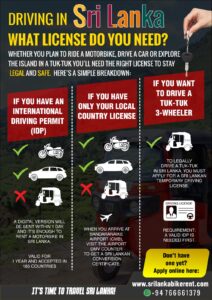
3. The Documents Every Greek Driver Needs — By Vehicle Here is the most important thing to understand: the documents you need depend on what you are driving. This is where most tourists go wrong.
Motorcycles and Scooters
- Valid Greek driving licence with motorcycle category
- International Driving Permit — digital version is acceptable
Simple. No extra permit needed from any local authority.
Tuk-Tuks (Three-Wheelers)
- Valid Greek driving licence with light vehicle category
- International Driving Permit — physical booklet required (digital not accepted)
- Sri Lankan Recognition/Covering Permit from the Automobile Association of Ceylon (AAC)
Tuk-tuks have the most steps. The AAC Recognition Permit is a firm requirement — and your IDP must be the printed physical booklet, not a digital copy on your phone.
Cars
- Valid Greek driving licence
- International Driving Permit
The key difference: Tuk-tuks require the AAC Recognition Permit. Motorcycles and cars do not. Plan your documents around your vehicle choice before you travel.
4. Getting Your IDP in Greece Before You Fly
Before you even board your flight, your first task is to get your IDP sorted in Greece.
In Greece, International Driving Permits are issued by the Automobile and Touring Club of Greece (ELPA) or your local licensing authority.
What you will need:
- Your valid Greek driving licence
- A passport-style photograph
- Completed application form
- Payment of the applicable fee
The IDP is issued relatively quickly, often on the same day or within a few days. It is valid for 1 year from the date of issue under the 1949 Geneva Convention.
Remember — the IDP must be issued in the same country as your driving licence. So you cannot sort this out once you land in Sri Lanka. Get it done in Greece first.
For guidance on IDPs and recognised issuing authorities worldwide, visit internationaldrivingpermit.org.
APPLY FOR INTERNATIONAL DRIVING PERMIT !
5. How to Get Your Sri Lanka Temporary Driving Licence
Once you arrive in Sri Lanka with your Greek licence and IDP, it is time to get your local permit.
Option A — The Automobile Association of Ceylon (AAC)
This is the most commonly used route for tourists and the officially recommended option.
AAC Address: 40, Sir Mohamed Macan Markar Mawatha, P.O. Box 338, Colombo 03 Website: aaceylon.lk
Documents to bring:
- Original Greek Driving Licence
- Original International Driving Permit (IDP)
- Original Passport
- Copy of your Sri Lanka visa
- Passport-sized photographs
Submit your documents, pay the fee, and you receive your Sri Lanka Temporary Driving Licence — usually on the same day.
Option B — The Department of Motor Traffic (DMT)
This is the government route, useful for longer-stay visitors or those who need a permit for a specific vehicle category not covered at the AAC.
DMT Website: dmt.gov.lk
Check their website for the latest procedures and required documents before visiting.
6. Driving a Tuk-Tuk in Sri Lanka — What Greek Tourists Need
Ah, the tuk-tuk. The iconic three-wheeler that is practically the symbol of Sri Lankan travel. Riding one gives you freedom and authenticity that no air-conditioned taxi can match.
But tuk-tuks have the strictest document requirements of any vehicle. Here is exactly what you need.
To legally drive a tuk-tuk in Sri Lanka, Greek tourists need all 3 of these:
- Valid Greek Driving Licence — light vehicle category Your licence must include the light vehicle category. Check before you travel.
- International Driving Permit — physical booklet only For tuk-tuks, a digital IDP is not accepted. You need the printed physical booklet from ELPA in Greece.
This is not just a formality. The AAC issues the Recognition Permit based on your physical IDP booklet. They review the printed document directly to verify your licence categories. Without it, they cannot process your permit.
- Sri Lankan Recognition/Covering Permit from the AAC This is the locally issued permit that officially authorises you to drive a three-wheeler on Sri Lankan roads.
This third document is what separates tuk-tuks from motorcycles. Motorcycles only need your Greek licence and IDP. Tuk-tuks need all three.
How to Get Your AAC Recognition Permit — 2 Options
Best Option: Apply Through Your Tuk-Tuk Rental Office
This is the smartest and most stress-free approach. When you book your tuk-tuk, ask your rental operator to arrange the AAC Recognition Permit for you. They handle the process in advance, so the permit is ready and waiting on the day you arrive.
No office queues. No Colombo traffic. No wasted time on day one.
Cost through a rental office: 12,000 LKR
APPLY FOR AAC CONVERTIN PERMIT!
Alternative: Visit the AAC Office Directly in Colombo
If you want to do it yourself, head to the AAC office in Colombo with your physical IDP, Greek licence, passport, visa copy, and passport photos. Permits are usually issued the same day.
Cost at the AAC office: 8,500 LKR
AAC Address: 40, Sir Mohamed Macan Markar Mawatha, P.O. Box 338, Colombo 03 Website: aaceylon.lk
AAC Recognition Permit — Quick Facts
| Detail | Info |
| Required for | Tuk-tuks only |
| IDP format | Physical booklet only |
| Valid for | 1 year from date of issue |
| Cost — AAC direct | 8,500 LKR |
| Cost — via rental office | 12,000 LKR |
| Best approach | Book through rental — ready on arrival |
Any restrictions on your Greek driving licence carry over automatically to your Sri Lankan permit.
7. New in 2025 — Getting Your Permit at the Airport
This is a genuinely exciting update for travellers.
As of August 2025, Sri Lanka now allows foreign tourists to obtain a Temporary Driving Licence directly at Bandaranaike International Airport (BIA) in Colombo upon arrival.
Previously, visitors had to make a separate journey into Colombo city — often in heavy traffic — just to visit the AAC office and collect their permit before they could drive anywhere.
Now you can land, queue at the airport permit desk, and be on the road the same day.
This is a huge improvement for anyone planning to explore Sri Lanka independently, especially those who want to start their journey straight from the airport.
8. Six Road Rules You Cannot Ignore in Sri Lanka
Beyond the paperwork, here is what actually matters once you are on the road.
Drive on the Left Coming from Greece where you drive on the right, this is your biggest adjustment. Take it slow for the first few days, especially at junctions and roundabouts.
Urban Speed Limit — 50 km/h In towns and cities, 50 km/h is the maximum. In rural areas the limit rises to 70 km/h. Cameras and police checks are active.
Seat Belts Are the Law Sri Lanka has a national seat belt law. No exceptions. Always buckle up.
Helmets Are Mandatory on Two-Wheelers Riding a motorcycle or tuk-tuk? Both the driver and any passenger must wear a helmet at all times. This is enforced.
No Phones While Driving Using a handheld mobile phone while driving is illegal in Sri Lanka. Hands-free is allowed, but keep your focus on the road — Sri Lankan traffic can be unpredictable.
Blood Alcohol Limit — 0.08% The legal BAC limit is 0.08%. Drink-driving is taken seriously. If you are exploring the local arrack scene in the evening, leave the keys behind.
For full official road safety information, refer to the Sri Lanka Ministry of Foreign Affairs.
9. The Real Risk of Driving Without a Permit
Let us be direct about this.
Many tourists in Sri Lanka — especially on motorbikes and scooters — end up driving without the proper permit. On a quiet country lane, nobody may notice.
But the moment something goes wrong — a minor collision, a police checkpoint, an accident — the consequences become very real.
Without a valid Sri Lanka Temporary Driving Licence:
- You are legally driving without a licence
- Police can issue fines, seize your vehicle, or require a court appearance
- Your travel insurance will very likely refuse to pay for medical costs or damages
- Third-party claims against you may go uncovered
The permit process is not expensive and not overly complicated. It simply requires planning. There is no good reason to skip it.
FAQ — Your Questions Answered
Q1: Is my Greece Driving License valid in Sri Lanka for renting a car? Not on its own. You need your Greek licence, an IDP obtained in Greece before travel, and a Sri Lanka Temporary Driving Licence or Recognition Permit issued locally. Car rental companies will typically require all three.
Q2: Do I need an IDP specifically to drive a tuk-tuk in Sri Lanka? Yes — and for tuk-tuks, the IDP must be a physical printed booklet, not a digital version. This is because the AAC issues the Recognition Permit based on your physical IDP document. They verify the booklet in person. Digital copies are not accepted for this process.
Q3: Can I get an IDP after I arrive in Sri Lanka? No. An IDP must be issued in the same country as your driving licence. Greek citizens must obtain their IDP from ELPA or a local licensing authority in Greece before travelling.
Q4: How much does the AAC Recognition Permit cost? If you apply directly at the AAC office in Colombo, the cost is 8,500 LKR. If you apply through a tuk-tuk rental office, the cost is 12,000 LKR — but the permit is prepared in advance and ready when you arrive, saving you a trip into Colombo.
Q4b: How long is the AAC Recognition Permit valid? The AAC Recognition Permit is valid for 1 year from the date of issue.
Q5: Is it now possible to get the permit at Colombo Airport? Yes. As of August 2025, foreign tourists can obtain a Temporary Driving Licence at Bandaranaike International Airport upon arrival in Sri Lanka — making same-day driving possible.
Q6: What happens if I am stopped by police without a local permit? You risk fines, vehicle seizure, and a court summons. Your travel insurance is also likely to be invalid for any incidents that occur while driving without the proper local permit.
Q7: Do all vehicle categories require a local Sri Lanka permit? Yes, with one minor exception. Scooters under 49cc technically do not require a licence in Sri Lanka, but these are almost never available to rent for foreign tourists, so the permit requirement effectively applies to all practical rental vehicles.
Q8: Where can I check the latest permit requirements and fees? Visit the Automobile Association of Ceylon at aaceylon.lk or the Department of Motor Traffic at dmt.gov.lk for up-to-date information.
Wrapping It Up
Planning to drive in Sri Lanka as a Greek tourist is absolutely doable — and highly rewarding. The island’s roads take you through places no tour bus can reach.
But is my Greece Driving License valid in Sri Lanka on its own? No, it is not. The process has 3 essential steps: get your Greek licence in order, obtain your IDP from ELPA before you leave Greece, and collect your Sri Lanka Temporary Driving Licence on arrival — either at the AAC in Colombo or now at the airport itself.
For tuk-tuk riders specifically, remember: IDP + Sri Lanka Temporary Driving Licence = legal to drive. Both are needed. Most tuk-tuk rental operators will help you sort this out, but knowing the requirement in advance puts you firmly in control.
Prepare right. Drive legal. Enjoy every kilometre.