Table of Contents
- Introduction
- Is My Bangladesh Driving License Valid in Sri Lanka?
- Understanding the International Driving Permit
- Exact Documents Required for Each Vehicle Type
- Everything You Need to Know About the AAC Recognition Permit
- How to Get Your AAC Permit — The Two Ways Explained
- How to Get Your IDP in Bangladesh
- Sri Lanka Road Rules Bangladeshi Drivers Must Follow
- Penalties for Driving Without Proper Documents
- How to Rent a Motorcycle or Tuk-Tuk Safely in Sri Lanka
- FAQs
- Conclusion
Introduction
Sri Lanka is one of the most rewarding countries in Asia to explore independently.
Imagine riding a motorcycle along the southern coastline as the sun sets over the Indian Ocean. Or navigating a cheerful tuk-tuk through the misty highlands of Ella with nowhere to be and nothing to rush.
It sounds incredible — and it genuinely is. But there is one question you absolutely need to answer before any of that happens.
Is my Bangladesh Driving License valid in Sri Lanka?
If you are a Bangladeshi traveller planning to rent a motorcycle, tuk-tuk, or car during your Sri Lanka trip, the answer to this question will determine whether you are exploring freely and legally — or whether you are one police checkpoint away from serious trouble.
The good news is that getting road-legal in Sri Lanka is not complicated. You just need to know the rules clearly before you arrive.
This guide gives you every fact you need — simply explained, fully accurate, and ready to act on.
Is My Bangladesh Driving License Valid in Sri Lanka?
Here is the honest answer that every Bangladeshi traveller needs to hear first.
Your Bangladesh driving license is not valid in Sri Lanka on its own.
Sri Lankan traffic law does not recognise a foreign national driving license as sufficient documentation to legally operate a vehicle. This applies to every foreign license — including those issued in Bangladesh.
To be road-legal in Sri Lanka as a Bangladeshi visitor, your national driving license must be accompanied by at least one additional official document. Which document — and how many — depends entirely on the type of vehicle you want to drive.
The core principle is simple: your Bangladesh license is the foundation, but it cannot stand alone.
Understanding the International Driving Permit
Before diving into vehicle-specific requirements, you need to fully understand what an International Driving Permit is and how it works — because it is central to everything.
An International Driving Permit, commonly called an IDP, is an internationally recognised document that translates your national driving license into 12 languages. It allows authorities in foreign countries to verify your driving credentials even if they cannot read your home country license.
Sri Lanka officially recognises IDPs issued under the 1949 Geneva Convention on Road Traffic.
Here are the essential facts about IDPs:
An IDP is never used alone. It must always be carried alongside your original Bangladesh driving license. One without the other has no legal standing.
Physical versus digital format matters. This distinction is critical in Sri Lanka. For motorcycle rentals, a digital IDP is perfectly acceptable. For tuk-tuks however, you must have the physical IDP booklet. This is not just a preference — it is a hard requirement because the AAC office in Colombo physically examines your IDP booklet when issuing the tuk-tuk Recognition Permit. No physical booklet means the AAC cannot process your application.
IDPs are typically valid for one year from the date of issue.
For a general overview of how IDPs work internationally, the RAC International Driving Permit guide is a helpful reference.
APPLY FOR INTERNATIONAL DRIVING PERMIT !
Exact Documents Required for Each Vehicle Type
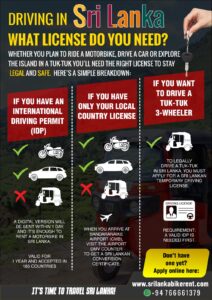
This is the heart of this guide — and the information that will keep you on the right side of Sri Lankan law.
The document requirements in Sri Lanka are vehicle-specific. Many tourists assume the same paperwork covers everything. It does not. Here is the precise breakdown.
| Vehicle | License Requirement | IDP Requirement | AAC Permit Required? |
| Motorcycle / Scooter | Motorcycle category on Bangladesh license | IDP — digital acceptable | No |
| Tuk-Tuk (Three-Wheeler) | Light vehicle category on Bangladesh license | Physical IDP booklet only | Yes — mandatory |
| Car | Standard car category on Bangladesh license | IDP — physical recommended | No |
For Motorcycles and Scooters
Riding a motorcycle or scooter is the most accessible option for independent travellers and has the simplest documentation path.
You need your valid Bangladesh driving license with a motorcycle category endorsement, and a valid IDP. Sri Lanka accepts a digital version of the IDP for motorcycles, which means if you applied online and received a digital IDP, you are covered. Carry both your license and your IDP together at all times.
For Tuk-Tuks (Three-Wheelers)
Driving a tuk-tuk is a bucket-list experience in Sri Lanka — but it carries the most demanding paperwork requirements of any rental vehicle category.
There are three non-negotiable documents for tuk-tuk drivers:
First, your Bangladesh driving license must carry a light vehicle category — not merely a motorcycle endorsement. Second, you must hold the physical IDP booklet. Digital formats are not accepted and cannot be used to obtain the AAC permit. Third, you must hold a valid AAC Recognition Permit issued by the Automobile Association of Ceylon in Sri Lanka.
The reason the physical IDP is so important for tuk-tuk drivers goes beyond just carrying it on the road. The AAC office in Colombo bases the Recognition Permit on your physical IDP. They examine the booklet, verify your license categories, and issue the permit accordingly. If you do not have the physical booklet, the AAC cannot complete the process and you will leave without the permit.
For Cars
Car rental sits between motorcycles and tuk-tuks in terms of paperwork complexity. You need your valid Bangladesh license and a valid IDP. The AAC Recognition Permit is not required for car rentals. It is advisable to carry the physical IDP booklet for car rentals as rental agencies and traffic police generally prefer the physical document over a digital version.
The critical takeaway: Tuk-tuks need the AAC Recognition Permit and a physical IDP. Motorcycles need only a license and an IDP — digital is fine. Know your vehicle, know your documents.
Everything You Need to Know About the AAC Recognition Permit
The AAC Recognition Permit is a Sri Lanka-specific document that exists for one purpose — to officially authorise foreign drivers to operate certain vehicle types on Sri Lankan roads.
It is issued exclusively by the Automobile Association of Ceylon (AAC), which is based in Colombo and is the only authority in Sri Lanka with the power to issue this permit to foreign nationals.
Here are all the key details in one place:
Who needs it? Only tourists planning to drive a tuk-tuk. Motorcycle and car drivers do not require the AAC Recognition Permit.
What is needed to get it? Your original Bangladesh driving license, your physical IDP booklet, your passport with a valid Sri Lanka entry stamp, and a passport-size photograph.
Why is the physical IDP required? The AAC issues the Recognition Permit based on the details in your physical IDP booklet. They need to inspect the actual document — a photo or digital copy is not sufficient for this process.
How long is it valid? The AAC Recognition Permit is valid for one full year from the date of issue. This makes it excellent value for long-stay visitors or anyone returning to Sri Lanka within the year.
How much does it cost?
- Visiting the AAC office in Colombo directly: LKR 8,500
- Arranging through your rental office: LKR 12,000
The LKR 3,500 difference when using a rental office covers the convenience of having your permit fully processed and waiting for you before you even set foot in Sri Lanka — which for most travellers is absolutely worth it.
Visit the official AAC website for current office information: www.aaceylon.lk
How to Get Your AAC Permit — The Two Ways Explained
There are two routes to getting your AAC Recognition Permit. Here is an honest look at both so you can choose what suits your trip.
Route 1 — Through Your Rental Office Before You Arrive (Best Option)
This is the approach that experienced Sri Lanka travellers consistently recommend — and for very good reason.
Step 1 — Contact your rental company before your trip. As soon as your Sri Lanka travel plans are confirmed, reach out to your rental company and let them know you need tuk-tuk rental and an AAC Recognition Permit.
Step 2 — Share your documents remotely. The rental office will ask you to send copies of your Bangladesh driving license and your physical IDP. They use these to begin the AAC permit process on your behalf.
Step 3 — Your permit is ready before you land. The rental office coordinates directly with the AAC. By the time you arrive in Sri Lanka, your Recognition Permit is prepared and waiting. No office visits, no queuing, no navigating an unfamiliar city on your very first day.
Step 4 — Walk in, collect your permit, and ride away. Your first morning in Sri Lanka is spent on the road — not in a waiting room.
The cost through a rental office is LKR 12,000. What you are paying for beyond the permit itself is preparation, coordination, and the freedom to start your adventure immediately on arrival.
For visitors arriving in the Negombo area, Srilankabikerent.com handles the complete AAC permit process for international guests before their arrival, covering tuk-tuk and motorcycle rentals with all documentation support included.
APPLY FOR AAC CONVERTIN PERMIT!
Route 2 — Visit the AAC Office in Colombo Directly
If you prefer to manage the process yourself, a direct visit to the AAC office in Colombo is straightforward.
What to bring:
- Original Bangladesh driving license
- Physical IDP booklet
- Passport with Sri Lanka entry stamp
- One passport-size photograph
- LKR 8,500 permit fee
Permits are typically issued on the same day. Plan your AAC visit for early in your Sri Lanka trip — ideally your first or second day in Colombo — so your documents are fully in order before you head anywhere else.
How to Get Your IDP in Bangladesh
Sorting your IDP before leaving Bangladesh is the foundation of the entire process — especially for tuk-tuk drivers who need the physical booklet.
Step 1 — Go to your nearest BRTA office. The Bangladesh Road Transport Authority handles IDP applications. Find your nearest office and visit well before your intended travel date.
Step 2 — Check your driving license is current. Your Bangladesh license must be valid. The IDP reflects exactly the vehicle categories on your existing license — it cannot upgrade or expand your categories.
Step 3 — Prepare your documents. You will need your original driving license and a photocopy, your passport and a copy, recent passport-size photographs, and a completed application form from BRTA.
Step 4 — Request the physical booklet explicitly. When applying, make clear that you need the physical IDP booklet — not just a digital version. This is essential if you intend to drive a tuk-tuk in Sri Lanka and need the physical document for the AAC permit process.
Step 5 — Pay the fee. Check the latest IDP fee at the BRTA official website as rates are subject to change.
Step 6 — Apply early. Give yourself a minimum of two to three weeks before your departure. Processing times vary and last-minute applications are stressful and sometimes unavoidable — but easily avoided with early action.
Sri Lanka Road Rules Bangladeshi Drivers Must Follow
Sri Lanka and Bangladesh share some similarities on the road — but there are important differences that every Bangladeshi driver needs to know before starting the engine.
Traffic flows on the LEFT. Coming from Bangladesh where traffic moves on the right, this requires a conscious mental adjustment. Drive slowly for your first 30 minutes. Roundabouts, junctions, and overtaking are where left-hand traffic catches out new arrivals most frequently.
Speed limits are 50 km/h in built-up areas and towns, and up to 100 km/h on the Southern Expressway. Speed cameras are used in some areas. Observe all posted signs.
Seat belts are mandatory for the driver and front passenger at all times.
Using a mobile phone while driving is illegal unless you have a certified hands-free setup.
Alcohol and driving do not mix in Sri Lanka. The law is clear and enforcement is real. There is no acceptable limit worth testing.
Expect varied road conditions. Colombo is dense and fast. The scenic highland roads of Kandy, Ella, and Nuwara Eliya are narrow, winding, and sometimes steep — beautiful but demanding. Northern and eastern roads have improved significantly in recent years. Coastal roads are generally in good condition but can be affected by flooding during the southwest monsoon (May to September) and northeast monsoon (November to January).
Rural roads bring surprises. Dogs, cattle, and pedestrians step onto roads — especially at dawn and dusk. Slow down through every village.
Petrol stations are widely available in towns and along major highways. In remote areas they can be rare, so fill your tank whenever you have the chance.
Penalties for Driving Without Proper Documents
Understanding what is at stake if you drive without the right paperwork is important — not to frighten you, but to make the decision to get it right an easy one.
Sri Lanka has active traffic police presence on major roads and at checkpoints throughout the country. If you are stopped and cannot produce a valid IDP alongside your Bangladesh license — or cannot show the AAC Recognition Permit for a tuk-tuk — the consequences can include an on-the-spot fine, detention of the rental vehicle, and potential legal proceedings depending on the severity of the situation.
The more serious issue however is insurance. If you are involved in a road accident while driving without the documents required by Sri Lankan law, your travel insurance policy will almost certainly be voided. This means you bear full personal liability for your own medical expenses, the vehicle repair or replacement costs, and any third-party injury or property damage claims.
Medical costs in Sri Lanka, while lower than in Western countries, can still be very significant for serious injuries — especially when compounded by vehicle costs and legal fees.
Getting your IDP and AAC permit right is genuinely one of the best investments you can make for your Sri Lanka trip. The cost is small. The protection it gives you is substantial.
How to Rent a Motorcycle or Tuk-Tuk Safely in Sri Lanka
Sri Lanka has a thriving vehicle rental market. Popular tourist bases like Negombo, Colombo, Kandy, Mirissa, and Ella all have plenty of options — but quality varies. Here is how to rent confidently.
Work with a rental company that handles your AAC permit. This single choice simplifies everything. A good rental company with experience in international guests will manage your permit preparation before you arrive, saving you time and eliminating the risk of arriving in Sri Lanka without the right documents.
Documentation checks are a green flag. A reputable rental provider will always ask to see your driving license, IDP, and AAC permit before handing over keys. If a company skips this step entirely, take it as a warning about their professionalism and standards.
Document the vehicle’s condition before you leave. Walk around the motorcycle or tuk-tuk and take clear dated photographs of every panel and surface. Send them to the rental company via WhatsApp or email immediately. This protects you from any post-rental claims about pre-existing damage.
Helmet use is legally required and genuinely important. Sri Lanka’s roads can be unpredictable. Wear a helmet on every journey, regardless of distance.
Clarify insurance before you sign. Ask specifically: does the rental price include third-party insurance? If the answer is unclear, arrange supplementary coverage through your travel insurance policy.
Request a roadside assistance contact. Knowing there is a number to call if you break down in a remote area gives you genuine peace of mind.
Be gentle with yourself at the start. If you are new to left-hand traffic, spend your opening minutes on quiet side streets around the rental area. The adjustment is quick but those first moments deserve respect.
FAQs
Q1: Is my Bangladesh Driving License valid in Sri Lanka without any other documents? No. Your Bangladesh driving license alone does not meet Sri Lankan legal requirements for driving. You must always pair it with a valid IDP and, for tuk-tuks specifically, an AAC Recognition Permit as well.
Q2: Why is the physical IDP booklet so important for tuk-tuk drivers? Because the AAC office in Colombo issues the Recognition Permit based on your physical IDP booklet. They need to inspect the actual physical document to verify your license details and vehicle categories. A digital IDP cannot be used for this process. No physical booklet means no AAC permit means no legal tuk-tuk driving.
Q3: Can I use a digital IDP for motorcycle rental in Sri Lanka? Yes. For motorcycles and scooters, a digital IDP is accepted in Sri Lanka. However if there is any possibility you will want to drive a tuk-tuk at any point, always travel with the physical booklet.
Q4: How much does the AAC Recognition Permit cost in Sri Lanka? If you visit the AAC office in Colombo directly it costs LKR 8,500. If you arrange it through your rental office it costs LKR 12,000, which includes full coordination and having the permit ready before your arrival.
Q5: How long is the AAC Recognition Permit valid for? The AAC Recognition Permit is valid for one full year from the date it is issued.
Q6: What is the best way to get the AAC permit organised? Contact your Sri Lanka rental office before your trip and arrange the permit through them. They handle everything with the AAC on your behalf and have your permit ready when you arrive. It is the most convenient and stress-free option.
Q7: Can I drive a tuk-tuk in Sri Lanka with just a motorcycle license from Bangladesh? No. A motorcycle-only license is not sufficient for tuk-tuk rental. Your Bangladesh license must carry a light vehicle category endorsement to legally drive a tuk-tuk in Sri Lanka.
Q8: Do I need an AAC Recognition Permit to drive a car in Sri Lanka? No. The AAC Recognition Permit is required only for tuk-tuks. For cars, your Bangladesh license and a valid IDP are sufficient.
Q9: What happens if I have an accident without proper driving documents in Sri Lanka? Beyond potential fines and legal proceedings, your travel insurance is very likely to be voided. This leaves you personally liable for all costs including medical bills, vehicle damage, and third-party claims.
Q10: How far in advance should I apply for an IDP in Bangladesh? Apply at least two to three weeks before your departure date to allow for processing time. If you are applying through BRTA for the first time, give yourself additional buffer time.
Conclusion
So — is my Bangladesh Driving License valid in Sri Lanka?
On its own, no. But paired with the right documents, you are completely free to explore this extraordinary island however you choose.
Here is your simple checklist before you travel:
For motorcycles — get your Bangladesh license with motorcycle category and an IDP. Digital is fine. You are ready.
For tuk-tuks — get your Bangladesh license with light vehicle category, apply for the physical IDP booklet through BRTA, and contact your Sri Lanka rental company in advance to arrange the AAC Recognition Permit before you arrive.
For cars — your Bangladesh license and a valid IDP covers you completely.
The process is clear, the costs are reasonable, and the reward is one of the most beautiful road trip destinations in all of Asia.
Sri Lanka is waiting. Sort your documents, trust the process, and go enjoy every single kilometre of it.